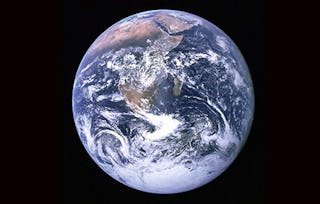
Earthquakes, volcanoes, mountain building, ice ages, landslides, floods, life evolution, plate motions—all of these phenomena have interacted over the vast expanses of deep time to sculpt the dynamic planet that we live on today. Planet Earth presents an overview of several aspects of our home, from a geological perspective. We begin with earthquakes—what they are, what causes them, what effects they have, and what we can do about them. We will emphasize that plate tectonics—the grand unifying theory of geology—explains how the map of our planet's surface has changed radically over geologic time, and why present-day geologic activity—including a variety of devastating natural disasters such as earthquakes—occur where they do. We consider volcanoes, types of eruptions, and typical rocks found there. Finally, we will delve into the processes that produce the energy and mineral resources that modern society depends on, to help understand the context of the environment and sustainability challenges that we will face in the future.
You will become familiar with the course, your classmates, and our learning environment. The orientation will also help you obtain the technical skills required for the course.
What's included
8 readings1 assignment1 plugin
Show info about module content
8 readings•Total 105 minutes
Welcome to Planet Earth...and You!•10 minutes
Syllabus•15 minutes
Google Earth Instructions•30 minutes
Updating Your Profile•10 minutes
Social Media•5 minutes
About the Discussion Forums•15 minutes
How Graded Discussions Work•10 minutes
Discussion Rubric•10 minutes
1 assignment•Total 15 minutes
Orientation Quiz•15 minutes
1 plugin•Total 15 minutes
Welcome! Please tell us about yourself.•15 minutes
Week 1: Earthquakes!
8 hours to complete
Module details
In the lectures for this week, we will consider what an earthquake is, how it occurs, how we can record and measure its size, and what we can do to mitigate damage. Our first weekly assignment consists of reporting your own experience with earthquakes (if any). The Week 1 Lab gives you a chance to work with seismograms, locate an earthquake epicenter, and determine magnitude. Finally, the Week 1 Discussion addresses the balance between risks from quakes and costs of preventive measures.
1.A.2 Generation of Earthquake Vibrations•6 minutes
1.A.3 Introduction to Faults•5 minutes
1.A.4 Types of Faults•6 minutes
1.A.5 Earthquake Waves•7 minutes
1.B.1 The Intensity and Magnitude of Earthquakes•6 minutes
1.B.2 Seismometers•5 minutes
1.B.3 Interpreting Seismograms and Earthquake Magnitude•5 minutes
1.B.4 Comparing Earthquakes•6 minutes
1.C.1 Damage Due to Ground Shaking•6 minutes
1.C.2 Other Consequences of Earthquakes•7 minutes
1.C.3 Tsunamis•9 minutes
1.D.1 The First Step in Predicting Earthquakes: Recognizing Where They Occur•7 minutes
1.D.2 Earthquake Recurrence Interval•7 minutes
1.D.3 Interpreting The Recurrence Interval•5 minutes
1.D.4 Efforts to Prevent Earthquake Devastation•5 minutes
1.D.5 Mitigating Earthquake Damage•8 minutes
Week 1 Lab: Triangulation Lab •14 minutes
1 reading•Total 10 minutes
Week 1 Overview•10 minutes
3 assignments•Total 210 minutes
Week 1 Quiz•60 minutes
Week 1 Assignment•60 minutes
Week 1 Lab•90 minutes
1 discussion prompt•Total 120 minutes
Week 1 Discussion•120 minutes
Week 2: Plate Tectonics
6 hours to complete
Module details
In the early twentieth century, publication of the hypothesis on continental drift caused an uproar that soon died down. Data collected in mid-century led geologists to reconsider the idea that continents could move. During the 1960s and 1970s, old ideas were reworked into what is now called the theory of plate tectonics. As we will see, this robust theory encompasses many geological phenomena that appear to be unrelated at first glance: earthquakes and volcanoes, but also ice ages, fossils, and mountains. Today, plate tectonics provides an overarching framework for interpreting the Earth. We study its details in Week 2, but we will return to this theory again and again throughout the rest of this course.
2.A.2 Alfred Wegener & Continental Drift•5 minutes
2.A.3 Evidence for Continental Drift•7 minutes
2.A.4 New Discoveries Leading to Plate Tectonics: Seafloor Bathymetry•10 minutes
2.A.5 New Discoveries Leading to Plate Tectonics: Apparent Polar-Wander Paths•8 minutes
2.A.6 New Discoveries Leading to Plate Tectonics: Evidence for Seafloor Spreading•11 minutes
2.B.1 Discovering Plate Tectonics•5 minutes
2.B.2 Earth's Internal Layers and the Concept of a Plate•7 minutes
2.B.3 Three Types of Plate Boundaries: Divergent Plate Boundary•6 minutes
2.B.4 Three Types of Plate Boundaries: Convergent Plate Boundary•6 minutes
2.B.5 Three Types of Plate Boundaries: Transform Plate Boundary•5 minutes
2.B.6 Continental Rifts and Continental Collisions•5 minutes
2.B.7 Intraplate Earthquakes•6 minutes
2.B.8 The Velocity of Plate Motion•8 minutes
2.B.9 Plate Driving Mechanisms•7 minutes
Week 2 Lab: Plate Tectonics! Lab Part 1•11 minutes
Week 2 Lab: Plate Tectonics! Lab Part 2•15 minutes
1 reading•Total 10 minutes
Week 2 Overview•10 minutes
3 assignments•Total 180 minutes
Week 2 Quiz•60 minutes
Week 2 Assignment•60 minutes
Week 2 Lab•60 minutes
1 peer review•Total 60 minutes
Weeks 1-2 Discussion Samples•60 minutes
1 discussion prompt•Total 10 minutes
Week 2 Discussion•10 minutes
Week 3: Volcanoes!
8 hours to complete
Module details
This week, you will learn how and where rocks can melt, and what happens when molten material of various compositions bursts out of the ground. The lecture videos also cover different types of eruptions, as well as the rocks and mountains produced by them. In the lab, you will study details about the 1980 eruption of Mount St. Helens and the eruption of Mount Vesuvius in the year 79. The discussion forum gives you the opportunity to weigh risks to people living on or near volcanoes and what can be done to minimize damage and loss of life. The weekly assignment provides a place for you to share your own experiences with volcanoes or eruptions or, if you have never been near a volcano, your thoughts about such events.
As part of the Week 4 Assignment, you will take a close look at your daily surroundings to identify Earth resources. The video lectures for the week examine various aspects of finding, extracting, and using resources such as metals and stones. For the lab, you will utilize Google Earth to examine several mining sites around the world. In the discussion, you will weigh the pros and cons of mining operations, as many communities have had to do already. This week also includes peer grading discussions, as explained on the How Graded Discussions Work page. Finally, we provide an optional assignment for those who would like to identify some common minerals.
4.B.3 Different Types of Sedimentary Rocks•5 minutes
4.B.4 Formation of Clastic Sedimentary Rocks•7 minutes
4.B.5 Primary Sedimentary Structures and Sedimentary Basins•6 minutes
4.B.6 Carbonate Sedimentary Rocks•6 minutes
4.C.1 How Rocks Can Change•11 minutes
4.C.2 Metamorphic Rocks Part 1•8 minutes
4.C.3 Metamorphic Rocks Part 2•8 minutes
4.C.4 The Rock Cycle•4 minutes
4.D.1 The Practical Uses of Rocks•8 minutes
4.D.2 The Nature of Metal Ore Deposits•10 minutes
4.D.3 Global Steel Usage•5 minutes
4.E.1 Non-Metallic Minerals – Concrete and Crushed Rock•10 minutes
4.E.2 Other Non-Metallic Resources – Brick, Gypsum, Dimension Stone•9 minutes
1 reading•Total 10 minutes
Week 4 Overview•10 minutes
3 assignments•Total 210 minutes
Week 4 Quiz•60 minutes
Week 4 Assignment•60 minutes
Week 4 Lab•90 minutes
1 peer review•Total 60 minutes
Weeks 3-4 Discussion Samples•60 minutes
1 discussion prompt•Total 120 minutes
Week 4 Discussion•120 minutes
Week 5: Energy Resources
8 hours to complete
Module details
The video lectures for this week cover various aspects of energy usage by modern civilization, especially our utilization of fossil fuels. The Week 5 Lab sends you on a Google Earth tour of energy-producing sites around the world, places where both conventional and alternative forms of energy are being generated. The Week 5 Assignment gives you a chance to survey your own personal use of energy – where does it come from and how much do you use – and then to share the information with others in the class. During the Week 5 Discussion, you will consider the implications of how society uses the energy of fossil fuels and the implications for the local environment and global climate.
The University of Illinois at Urbana-Champaign is a world leader in research, teaching and public engagement, distinguished by the breadth of its programs, broad academic excellence, and internationally renowned faculty and alumni. Illinois serves the world by creating knowledge, preparing students for lives of impact, and finding solutions to critical societal needs.
OK
Explore more from Environmental Science and Sustainability
"To be able to take courses at my own pace and rhythm has been an amazing experience. I can learn whenever it fits my schedule and mood."
Jennifer J.
Learner since 2020
"I directly applied the concepts and skills I learned from my courses to an exciting new project at work."
Larry W.
Learner since 2021
"When I need courses on topics that my university doesn't offer, Coursera is one of the best places to go."
Chaitanya A.
"Learning isn't just about being better at your job: it's so much more than that. Coursera allows me to learn without limits."
Learner reviews
4.9
539 reviews
5 stars
88.12%
4 stars
10.20%
3 stars
0.74%
2 stars
0.55%
1 star
0.37%
Showing 3 of 539
E
EN
5·
Reviewed on Jul 30, 2020
A great course! It is easy to follow and complete it. Good for students who are interested in geology but have no prior knowledge about it.
K
KW
5·
Reviewed on Oct 1, 2020
Lesson content, especially the video lectures, is accessible and also adds on more to what I already learned about the geology.
N
NS
5·
Reviewed on May 22, 2020
The professors make learning fun and fruitful. This course is interesting and provides great insights into Mother Nature and why we should protect the one and only home we have.
When will I have access to the lectures and assignments?
To access the course materials, assignments and to earn a Certificate, you will need to purchase the Certificate experience when you enroll in a course. You can try a Free Trial instead, or apply for Financial Aid. The course may offer 'Full Course, No Certificate' instead. This option lets you see all course materials, submit required assessments, and get a final grade. This also means that you will not be able to purchase a Certificate experience.
What will I get if I purchase the Certificate?
When you purchase a Certificate you get access to all course materials, including graded assignments. Upon completing the course, your electronic Certificate will be added to your Accomplishments page - from there, you can print your Certificate or add it to your LinkedIn profile.
Is financial aid available?
Yes. In select learning programs, you can apply for financial aid or a scholarship if you can’t afford the enrollment fee. If fin aid or scholarship is available for your learning program selection, you’ll find a link to apply on the description page.