
Turn AI Risk Into Readiness: A Reskilling Roadmap for Government
A global Coursera survey of 700 government leaders reveals that rapid AI adoption is outpacing policy in the public sector, creating efficiency and security risks for teams working without clear guardrails.

Right now, a government employee is likely using a public AI tool to summarize a complex policy brief, draft an email, or analyze a spreadsheet. They aren’t waiting for agency-approved tools; they just want to work more efficiently.
But grassroots modernization comes with a hidden cost: In the public sector, rapid AI adoption is outpacing formal policy—creating unintended security blind spots for teams working without clear guardrails.
That tension shows up clearly in Coursera’s survey of 700 government technology leaders across the United States, India, the United Kingdom, Mexico, and the United Arab Emirates*. The findings reveal a workforce moving quickly toward AI, without the training, policy, or security structures needed to support it safely.
At the same time, public sector agencies often struggle to compete with private companies for AI and cybersecurity experts, because pay and hiring constraints make it difficult to attract scarce talent. Caught between growing security risks and limited budgets, leaders must train the employees they already have.
The skills gap in public sector teams
Three primary factors are driving today’s urgency for skills development in government agencies: improving efficiency, modernizing digital infrastructure, and meeting the increasing demand for user-friendly public services.
When it comes to AI specifically, the stakes are even higher. Leaders cite strengthening national security and modernizing digital infrastructure as their top drivers for AI enablement.
To meet these sweeping demands over the next three to five years, government leaders rank cybersecurity, data, and AI as their highest-priority target skills.
But one factor impedes these ambitions: a clear talent bottleneck. Currently, 37% of government tech leaders do not believe their teams possess the necessary skills to achieve their digital transformation goals within the next six to 12 months. Governments have the mandate to modernize, but many lack the workforce capabilities to execute it.
The AI paradox: High adoption, low enablement
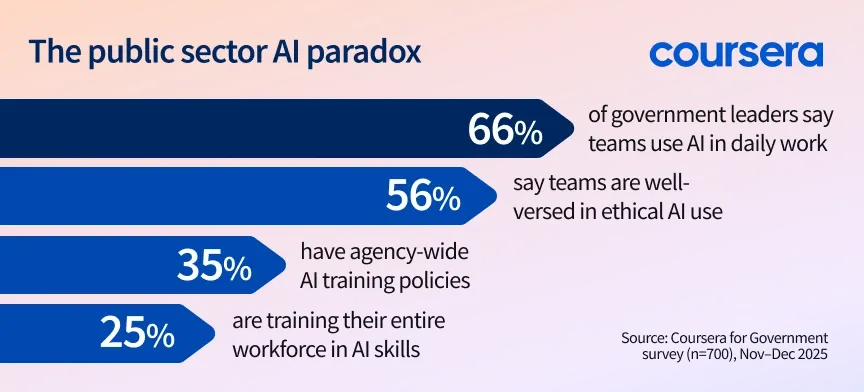
Seventy-seven percent of government tech leaders believe integrating AI tools into existing workflows is crucial to achieving key objectives over the next three to five years. In reality, that future is already here: 66% report that their teams are already using AI for day-to-day work. But employees are moving faster than formal training has caught up—without formal training or guardrails—leading to unaddressed security and ethical blindspots. This creates a high-risk AI paradox:
Only 56% of government tech leaders say their teams are well-versed in ethical AI use.
Only 36% have an inclusive, agency-wide training policy to ensure equitable access and prevent a skills divide.
Only 25% are actually training their entire workforce in AI skills.
The ROI of reskilling
If government agencies cannot outspend the private sector to acquire top-tier cybersecurity, data, and AI talent, a sustainable solution is to build from within.
There is wide consensus on this reality: 75% of leaders believe training existing employees is necessary to achieve their digital transformation goals in the next six to 12 months. Yet, a massive deficit remains, with only 18% reporting that more than half of their agency’s workforce receives dedicated skills training annually.
Agencies must urgently close this gap, especially as AI begins to reshape the organizational chart. Automation is poised to free up existing workers, such as help desk technicians, who can then be reskilled for higher-value, specialized roles. Within the next three years:
22% of leaders expect >40% of Help Desk Technician tasks to be automated.
19% expect >40% of IT Specialist tasks to be automated.
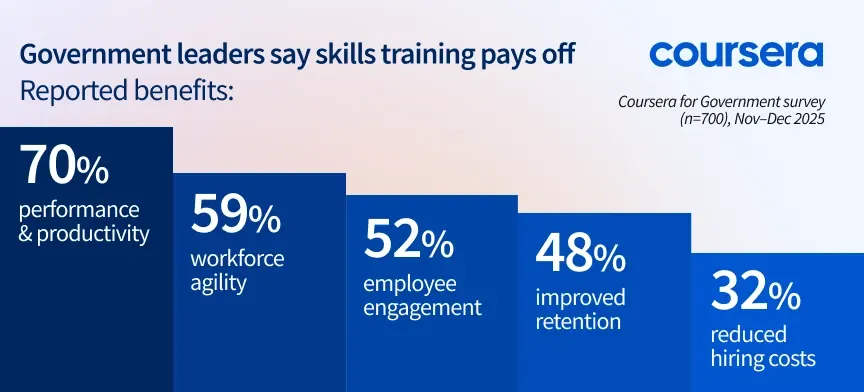
For the agencies that do invest in reskilling, the return on investment (ROI) is staggering. Government tech leaders who offer skills training report transformative organizational benefits:
70% report enhanced performance and productivity
59% report improved talent agility
52% report increased employee engagement
48% report increased employee retention
32% report reduced hiring costs
20% note that AI training specifically leads to significant boosts in team productivity
Reduce security risks with the right learning platform
Government agencies cannot risk exposing live legacy systems or sensitive citizen data while employees learn new tools. So, what do IT and data leaders actually require from a learning partner to safely bridge the digital divide?
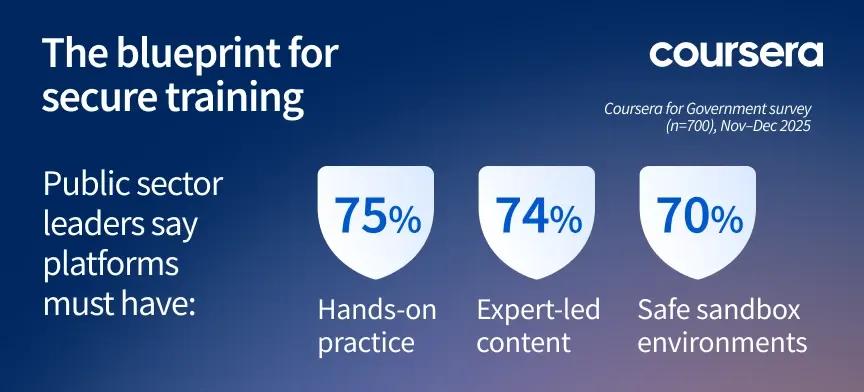
When evaluating training platforms, government leaders prioritize risk-free application and expert guidance. The top requirements include:
75%: “Hands-on practice to apply new skills:” (Rated #1 across all countries)
74%: “High-quality content authored by industry experts”
70%: “Having a safe ‘sandbox’ environment to learn and practice without risk to live systems”
67%: “Curated learning paths aligned to job roles and career levels”
67%: “The ability to customize training content to the needs of the team(s) I manage”
61%: “The ability to offer credentials or badges that verify skills proficiency”
To meet these stringent requirements, agencies are turning to trusted enterprise platforms. For example, roughly one-third of respondents use or have used Coursera for online skills training to deliver the safe, customizable, and hands-on education government workforces require.
Public sector AI readiness by country
These regional variations highlight the unique challenges and priorities facing distinct public sector workforces across the globe.
United States
The AI access gap: While 62% of US teams use AI for day-to-day work, only 32% have formal training policies that ensure equitable access to AI upskilling.
Lowest overall training: Only 9% of US government tech leaders report that more than half of their workforce receives dedicated skills training annually—the lowest rate globally.
United Kingdom
Policy deficit: Only 28% of UK agencies have a formal AI training policy (the lowest globally).
AI training gap: Only 23% are training their entire workforce in AI skills.
United Arab Emirates (UAE)
Unique priorities: The UAE ranks “Upskill employees for open roles” as a top 3 overall driver, and points to “Maximizing productivity” as its #1 driver for AI adoption.
Highest enablement: A robust 56% have an agency-wide AI policy, and 42% report AI training significantly boosts productivity (double the global average).
Unique gaps: Despite high enablement, 54% still report their teams lack the necessary skills for 6–12 month goals (the highest globally).
India
A unified mandate: 76% agree that training existing employees is necessary to achieve near-term goals.
Strong ROI: Leaders report massive benefits from training, with 69% noting enhanced productivity and 60% reporting improved talent agility.
Mexico
AI training is central: 82% of leaders in Mexico say AI is crucial for critical objectives (the highest globally).
Strong ROI: 78% agree that training existing employees is necessary for near-term goals, and 73% report enhanced productivity resulting from that training.
Upskill your government workforce with Coursera
Government teams are already using AI, but most agencies aren’t equipping them to use it safely or effectively. That training gap, not a lack of ambition, is what’s slowing digital transformation and leaving sensitive systems exposed.
The agencies closing this gap fastest are investing in their existing workforce rather than competing for scarce outside talent. Reskilling delivers measurable returns, from productivity and retention gains to stronger security, while helping IT and data leaders meet AI and cybersecurity goals within the next six to 12 months.
Ready to build a safer, more capable government workforce?

*Coursera survey conducted November 2025
This content has been made available for informational purposes only. Learners are advised to conduct additional research to ensure that courses and other credentials pursued meet their personal, professional, and financial goals.