
Building Advanced IT Skills at the University of Szeged: Meet Gábor
Gábor T., an information technology (IT) student at the University of Szeged, is building career-ready skills in cloud engineering, cybersecurity, and AI through Coursera for Campus.
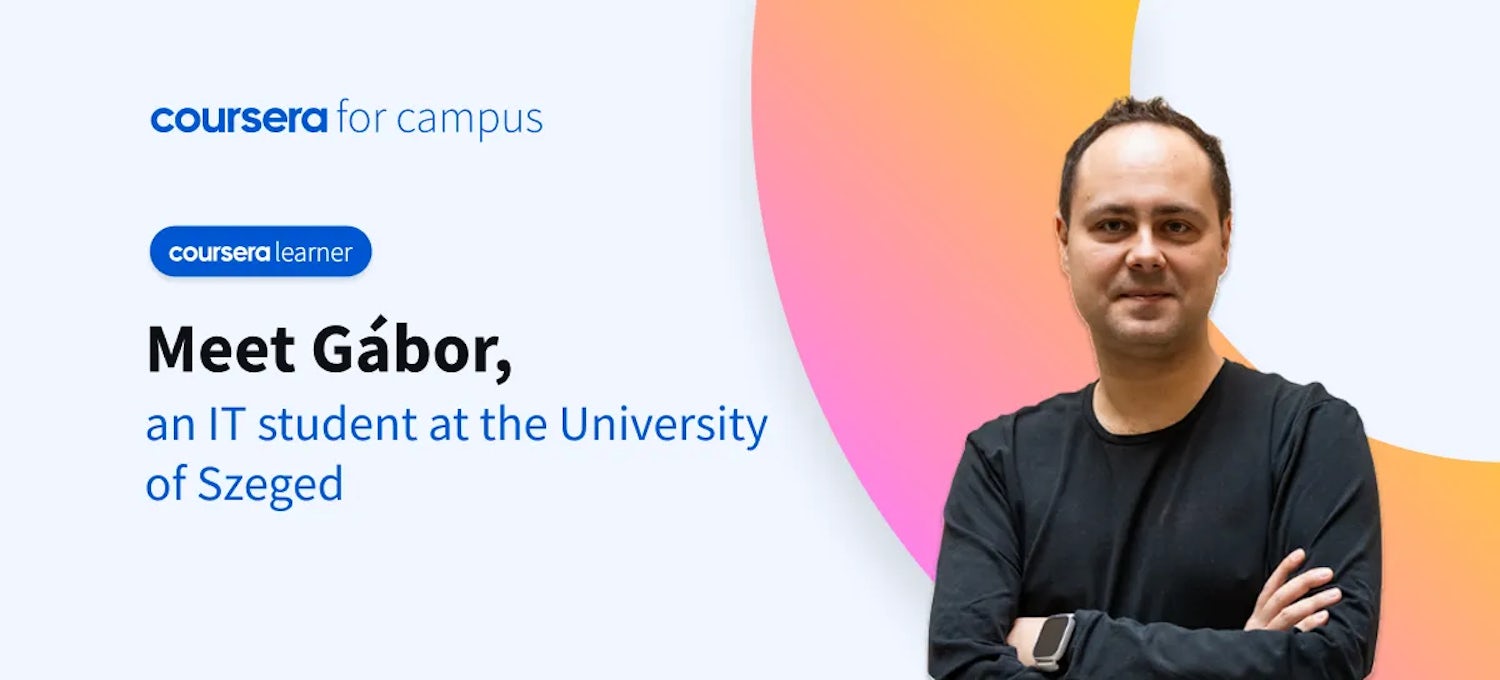
Gábor T., a student studying IT and electrical engineering at the University of Szeged in Hungary, is building advanced IT skills through Coursera as he works toward a career in cloud engineering, cybersecurity, and artificial intelligence (AI).
For Gábor, learning has always been fueled by curiosity. From an early interest in electronics and computer science to pursuing university studies in engineering and IT, he has consistently looked for opportunities to deepen his technical expertise and explore emerging technologies.
Gábor's experience reflects the University of Szeged's partnership with Coursera for Campus, which helps students build career-relevant skills alongside their academic studies. Through access to Coursera courses, Guided Projects, and Professional Certificates, learners can explore specialized topics and earn academic credit while pursuing their degrees.
Through Coursera courses in cloud architecture, cybersecurity, ethical hacking, AI development, and systems engineering, Gábor is developing advanced technical skills aligned with today’s fast-changing technology landscape.
“The platform allows me to access deep technical modules that cover everything from threat landscape analysis to modern data processing pipelines,” Gábor explained. “These skills directly complement and further develop my university studies and give me a massive edge in tracking current industry priorities.”
In this interview, Gábor shares how Coursera has helped him expand his expertise, stay engaged in lifelong learning, and prepare for a future career in IT.
Tell us a little about your professional or academic background.
Since I was a child, I have been deeply interested in two fields: electronics and computer science. I have always been driven by an intense curiosity about what it really means to be an engineer who invents new technologies and how these systems work behind the scenes. To that end, I studied electrical engineering and computer science in high school, and later worked in these two sectors.
However, I felt that intermediate technical knowledge was not enough; the concept of engineering and high-level sciences kept calling me, which eventually inspired me to start my university studies. At the end of my first semester at university, I discovered Coursera, which became the perfect platform to expand my horizons.
What was your goal in learning on Coursera?
My first goal was performing well in competitions; that's how I first got to know Coursera. When I saw that there were university courses, even at the master's level, and that you could take university courses and get a certificate, I used Coursera on a daily basis in many cases. And I always find new and more interesting things within the profession.
What skills have you gained through Coursera?
I have gained highly specialized skills in advanced IT sectors, particularly in cloud architecture, data science, cybersecurity, AI development, and systems engineering. The platform allows me to access deep technical modules that cover everything from threat landscape analysis to modern data processing pipelines. These skills directly complement and further develop my university studies and give me a massive edge in tracking current industry priorities.
How has access to a broad catalog of skills-focused content from top universities and industry leaders helped you achieve your goals and drive impact at work?
My goal was to move from an intermediate level to a high level within IT. That's why I went to university. When I realized that on Coursera I could further develop this at my own pace and learn new things that are very specialized, and that there is no such subject in school, I knew that this platform was invented for me.
What helped you feel motivated and empowered to actively engage in your learning program?
The academic competitions. I have mainly expanded my learning through competitions, for example, at Google Cloud and at Carnegie Mellon University's annual cybersecurity ethical hacking competition. Learning and competitions provide motivation for each other.
I chose Coursera because it offers thousands of deeply technical courses within computer science alone, making it easy to find exactly what you need to grow.
What have you most enjoyed or found most valuable about your learning experience on Coursera?
What I like about Coursera is that it's go-as-you-please, and I can use it anytime, 24 hours a day. If I'm not ready for the exam, I can do it later. If I'm faster at certain courses, that's not a problem either. If I want to watch it again, I can do that too.
I really like those video teaching materials that, while the teacher is speaking, present important things in the teaching material (e.g., a table or a piece of writing pops up on the screen). I usually have artificial intelligence do example tasks, or a short, concise summary of the course material.
Stay consistent, treat every module as a step toward mastering your craft, and never stop looking for new insights within your profession.
What are your future professional or learning goals? How do you want to keep growing?
My current plan is to find a full-time job and work in the IT sector. I also need to make sure I finish my university studies. I would like to work in the areas that I learned about, such as cybersecurity, cloud engineering, ethical hacking, and data science.
What advice would you give to other professionals interested in deepening their expertise or developing new skills?
My main advice is to find a platform that aggregates top-tier knowledge and use it relentlessly to fuel your curiosity. I chose Coursera because it offers thousands of deeply technical courses within computer science alone, making it easy to find exactly what you need to grow.
Stay consistent, treat every module as a step toward mastering your craft, and never stop looking for new insights within your profession. Although I only know the technical courses on Coursera, there are many others.
Explore Coursera for your institution
Coursera for Campus empowers any university to offer job-relevant, credit-ready* online education to students, faculty, and staff. With Coursera for Campus, you can promote student employability by teaching in-demand skills for high-growth fields and help students master job-ready skills with Guided Projects, programming assignments, and in-course assessments—online, offline, and via mobile. Enable faculty to create projects, assessments, and courses tailored to learner needs with Coursera for Campus.
*Credit eligibility determined by your institution.
*Individual experiences and outcomes can vary, and Coursera does not guarantee job interviews or job placements upon completion of its courses.
This content has been made available for informational purposes only. Learners are advised to conduct additional research to ensure that courses and other credentials pursued meet their personal, professional, and financial goals.