Master the foundational principles of differential calculus and unlock analytical capabilities essential for data science, engineering, and advanced mathematics. This course provides comprehensive training in derivative calculations, optimization techniques, and real-world problem-solving applications. Through systematic exploration of differentiation rules, implicit differentiation, and critical point analysis, you will develop robust mathematical reasoning skills applicable across scientific and business domains. Learn to model dynamic systems, analyze rates of change, and apply calculus techniques to solve complex optimization challenges. Whether advancing in quantitative fields or building analytical foundations for graduate studies, this course equips you with rigorous mathematical frameworks and practical computational skills to excel in data-driven decision-making and technical problem-solving.

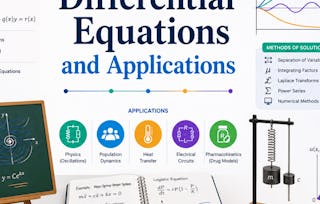
Differential Equations & Advanced Applications

Differential Equations & Advanced Applications

Instructor: Stavros Richard Christopoulos
Access provided by PALC Dev
Recommended experience
What you'll learn
Apply product, quotient, and chain rules to solve real-world rate-of-change problems in science and business.
Use derivatives for optimization, identifying maxima, minima, and inflection points in practical applications.
Perform implicit and higher-order differentiation to model interdependent variables and dynamic systems.
Apply derivatives to gradient estimation, curve analysis, and optimization in data science and engineering.
Details to know

Add to your LinkedIn profile
8 assignments
February 2026
See how employees at top companies are mastering in-demand skills

There are 4 modules in this course
Prepare for a degree
Taking this course by University of Huddersfield may provide you with a preview of the topics, materials and instructors in a related degree program which can help you decide if the topic or university is right for you.
Instructor
Offered by

Why people choose Coursera for their career

Felipe M.

Jennifer J.

Larry W.

Chaitanya A.
Explore more from Math and Logic

University of Huddersfield
Birla Institute of Technology & Science, Pilani

The Hong Kong University of Science and Technology
Universitat Politècnica de València