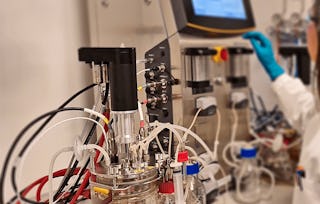
Discover how fermentation is transforming industries and driving a sustainable future. This course begins by exploring the evolution of fermentation—from ancient food traditions to modern precision techniques—and why it matters today. You’ll dive into the science behind fermentation, including microbes, synthetic biology, and feedstocks, before examining the innovative products shaping global markets in food, beauty, and industrial materials. Finally, you’ll tackle one of the biggest challenges: scaling fermentation from lab to commercial production.
This course is part of the College of ACES suite of online programs and is supported by the Integrated Bioprocessing Research Lab (IBRL), a pilot plant facility focused on bioprocessing technologies located at the University of Illinois in Urbana-Champaign. The IBRL was built with the needs of industry projects and customers in mind, supporting over 1,000 scale-up projects for our clients since opening in 2018.
Learn more about online programs from the College of ACES: https://acesonline.illinois.edu
Learn more about IBRL: https://ibrl.aces.illinois.edu
In the course orientation, we’ll get to know the course, our learning environment, and the tools we’ll use. Then, we’ll explore how fermentation has evolved—from ancient food traditions to cutting-edge innovations. Together, we’ll discover why precision fermentation is reshaping the future of food, sustainability, and the bioeconomy. This foundational module sets the stage for understanding the science and markets we’ll explore next.
Das ist alles enthalten
4 Videos4 Lektüren2 Aufgaben1 Diskussionsthema
Infos zu Modulinhalt anzeigen
4 Videos•Insgesamt 10 Minuten
Course Overview•5 Minuten
Module 1 Overview•1 Minute
Why Fermentation Matters: From Ancient Practice to Future Markets •3 Minuten
Module 1 Wrap -Up•1 Minute
4 Lektüren•Insgesamt 40 Minuten
Course Guide•10 Minuten
Updating Your Profile•10 Minuten
Precision Fermentation: a guide for endless opportunities to reshape traditional foods using microbial factories•10 Minuten
Interactive | Explore Fermentation Through Time•10 Minuten
2 Aufgaben•Insgesamt 50 Minuten
Module 1 | Knowledge Check•20 Minuten
Orientation Quiz•30 Minuten
1 Diskussionsthema•Insgesamt 10 Minuten
Getting to Know Your Classmates•10 Minuten
Module 2 | Understanding Fermentation: From Traditional to Precision
Modul 2•1 Stunde abzuschließen
Moduldetails
Building on the big-picture context, this module takes us inside the science of fermentation. We’ll learn how traditional and precision fermentation differ, explore the role of synthetic biology, and examine the sustainability of common feedstocks. By the end, we’ll have the core concepts needed to understand how fermentation technologies work—and why they’re gaining traction across industries.
Das ist alles enthalten
5 Videos2 Lektüren1 Aufgabe
Infos zu Modulinhalt anzeigen
5 Videos•Insgesamt 14 Minuten
Module 2 Overview•1 Minute
What is Fermentation? •3 Minuten
Synthetic Biology •3 Minuten
Common Feedstocks •6 Minuten
Module 2 Wrap-Up•1 Minute
2 Lektüren•Insgesamt 20 Minuten
The Synthetic Biology Revolution•10 Minuten
Common Feedstocks •10 Minuten
1 Aufgabe•Insgesamt 20 Minuten
Module 2 | Knowledge Check•20 Minuten
Module 3 | Fermentation Products & Global Markets
Modul 3•1 Stunde abzuschließen
Moduldetails
Now that we understand the science, it’s time to see what fermentation can create. This module highlights key product categories—from food and beauty to industrial materials—and connects them to global market trends. We’ll even explore an interactive map of regional fermentation hubs to see how geography, feedstocks, and innovation shape the bioeconomy.
In our final module, we’ll examine what it takes to bring fermentation innovations to scale. We’ll explore capacity constraints, technology readiness levels, and workforce needs. Through a scenario-based activity, we’ll step into the role of an advisor helping a startup navigate scale-up strategy. After completing this module, we’ll be ready to take the final assessment and earn our Coursera certificate!
Das ist alles enthalten
6 Videos6 Lektüren2 Aufgaben
Infos zu Modulinhalt anzeigen
6 Videos•Insgesamt 32 Minuten
Module 4 Overview•1 Minute
Capacity Constraints: Why Scaling Fermentation Is Hard•4 Minuten
Tech Readiness: From Lab Bench to Commercial Scale•15 Minuten
Workforce Development & Bioprocessing Hubs •10 Minuten
Module 4 Wrap-Up•1 Minute
Course Summary •2 Minuten
6 Lektüren•Insgesamt 55 Minuten
BCG Synonym Report•10 Minuten
Sustainable Scale-Up: Environmental Impacts & Industry Insights•10 Minuten
Regional Biomanufacturing Hubs and Policy•10 Minuten
Learner Guide: Advising MycoScale on Scale-Up Strategy•5 Minuten
The University of Illinois at Urbana-Champaign is a world leader in research, teaching and public engagement, distinguished by the breadth of its programs, broad academic excellence, and internationally renowned faculty and alumni. Illinois serves the world by creating knowledge, preparing students for lives of impact, and finding solutions to critical societal needs.
OK
Mehr von Environmental Science and Sustainability entdecken
When will I have access to the lectures and assignments?
To access the course materials, assignments and to earn a Certificate, you will need to purchase the Certificate experience when you enroll in a course. You can try a Free Trial instead, or apply for Financial Aid. The course may offer 'Full Course, No Certificate' instead. This option lets you see all course materials, submit required assessments, and get a final grade. This also means that you will not be able to purchase a Certificate experience.
What will I get if I purchase the Certificate?
When you purchase a Certificate you get access to all course materials, including graded assignments. Upon completing the course, your electronic Certificate will be added to your Accomplishments page - from there, you can print your Certificate or add it to your LinkedIn profile.
Is financial aid available?
Yes. In select learning programs, you can apply for financial aid or a scholarship if you can’t afford the enrollment fee. If fin aid or scholarship is available for your learning program selection, you’ll find a link to apply on the description page.