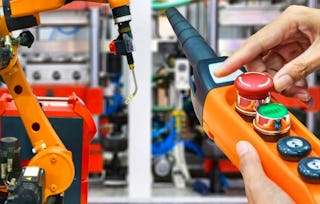
In an era where automation and intelligent robotics redefine high-tech manufacturing, mastering robotic programming and integration is key to achieving precision, scalability, and efficiency. This course equips engineers and manufacturing professionals with the technical foundations to design, program, and deploy industrial and mobile robotic systems in modern production environments. Through interactive modules and hands-on labs, learners explore the evolution of industrial robotics, key robot types and applications, and the principles of motion control, task sequencing, and sensor integration using classical programming methods such as RAPID, KRL, and Python APIs and robotics programming framework like ROS 2. Participants also examine collaborative and autonomous systems, end-of-arm tooling, and vision-based precision, culminating in advanced integration exercises that introduce ROS 2 as a framework for interoperability.

Robotics in High-Tech Manufacturing

Gain insight into a topic and learn the fundamentals.
Intermediate level
Recommended experience
5 hours to complete
Flexible schedule
Learn at your own pace
What you'll learn
Classify and evaluate advanced robotic systems used in high-tech manufacturing based on their types, architectures, and applications.
Analyze how cobots and AMRs improve flexibility, safety, and efficiency in modern production environments.
Use foundational robot programming and system integration principles to deploy effective robotics solutions in modern manufacturing operations.
Skills you'll gain
Tools you'll learn
Details to know

Shareable certificate
Add to your LinkedIn profile
Assessments
1 assignment
Taught in English
Recently updated!
February 2026
See how employees at top companies are mastering in-demand skills

There are 3 modules in this course
Instructor

Offered by

Why people choose Coursera for their career

Felipe M.
Learner since 2018
"To be able to take courses at my own pace and rhythm has been an amazing experience. I can learn whenever it fits my schedule and mood."

Jennifer J.
Learner since 2020
"I directly applied the concepts and skills I learned from my courses to an exciting new project at work."

Larry W.
Learner since 2021
"When I need courses on topics that my university doesn't offer, Coursera is one of the best places to go."

Chaitanya A.
"Learning isn't just about being better at your job: it's so much more than that. Coursera allows me to learn without limits."