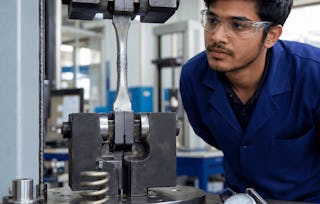
Understanding how structures vibrate is at the heart of modern engineering from reducing EV motor noise to preventing fatigue failures in aircraft panels. This course introduces you to the essential world of modal analysis, where natural frequencies, mode shapes, and damping characteristics reveal how mechanical structures behave under real-world conditions. Through a combination of theory, guided coach dialogues, and hands-on exercises in Siemens Simcenter FEMAP (free student version), you’ll learn how NVH engineers extract modal parameters, diagnose vibration issues, and make data-driven design improvements.

Modal Analysis in Mechanical Structures

Modal Analysis in Mechanical Structures


Instructors: Starweaver
Access provided by IT Education Association
Gain insight into a topic and learn the fundamentals.
Intermediate level
Recommended experience
5 hours to complete
Flexible schedule
Learn at your own pace
What you'll learn
Apply vibration fundamentals to analyze natural frequencies, mode shapes, damping, and resonance in mechanical components.
Build finite-element models, extract modal parameters, and evaluate how conditions influence modal behavior.
Interpret modal results to diagnose vibration issues and propose engineering modifications to improve NVH performance.
Details to know

Shareable certificate
Add to your LinkedIn profile
Assessments
1 assignment
Taught in English
See how employees at top companies are mastering in-demand skills

There are 3 modules in this course
Instructors
Offered by

Why people choose Coursera for their career

Felipe M.
Learner since 2018
"To be able to take courses at my own pace and rhythm has been an amazing experience. I can learn whenever it fits my schedule and mood."

Jennifer J.
Learner since 2020
"I directly applied the concepts and skills I learned from my courses to an exciting new project at work."

Larry W.
Learner since 2021
"When I need courses on topics that my university doesn't offer, Coursera is one of the best places to go."

Chaitanya A.
"Learning isn't just about being better at your job: it's so much more than that. Coursera allows me to learn without limits."
Explore more from Information Technology
Korea Advanced Institute of Science and Technology(KAIST)
ISAE-SUPAERO

ISAE-SUPAERO