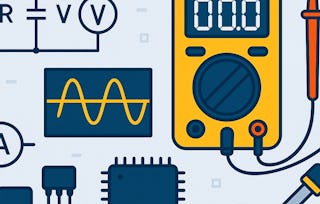
Understanding how to analyze, simulate, and verify electronic circuits is a fundamental skill in electronics. Every reliable system starts with a well-analyzed circuit, but proper techniques, practical simulations, and hands-on exercises ensure your design works—whether for a hobby project, prototype, or professional application. This course guides you step-by-step through circuit analysis from basics to advanced concepts using SPICE and visual animations. You’ll learn to apply Ohm’s Law, Kirchhoff’s Laws, nodal and mesh analysis, simplify circuits with Thevenin and Norton equivalents, and analyze DC, transient, and AC responses through practical demonstrations. The course provides a structured, hands-on introduction to circuit analysis. You’ll follow a clear workflow suitable for simple resistor circuits or complex RLC and filter networks. Key highlights include step-by-step SPICE simulations, visual animations for current and voltage behavior, DC, transients, and AC concepts.

Electrical Design Engineer - Circuit Analysis

Electrical Design Engineer - Circuit Analysis


Instructors: Maheen Rasheed
Access provided by US Postal Service
Gain insight into a topic and learn the fundamentals.
Intermediate level
Recommended experience
4 hours to complete
Flexible schedule
Learn at your own pace
What you'll learn
Apply Ohm’s and Kirchhoff’s Laws to analyze DC circuits, then simulate circuit behavior using SPICE.
Apply nodal, mesh, and superposition methods, simplify with Thevenin/Norton equivalents, and simulate circuit behavior using SPICE.
Analyze transient and AC circuits with capacitors and inductors, design filters, and simulate real-world applications using SPICE.
Details to know

Shareable certificate
Add to your LinkedIn profile
Assessments
1 assignment
Taught in English
Recently updated!
December 2025
See how employees at top companies are mastering in-demand skills

There are 3 modules in this course
Offered by


Why people choose Coursera for their career

Felipe M.
Learner since 2018
"To be able to take courses at my own pace and rhythm has been an amazing experience. I can learn whenever it fits my schedule and mood."

Jennifer J.
Learner since 2020
"I directly applied the concepts and skills I learned from my courses to an exciting new project at work."

Larry W.
Learner since 2021
"When I need courses on topics that my university doesn't offer, Coursera is one of the best places to go."

Chaitanya A.
"Learning isn't just about being better at your job: it's so much more than that. Coursera allows me to learn without limits."
Explore more from Physical Science and Engineering
Birla Institute of Technology & Science, Pilani
University of Colorado Boulder
Georgia Institute of Technology
