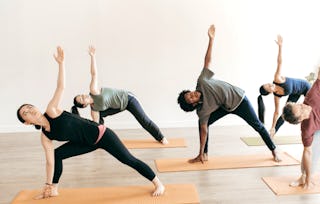
By the end of this course, you will (1) understand human anatomy and biomechanics in yoga practice and (2) apply that knowledge to improve alignment, safety, and performance. Dr. Constance Bradley, L.Ac., PhD, combines her expertise in yoga and biomedical sciences to deliver a course that connects structure and function in motion.

Profitez d'une croissance illimitée avec un an de Coursera Plus pour 199 $ (régulièrement 399 $). Économisez maintenant.

Anatomy, Physiology, and Biomechanics for Yoga Practice

Ce cours fait partie de Spécialisation Integrative Traditional Chinese Medicine Specialist

Instructeur : Niel Asher Education
Inclus avec
Expérience recommandée
Ce que vous apprendrez
How anatomy and biomechanics shape alignment and safety in yoga practice
How to analyze poses and guide students using anatomical reasoning
Compétences que vous acquerrez
- Catégorie : Athletic Training
- Catégorie : Respiratory Therapy
- Catégorie : Exercise Therapy
- Catégorie : Self-Awareness
- Catégorie : Spatial Analysis
- Catégorie : Orthopedics
- Catégorie : Mindfulness
- Catégorie : Neurology
- Catégorie : Biology
- Catégorie : Physical Therapy
- Catégorie : Sports Medicine
- Catégorie : Manual Therapy
- Catégorie : Medical Terminology
Détails à connaître

Ajouter à votre profil LinkedIn
décembre 2025
6 devoirs
Découvrez comment les employés des entreprises prestigieuses maîtrisent des compétences recherchées

Élaborez votre expertise du sujet
- Apprenez de nouveaux concepts auprès d'experts du secteur
- Acquérez une compréhension de base d'un sujet ou d'un outil
- Développez des compétences professionnelles avec des projets pratiques
- Obtenez un certificat professionnel partageable

Il y a 6 modules dans ce cours
Module 1 introduces the foundational language and principles needed to study the human body through a yoga lens. Dr. Constance Bradley begins by outlining the purpose of the course and clarifying who it is designed for—yoga teachers, practitioners, movement enthusiasts, and anyone wanting a deeper understanding of how the body functions in practice. The module explains standard anatomical position and the importance of directional terminology, helping learners create a consistent frame of reference for discussing structure and movement. It also introduces major biological systems, including the skeletal, muscular, connective tissue, nervous, respiratory, digestive, and endocrine systems. Throughout, Dr. Bradley maintains a clear connection to yoga, emphasising how these anatomical and physiological concepts translate directly into alignment, awareness, and safe teaching on the mat.
Inclus
11 vidéos2 lectures1 devoir1 sujet de discussion
Module 2 explores the hierarchical organisation of the human body, beginning with cells and moving through tissues, organs, and organ systems. Dr. Bradley explains the four major tissue types—epithelial, muscle, nervous, and connective tissue—highlighting how each contributes to movement and yoga practice. The module devotes extensive time to connective tissue, describing its structure, extracellular matrix, and the differences between loose, dense, and specialized connective tissues such as ligaments, cartilage, and bone. Learners are guided through the roles of collagen, elastin, and ground substance, and how these structures influence mobility, stability, and injury risk. By the end of this module, students gain a clearer understanding of how the body’s internal architecture supports both everyday movement and the demands of yoga practice.
Inclus
4 vidéos1 lecture1 devoir
Module 3 provides an in-depth exploration of the major muscle groups involved in yoga asana. Dr. Bradley walks through more than a dozen key muscles or muscle groups, including the pectorals, serratus anterior, biceps brachii, triceps brachii, rotator cuff complex, abdominals, gluteals, quadriceps, hamstrings, and more. For each, she outlines origin, insertion, major actions, and examples of where these muscles engage or lengthen in common yoga postures such as Chaturanga, Utkatasana, Bow Pose, and Plank. The module highlights the agonist–antagonist relationships that shape balanced practice and introduces how repetitive patterns or poor technique can create muscular imbalances. This section gives yoga teachers and practitioners the tools to understand movement mechanics in real time, improving cueing, alignment, strength development, and injury prevention.
Inclus
3 vidéos1 lecture1 devoir
Module 4 expands the course into the body’s major physiological systems and their direct relevance to yoga practice. Dr. Constance Bradley introduces the respiratory, cardiovascular, and digestive systems, explaining how breathwork, circulation, abdominal compression, twisting, and parasympathetic activation support both health and the internal experience of asana. She describes how long, slow, intentional breathing influences the autonomic nervous system, how forward folds and twists stimulate digestive function, and how improved circulation enhances oxygen delivery throughout the body. Alongside this systems-focused teaching, the module also reviews important muscle groups engaged in yoga, highlighting where they lengthen, contract, or stabilise during common postures. By the end, learners gain a fuller understanding of how internal physiology and muscular engagement work together to create safe, effective, and mindful yoga movement.
Inclus
6 vidéos1 lecture1 devoir
This module brings together the biomechanics of the spine with the functional understanding of postural imbalance patterns. Dr. Constance Bradley explains how the cervical, thoracic, and lumbar regions contribute differently to movement, highlighting why certain postures favour flexion, extension, rotation, or lateral flexion and how compensation patterns appear when mobility is limited. She discusses the difference between spatial movement and true spinal movement, giving learners a more accurate lens for analysing alignment. The module then moves into postural and muscular imbalances, including the distinctions between postural (short, tight) and phasic (long, weak) muscles and the predictable patterns seen in upper and lower crossed syndromes. Learners gain practical insight into how these imbalances affect yoga practice, how to recognise them in students, and how to use specific postures to restore balance, stability, and functional movement.
Inclus
11 vidéos1 lecture1 devoir1 sujet de discussion
This final exam is designed to assess your understanding of the key concepts presented throughout the course. Please review all video lessons and written materials before beginning. A passing score of 70% or higher is required to successfully complete the course and earn your CE certificate. You may reference your notes during the exam. Once you pass, your certificate will be available for immediate download.
Inclus
1 devoir
Obtenez un certificat professionnel
Ajoutez ce titre à votre profil LinkedIn, à votre curriculum vitae ou à votre CV. Partagez-le sur les médias sociaux et dans votre évaluation des performances.
Instructeur

Offert par
En savoir plus sur Patient Care

Niel Asher Education
Statut : PrévisualisationNew York University

Niel Asher Education
Statut : Essai gratuitNational Academy of Sports Medicine
Pour quelles raisons les étudiants sur Coursera nous choisissent-ils pour leur carrière ?


Ouvrez de nouvelles portes avec Coursera Plus
Accès illimité à 10,000+ cours de niveau international, projets pratiques et programmes de certification prêts à l'emploi - tous inclus dans votre abonnement.
Faites progresser votre carrière avec un diplôme en ligne
Obtenez un diplôme auprès d’universités de renommée mondiale - 100 % en ligne


Rejoignez plus de 3 400 entreprises mondiales qui ont choisi Coursera pour les affaires
Améliorez les compétences de vos employés pour exceller dans l’économie numérique
Foire Aux Questions
To access the course materials, assignments and to earn a Certificate, you will need to purchase the Certificate experience when you enroll in a course. You can try a Free Trial instead, or apply for Financial Aid. The course may offer 'Full Course, No Certificate' instead. This option lets you see all course materials, submit required assessments, and get a final grade. This also means that you will not be able to purchase a Certificate experience.
When you enroll in the course, you get access to all of the courses in the Specialization, and you earn a certificate when you complete the work. Your electronic Certificate will be added to your Accomplishments page - from there, you can print your Certificate or add it to your LinkedIn profile.
Yes. In select learning programs, you can apply for financial aid or a scholarship if you can’t afford the enrollment fee. If fin aid or scholarship is available for your learning program selection, you’ll find a link to apply on the description page.
Plus de questions
Aide financière disponible,