When you enroll in this course, you'll also be enrolled in this Specialization.
Learn new concepts from industry experts
Gain a foundational understanding of a subject or tool
Develop job-relevant skills with hands-on projects
Earn a shareable career certificate
There are 3 modules in this course
This course is an introductory and foundational course on sustainable consumption and health. In the first part of this course, we briefly review definitions of sustainability and the relationship between the three dimensions of sustainability and the UN-Environment Sustainable Environment Goals (SDGs), target and indicators. We then look at frameworks, indicators and footprint requirements to adequately measure sustainability, offering the opportunity to the participants to assess their own carbon and environmental footprint and make recommendation on how to reduce it. We then address the theme of sustainable consumption, looking at our main domains of consumption and at the key conditions to reach sustainable consumption and avoid rebounds effects that tend to reduce the benefits of increased product efficiency. We finally look at "what is good enough" for a given product or activity, in relationship with absolute sustainability and planetary boundaries.
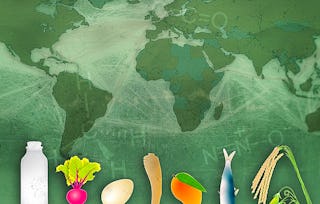
In the second part focusing on health, we will first identify the main factors affecting health, define DALYs (disability-adjusted life years) as a key metric to measure health burden, and use the rich information made available by the Global Burden of Disease (GBD). We will then use the GBD visualization tool to quantify and compare the respective burdens associated with 70 risks factors and numerous disease causes, in every country of the world and even at the state level for the US. We finally analyze the health impact associated with global trade, evaluating the fraction of the health impacts due to fine particulate in Asia, that are induced by Western consumption.
This course is an introductory and foundational course on sustainable consumption and health. In the first part of this course, we briefly review definitions of sustainability and the relationship between the three dimensions of sustainability and the UN-Environment Sustainable Environment Goals (SDGs), target and indicators. We then look at frameworks, indicators and footprint requirements to adequately measure sustainability, offering the opportunity to the participants to assess their own carbon and environmental footprint and make recommendation on how to reduce it. We then address the theme of sustainable consumption, looking at our main domains of consumption and at the key conditions to reach sustainable consumption and avoid rebounds effects that tend to reduce the benefits of increased product efficiency. We finally look at "what is good enough" for a given product or activity, in relationship with absolute sustainability and planetary boundaries.
In the second part focusing on health, we will first identify the main factors affecting health, define DALYs (disability-adjusted life years) as a key metric to measure health burden, and use the rich information made available by the Global Burden of Disease (GBD). We will then use the GBD visualization tool to quantify and compare the respective burdens associated with 70 risks factors and numerous disease causes, in every country of the world and even at the state level for the US. We finally analyze the health impact associated with global trade, evaluating the fraction of the health impacts due to fine particulate in Asia, that are induced by Western consumption.
Connecting SDGs and the Sustainability Pillars•10 minutes
Reflecting on My Personal Footprint Activity•15 minutes
Consumption Environmental Impacts vs Costs, and Absolute Sustainability
Module 2•3 hours to complete
Module details
This section focuses looks at the key conditions for sustainable consumption providing an overview of the impacts generated by consumers and by the participants themselves. After establishing our personal carbon footprint, we first relate impacts and costs and identify the critical conditions towards sustainable consumption accounting for rebounds effects. We then discuss how far we have been able to decouple environmental from GDP in different regions of the world. We finally discuss what is good enough and what the product specific targets can be to meet sustainable consumption objectives, not to exceed planetary boundaries.
(Optional)Luderer et al. 2019 and UNECE, 2016 •0 minutes
Absolute Sustainability Practice•20 minutes
3 assignments•Total 70 minutes
Knowledge Check: Impacts, Costs, and Trends•10 minutes
Knowedge check absolute sustainability practice - protein example•30 minutes
Week 2 Assessment•30 minutes
1 discussion prompt•Total 15 minutes
Reflecting on Impacts vs. Costs•15 minutes
Main Risk Factors Affecting Health
Module 3•6 hours to complete
Module details
We will now look at the dietary impacts of multiple foods to then analyze trade-offs and targeted change that can bring substantial health and environmental benefits with less than 10% caloric change. We finally address the health and sustainable performances of various diets, looking at disparities between gender, races and diets.
Then, equipped with the knowledge and skills you developed throughout our course, you will conclude with two final exercises. First, you will develop a 6-point action plan to feed our planet in a healthy and sustainable way as part of a peer-reviewed assignment. Next,
The mission of the University of Michigan is to serve the people of Michigan and the world through preeminence in creating, communicating, preserving and applying knowledge, art, and academic values, and in developing leaders and citizens who will challenge the present and enrich the future.
When will I have access to the lectures and assignments?
To access the course materials, assignments and to earn a Certificate, you will need to purchase the Certificate experience when you enroll in a course. You can try a Free Trial instead, or apply for Financial Aid. The course may offer 'Full Course, No Certificate' instead. This option lets you see all course materials, submit required assessments, and get a final grade. This also means that you will not be able to purchase a Certificate experience.
What will I get if I subscribe to this Specialization?
When you enroll in the course, you get access to all of the courses in the Specialization, and you earn a certificate when you complete the work. Your electronic Certificate will be added to your Accomplishments page - from there, you can print your Certificate or add it to your LinkedIn profile.
Is financial aid available?
Yes. In select learning programs, you can apply for financial aid or a scholarship if you can’t afford the enrollment fee. If fin aid or scholarship is available for your learning program selection, you’ll find a link to apply on the description page.