Most of the phenomena in the world around you are, at the fundamental level, based on physics, and much of physics is based on mechanics. Mechanics begins by quantifying motion, and then explaining it in terms of forces, energy and momentum. This allows us to analyse the operation of many familiar phenomena around us, but also the mechanics of planets, stars and galaxies.

Mechanics: Motion, Forces, Energy and Gravity, from Particles to Planets

Mechanics: Motion, Forces, Energy and Gravity, from Particles to Planets


Instructors: Prof. Joe Wolfe
Access provided by SmartStream
75,049 already enrolled
1,079 reviews
Skills you'll gain
Details to know

Add to your LinkedIn profile
See how employees at top companies are mastering in-demand skills

There are 8 modules in this course
This module introduces the foundational tools and concepts needed to study mechanics. You’ll learn how physicists describe the physical world using units, significant figures, vectors, and estimation techniques. These essential skills will help you interpret measurements, analyze motion, and solve physics problems accurately. You’ll also learn how physicists make useful approximations to understand real-world phenomena, from everyday objects to planets and galaxies.
What's included
5 videos2 readings6 assignments
In this module, you’ll begin your study of kinematics—the description of motion. You’ll learn how to represent motion using graphs and equations, and how velocity and acceleration describe how objects move and change speed over time. You’ll explore motion in a straight line and learn how to analyze relative motion between observers. These tools form the basis for understanding more complex motion in later modules.
What's included
4 videos1 reading5 assignments
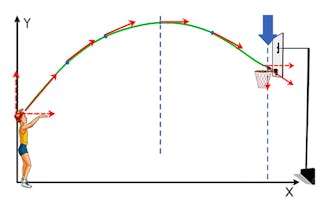
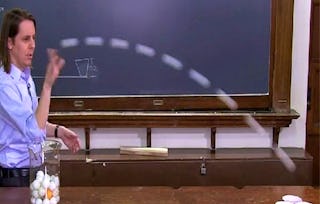
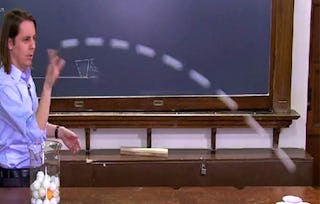
This module extends your understanding of motion to two dimensions. You’ll explore projectile motion, including objects falling under gravity and moving through the air, and learn how horizontal and vertical motion combine. You’ll also study uniform circular motion, which describes the motion of planets, satellites, and many everyday systems. These concepts will help you analyze realistic motion beyond simple straight-line movement.
What's included
4 videos1 reading6 assignments
This module introduces Newton’s three laws of motion, which explain how forces affect motion. You’ll learn how forces cause acceleration, how motion depends on reference frames, and how forces always occur in pairs. These principles allow you to explain and predict motion in systems ranging from everyday objects to engineering structures and astronomical bodies.
What's included
7 videos1 reading6 assignments
In this module, you’ll explore important forces encountered in everyday life. You’ll learn the difference between mass and weight, and how gravity acts on objects. You’ll study elastic forces using Hooke’s law and examine contact forces such as normal force and friction. These concepts will help you understand how objects interact when pushed, pulled, stretched, or in contact with surfaces.
What's included
4 videos1 reading5 assignments
This module introduces the powerful concepts of work, energy, and power. You’ll learn how energy is transferred and transformed, and how energy conservation helps explain motion without directly calculating forces. You’ll explore kinetic and potential energy, conservative and non-conservative forces, and how power describes the rate at which work is done. These ideas connect physics to real-world applications, from human movement to machines and technology.
What's included
5 videos1 reading7 assignments
In this module, you’ll learn about momentum and how it helps explain collisions and interactions between objects. You’ll study impulse, conservation of momentum, and the difference between elastic and inelastic collisions. These principles allow physicists to analyze events ranging from sports and vehicle safety to particle physics and space exploration.
What's included
4 videos1 reading5 assignments
This final module explores gravity—the force that governs motion on Earth and throughout the universe. You’ll learn how gravity determines weight, orbits, and the motion of planets and satellites. You’ll explore gravitational potential energy, escape velocity, and how gravity shapes stars, galaxies, and black holes. This module connects the physics you’ve learned to the large-scale structure of the universe.
What's included
5 videos1 reading6 assignments
Instructors


Why people choose Coursera for their career

Felipe M.

Jennifer J.

Larry W.

Chaitanya A.
Learner reviews
- 5 stars
80.35%
- 4 stars
13.80%
- 3 stars
2.96%
- 2 stars
0.92%
- 1 star
1.94%
Showing 3 of 1079
Reviewed on Feb 20, 2021
I loved everyday life, challenging, interesting questions and the presenting of the course.
Reviewed on Jul 20, 2016
Great course. Good explanations and examples. The quizes and tests are not very easy sometimes, but they do you let think again. Very enjoyable! Just the course I was looking for a long time!
Reviewed on Apr 16, 2020
Very informative course and the way the speakers voice out the lesson is not boring and it makes us more energetic to learn Phyiscs
Explore more from Physical Science and Engineering
Universitat Politècnica de València
Rice University
Birla Institute of Technology & Science, Pilani
Rice University
¹ Some assignments in this course are AI-graded. For these assignments, your data will be used in accordance with Coursera's Privacy Notice.

