Mathematics Courses
Mathematics courses can help you learn algebra, calculus, statistics, and discrete mathematics. You can build skills in problem-solving, logical reasoning, and data analysis, that support interpreting complex information. Many courses introduce tools like graphing calculators, statistical software, and programming languages such as Python, showing how these skills apply in fields like finance, engineering, and data science.
Popular Mathematics Courses and Certifications

Skills you'll gain: Computer Graphics, Visualization (Computer Graphics), Computer Graphic Techniques, C and C++, C++ (Programming Language), Image Quality, Applied Mathematics, Algebra

Skills you'll gain: Integrated Development Environments, UI Components, User Interface (UI), Jupyter, Development Environment, Application Development, Program Development, Python Programming, Event-Driven Programming, Test Case, Mathematical Software, Interactive Design, Computational Logic
University of Colorado Boulder
Skills you'll gain: Verification And Validation, Computational Thinking, Systems Design, Systems Analysis, Model Optimization, Software Design, Computer Architecture, Software Quality (SQA/SQC), Logical Reasoning

Pontificia Universidad Católica de Chile
Skills you'll gain: Thermal Management, Plot (Graphics), Simulation and Simulation Software, Mechanical Engineering, Engineering Analysis, HVAC, Energy and Utilities, Simulations, Engineering Calculations, Hydraulics, Numerical Analysis, Mathematical Software, Python Programming, Process Modeling, Computer Programming Tools
Coursera
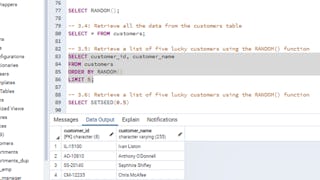
Skills you'll gain: SQL, PostgreSQL, Database Management, Data Manipulation, Database Systems, Query Languages
In summary, here are 5 of our most popular math courses
- DirectX: Implement & Optimize 3D Rendering: EDUCBA
- Python GUI Calculators with Tkinter: Build & Implement: EDUCBA
- Equivalences, Abstraction, and Partial Order Reduction: University of Colorado Boulder
- Análisis de sistemas térmicos usando Python: Pontificia Universidad Católica de Chile
- SQL Mathematical Functions: Coursera










