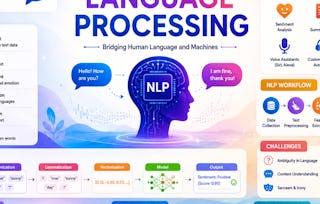
The field of natural language processing (NLP) aims at getting computers to perform useful and interesting tasks with human language. This course introduces students to the 3 pillars underlying modern NLP: probabilistic language models, simple neural networks with a focus on gradient based learning, and vector-based meaning representations in the form of word embeddings. At the end of the course, students will be able to implement and analyze probabilistic language models based on N-grams, text classifiers using logistic regression and gradient-based learning, and vector-based approaches to word meaning and text classification.

Fundamentals of Natural Language Processing

Fundamentals of Natural Language Processing

Dozent: James Martin
3.444 bereits angemeldet
Bei Mehr erfahren enthalten
Verschaffen Sie sich einen Einblick in ein Thema und lernen Sie die Grundlagen.
20 Bewertungen
Stufe Mittel
Empfohlene Erfahrung
Flexibler Zeitplan
2 Wochen bei 10 Stunden eine Woche
In Ihrem eigenen Lerntempo lernen
Was Sie lernen werden
Analyze corpora to develop effective lexicons using subword tokenization.
Develop language models that can assign probabilities to texts.
Design, implement, and evaluate the effectiveness of text classifiers using gradient-based learning techniques.
Design, implement and evaluate unsupervised methods for learning word embeddings.
Kompetenzen, die Sie erwerben
- Kategorie: Machine Learning Methods
- Kategorie: Natural Language Processing
- Kategorie: Embeddings
- Kategorie: Model Optimization
- Kategorie: Text Mining
- Kategorie: Model Training
- Kategorie: Model Evaluation
- Kategorie: Markov Model
- Kategorie: Supervised Learning
- Kategorie: Statistical Modeling
- Kategorie: Logistic Regression
Werkzeuge, die Sie lernen werden
- Kategorie: Classification Algorithms
Wichtige Details

Zertifikat zur Vorlage
Zu Ihrem LinkedIn-Profil hinzufügen
Bewertungen
5 Aufgaben
Unterrichtet in Englisch
Auf einen Abschluss hinarbeiten
Erfahren Sie, wie Mitarbeiter führender Unternehmen gefragte Kompetenzen erwerben.

In diesem Kurs gibt es 4 Module
Auf einen Abschluss hinarbeiten
Dieses Kurs ist Teil des/der folgenden Studiengangs/Studiengänge, die von University of Colorado Boulderangeboten werden. Wenn Sie zugelassen werden und sich immatrikulieren, können Ihre abgeschlossenen Kurse auf Ihren Studienabschluss angerechnet werden und Ihre Fortschritte können mit Ihnen übertragen werden.¹
Dozent
Lehrkraftbewertungen
(8 Bewertungen)
Mehr von Algorithms entdecken

University of Colorado Boulder
Birla Institute of Technology & Science, Pilani


Warum entscheiden sich Menschen für Coursera für ihre Karriere?

Felipe M.
Lernender seit 2018
„Es ist eine großartige Erfahrung, in meinem eigenen Tempo zu lernen. Ich kann lernen, wenn ich Zeit und Nerven dazu habe.“

Jennifer J.
Lernender seit 2020
„Bei einem spannenden neuen Projekt konnte ich die neuen Kenntnisse und Kompetenzen aus den Kursen direkt bei der Arbeit anwenden.“

Larry W.
Lernender seit 2021
„Wenn mir Kurse zu Themen fehlen, die meine Universität nicht anbietet, ist Coursera mit die beste Alternative.“

Chaitanya A.
„Man lernt nicht nur, um bei der Arbeit besser zu werden. Es geht noch um viel mehr. Bei Coursera kann ich ohne Grenzen lernen.“
Bringen Sie Ihre Karriere mit einem Online-Abschluss voran.
Erwerben Sie einen Abschluss von erstklassigen Universitäten – 100 % online




Häufig gestellte Fragen
Weitere Fragen
Finanzielle Unterstützung verfügbar,