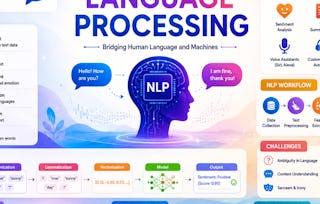
The field of natural language processing (NLP) aims at getting computers to perform useful and interesting tasks with human language. This course introduces students to the 3 pillars underlying modern NLP: probabilistic language models, simple neural networks with a focus on gradient based learning, and vector-based meaning representations in the form of word embeddings. At the end of the course, students will be able to implement and analyze probabilistic language models based on N-grams, text classifiers using logistic regression and gradient-based learning, and vector-based approaches to word meaning and text classification.
This course can be taken for academic credit as part of CU Boulder’s MS in Data Science or MS in Computer Science degrees offered on the Coursera platform. These fully accredited graduate degrees offer targeted courses, short 8-week sessions, and pay-as-you-go tuition. Admission is based on performance in three preliminary courses, not academic history. CU degrees on Coursera are ideal for recent graduates or working professionals. Learn more:
MS in Data Science: https://www.coursera.org/degrees/master-of-science-data-science-boulder
MS in Computer Science: https://coursera.org/degrees/ms-computer-science-boulder
This first week of Fundamentals of Natural Language Processing introduces the fundamental concepts of natural language processing (NLP), focusing on how computers process and analyze human language. You will explore key linguistic structures, including words and morphology, and learn essential techniques for text normalization and tokenization.
Das ist alles enthalten
5 Videos8 Lektüren2 Aufgaben
Infos zu Modulinhalt anzeigen
5 Videos•Insgesamt 56 Minuten
Meet Your Instructor•1 Minute
Course Introduction•7 Minuten
Morphology•16 Minuten
Text Normalization•17 Minuten
Subword Tokenization•15 Minuten
8 Lektüren•Insgesamt 141 Minuten
Course Updates and Accessibility Support•1 Minute
Earn Academic Credit for Your Work! •10 Minuten
Course Support•10 Minuten
Assessment Expectations•5 Minuten
AI Citation and Acknowledgement•10 Minuten
Morphology•30 Minuten
Text Normalization•60 Minuten
Byte-Pair Encoding•15 Minuten
2 Aufgaben•Insgesamt 35 Minuten
AI Policy Quiz•5 Minuten
Quiz 1: Morphology and Tokenization•30 Minuten
Probabilistic Language Models
Modul 2•6 Stunden abzuschließen
Moduldetails
This week explores foundational language modeling techniques, focusing on n-gram models and their role in statistical Natural Language Processing. You will learn how n-gram language models are constructed, smoothed, and evaluated for effectiveness.
Das ist alles enthalten
4 Videos4 Lektüren1 Aufgabe1 Programmieraufgabe
Infos zu Modulinhalt anzeigen
4 Videos•Insgesamt 61 Minuten
Introducing Language Models•14 Minuten
N-Gram Based Language Models•16 Minuten
Smoothing N-Gram Language Models•22 Minuten
Evaluating Language Models•9 Minuten
4 Lektüren•Insgesamt 80 Minuten
N-Gram Language Models: Introduction•10 Minuten
N-Gram Language Models: N-Grams•20 Minuten
N-Gram Language Models: Smoothing, Interpolation, and Backoff•20 Minuten
Evaluating Language Models•30 Minuten
1 Aufgabe•Insgesamt 30 Minuten
Quiz 2: Language Models•30 Minuten
1 Programmieraufgabe•Insgesamt 180 Minuten
Constructing a Language Model•180 Minuten
Text Classification and Logistic Regression
Modul 3•7 Stunden abzuschließen
Moduldetails
This week introduces text classification and explores logistic regression as a powerful classification technique. You will learn how logistic regression models work, including key mathematical concepts such as the logit function, gradients, and stochastic gradient descent. The week also covers evaluation metrics for assessing classifier performance.
Das ist alles enthalten
6 Videos3 Lektüren1 Aufgabe1 Programmieraufgabe
Infos zu Modulinhalt anzeigen
6 Videos•Insgesamt 91 Minuten
Introduction to Text Classification•10 Minuten
Logistic Regression•16 Minuten
Introducing the Logit•7 Minuten
Learning in Logistic Regression•19 Minuten
Learning Algorithms for Logistic Regression•17 Minuten
Evaluating Classifiers•21 Minuten
3 Lektüren•Insgesamt 125 Minuten
Introduction to Text Classification•35 Minuten
Logistic Regression•60 Minuten
Evaluating Classifiers•30 Minuten
1 Aufgabe•Insgesamt 30 Minuten
Quiz 3: Logistic Regression •30 Minuten
1 Programmieraufgabe•Insgesamt 180 Minuten
Sentiment Classification with Logistic Regression•180 Minuten
Vector Space Semantics and Word Embeddings
Modul 4•7 Stunden abzuschließen
Moduldetails
This final week explores how words can be represented as vectors in a high-dimensional space, allowing computational models to capture semantic relationships between words. You will learn about both sparse and dense vector representations, including TF-IDF, Pointwise Mutual Information (PMI), Latent Semantic Analysis (LSA), and Word2Vec. The module also covers techniques for evaluating and applying word embeddings.
Evaluation and Application of Word Embeddings•45 Minuten
1 Aufgabe•Insgesamt 30 Minuten
Quiz 4: Vector-Space Semantics•30 Minuten
1 Programmieraufgabe•Insgesamt 180 Minuten
Training and Applying Word Embeddings•180 Minuten
Auf einen Abschluss hinarbeiten
Dieses Kurs ist Teil des/der folgenden Studiengangs/Studiengänge, die von University of Colorado Boulderangeboten werden. Wenn Sie zugelassen werden und sich immatrikulieren, können Ihre abgeschlossenen Kurse auf Ihren Studienabschluss angerechnet werden und Ihre Fortschritte können mit Ihnen übertragen werden.¹
Mögliche Abschüsse anzeigen
Auf einen Abschluss hinarbeiten
Dieses Kurs ist Teil des/der folgenden Studiengangs/Studiengänge, die von University of Colorado Boulderangeboten werden. Wenn Sie zugelassen werden und sich immatrikulieren, können Ihre abgeschlossenen Kurse auf Ihren Studienabschluss angerechnet werden und Ihre Fortschritte können mit Ihnen übertragen werden.¹
¹Erfolgreiche Bewerbung und Einschreibung sind erforderlich. Es gelten die Zulassungsbedingungen. Jede Einrichtung legt die Anzahl der Credits fest, die durch die Absolvierung dieser Inhalte anerkannt werden und auf die Abschlussanforderungen angerechnet werden können, wobei bereits vorhandene Credits berücksichtigt werden. Klicken Sie auf einen bestimmten Kurs, um weitere Informationen zu erhalten.
OK
Dozent
Lehrkraftbewertungen
Wir haben alle Lernenden um Feedback zu unseren Dozenten gebeten, ausgehend von der Qualität ihres Unterrichtsstils.
CU Boulder is a dynamic community of scholars and learners on one of the most spectacular college campuses in the country. As one of 34 U.S. public institutions in the prestigious Association of American Universities (AAU), we have a proud tradition of academic excellence, with five Nobel laureates and more than 50 members of prestigious academic academies.
What is the recommended background for this course?
Learners should be proficient in Python programming including the use of packages such as numpy, scikit-learn and pandas. Students should be proficient in data structures and basic topics in algorithm design, such as sorting and searching, dynamic programming, and algorithm analysis. Students should also have basic familiarity with introductory concepts from calculus, discrete probability, and linear algebra.
When will I have access to the lectures and assignments?
To access the course materials, assignments and to earn a Certificate, you will need to purchase the Certificate experience when you enroll in a course. You can try a Free Trial instead, or apply for Financial Aid. The course may offer 'Full Course, No Certificate' instead. This option lets you see all course materials, submit required assessments, and get a final grade. This also means that you will not be able to purchase a Certificate experience.
What will I get if I subscribe to this Specialization?
When you enroll in the course, you get access to all of the courses in the Specialization, and you earn a certificate when you complete the work. Your electronic Certificate will be added to your Accomplishments page - from there, you can print your Certificate or add it to your LinkedIn profile.
Is financial aid available?
Yes. In select learning programs, you can apply for financial aid or a scholarship if you can’t afford the enrollment fee. If fin aid or scholarship is available for your learning program selection, you’ll find a link to apply on the description page.