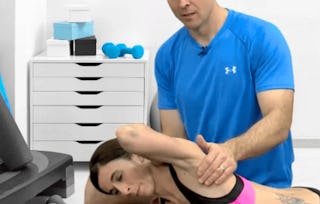
By the end of this course, you will (1) analyze and apply the biomechanical principles governing upper and lower body movement, and (2) use myofascial and anatomical insights to assess, treat, and prevent common injuries. Taught by award-winning educator and physiotherapist Phillipa Butler PT, this comprehensive program integrates biomechanics, myofascial anatomy, and functional movement science. You’ll explore the interconnection between the shoulder, spine, hips, and lower limbs—learning how to identify faulty movement patterns, design corrective exercises, and enhance movement efficiency.

Gain next-level skills with Coursera Plus for $199 (regularly $399). Save now.

Recommended experience
What you'll learn
How to assess and correct faulty movement patterns using myofascial and biomechanical principles
How to apply biomechanical analysis to rehabilitation and exercise programs for the upper and lower body
Skills you'll gain
- Treatment Planning
- Exercise Therapy
- Rehabilitation
- Clinical Practices
- Health And Wellness Coaching
- Human Musculoskeletal System
- Kinesiology
- Human Relations Movement
- Manual Therapy
- Injury Prevention
- Anatomy
- Athletic Training
- Orthopedics
- Pain Management
- Exercise Science
- Mechanics
- Physical Therapy
- Patient Evaluation
- Clinical Assessment
- Sports Medicine
Details to know

Add to your LinkedIn profile
December 2025
7 assignments
See how employees at top companies are mastering in-demand skills

There are 7 modules in this course
Module 1 introduces the foundational biomechanics of the upper body with a focus on how regional interactions influence movement, loading, and clinical decision-making. The instructor explores the relationships between the cervical spine, thoracic spine, ribs, scapulae, and upper-limb joints, emphasising how movement restrictions or compensations in one region can create symptoms elsewhere. Throughout the module, learners are guided through clinically relevant concepts such as optimal thoracic motion, scapular orientation, muscle recruitment strategies, and the kinetic chain’s role in functional movement. This session sets the stage for a practical, evidence-informed understanding of how upper-body biomechanics shape assessment and treatment planning for therapists, trainers, and rehabilitation professionals.
What's included
9 videos3 readings1 assignment1 discussion prompt
Module 2 focuses on detailed biomechanics and clinical reasoning related to the acromioclavicular (AC) joint, cervical spine contribution to symptoms, and the influence of scapular mechanics on upper-body function. The instructor explains common AC joint presentations—including instability, osteolysis, and degenerative changes—alongside typical mechanisms of injury and pain referral patterns. Learners are shown how provocative movements, repeated-movement testing, and symptom-modification strategies can help differentiate shoulder pathology from cervical contributions. The module also highlights the vital role of thoracic rotation, scapular positioning, and coordinated muscular control in maintaining efficient load transfer and shoulder performance.
What's included
9 videos1 reading1 assignment
Module 3 progresses into practical upper-body biomechanics through targeted therapeutic and rehabilitative exercises. The instructor demonstrates how to modify the scapular assistance test, facilitate clavicular and scapular movement, and select exercises based on symptom-modification findings. A wide range of shoulder and upper-limb exercises—including wall slides, serratus-biased drills, deltoid and cuff conditioning, open-book variations, bow-and-arrow patterns, and progressive push-ups—are broken down biomechanically to highlight their clinical purpose. The module concludes with cervical rehabilitation principles, emphasising deep neck flexor activation, endurance development, pattern retraining, and postural control. The session equips therapists with actionable strategies for restoring coordinated upper-body movement.
What's included
9 videos1 reading1 assignment
Module 1 explores the foundational biomechanics of lower-body movement through the lens of myofascial continuity, efficient gait, and optimal load distribution. Beginning with an overview of fascia, anatomy trains, and tensegrity, the instructor explains how fascial elasticity, joint sequencing, and muscular coordination together support efficient walking and reduce compensatory strain. You’ll examine the essential events of gait—heel strike, mid-stance, heel off, toe off, and swing—and learn how the four foot rockers (heel, ankle, midfoot, great toe) drive fluid motion up the kinetic chain. The module also demonstrates practical observations using a model to highlight superficial front, superficial back, lateral, and spiral line involvement in walking. By the end, you’ll better understand how mobility, stability, and timing must interact for healthy, energy-efficient lower-body movement.
What's included
5 videos2 readings1 assignment
Module 2 expands on lower-body biomechanics by exploring common movement errors of the superficial front and back lines and demonstrating targeted clinical interventions. You’ll investigate how dysfunction in the foot rockers leads to compensations such as hip hitching, overpronation, and altered torsional patterns, and how these contribute to conditions like plantar fasciitis, Achilles tendinopathy, patellofemoral pain, and toe-off inefficiency. The instructor demonstrates a full range of practical techniques including progressive loading, stretching, self-mobilisation, foam rolling, plantar fascia release, acupressure (BL60), and joint mobilisations for hallux rigidus. The module also covers intrinsic foot-muscle strengthening, footwear considerations, and orthotic strategies. By the end, you’ll have a set of clinically applicable tools to assess, treat, and retrain lower-body movement and foot mechanics.
What's included
12 videos1 reading1 assignment
This module translates biomechanical theory into real-world clinical application. Learners will observe and analyze functional movement patterns to recognize muscular imbalances and inefficient mechanics. Through case-based reasoning, manual therapists will learn how to adjust technique, apply treatment strategies that improve movement quality, and support safer, more effective client outcomes.
What's included
4 videos1 assignment1 discussion prompt
This final exam is designed to assess your understanding of the key concepts presented throughout the course. Please review all video lessons and written materials before beginning. A passing score of 70% or higher is required to successfully complete the course and earn your CE certificate. You may reference your notes during the exam. Once you pass, your certificate will be available for immediate download.
What's included
1 assignment
Instructor

Offered by
Explore more from Patient Care
Status: Free TrialNiel Asher Education
Status: Free Trial
Status: Free TrialNiel Asher Education
Why people choose Coursera for their career


Open new doors with Coursera Plus
Unlimited access to 10,000+ world-class courses, hands-on projects, and job-ready certificate programs - all included in your subscription
Advance your career with an online degree
Earn a degree from world-class universities - 100% online
Join over 3,400 global companies that choose Coursera for Business
Upskill your employees to excel in the digital economy
Frequently asked questions
To access the course materials, assignments and to earn a Certificate, you will need to purchase the Certificate experience when you enroll in a course. You can try a Free Trial instead, or apply for Financial Aid. The course may offer 'Full Course, No Certificate' instead. This option lets you see all course materials, submit required assessments, and get a final grade. This also means that you will not be able to purchase a Certificate experience.
When you purchase a Certificate you get access to all course materials, including graded assignments. Upon completing the course, your electronic Certificate will be added to your Accomplishments page - from there, you can print your Certificate or add it to your LinkedIn profile.
Yes. In select learning programs, you can apply for financial aid or a scholarship if you can’t afford the enrollment fee. If fin aid or scholarship is available for your learning program selection, you’ll find a link to apply on the description page.
More questions
Financial aid available,