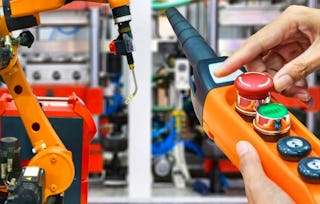
As robots evolve and increasingly interact with humans, enhancing the safety of personnel working with these “collaborative robots” (cobots) is vital. This course equips you to assess the safety of a collaborative robot workcell and prevent the chances of injury or harm. It imparts industry-endorsed safety standards, technical report recommendations and best practices from the International Organization for Standardization (ISO), Robotic Industries Association (RIA) and Occupational Safety and Health Administration (OSHA). Learners are introduced to similarities and differences between traditional robots, cobots and conventional machinery before delving into risk assessments, causes of robot accidents and collaborative applications. Material also includes key design techniques for reducing collision forces and a methodology for safety testing.


Collaborative Robot Safety: Design & Deployment
Ends in 4 days! Save 40% on your access to 10,000+ programs and make a real impact in your career. Save now.

Collaborative Robot Safety: Design & Deployment


Instructors: Brian Carlisle
9,715 already enrolled
Included with Learn more
Ask Coursera
Gain insight into a topic and learn the fundamentals.
260 reviews
Beginner level
No prior experience required
2 weeks to complete
at 10 hours a week
Flexible schedule
Learn at your own pace
Details to know

Shareable certificate
Add to your LinkedIn profile
Assessments
15 assignments
Taught in English
See how employees at top companies are mastering in-demand skills

There are 4 modules in this course
Instructors
Instructor ratings
(77 ratings)

Explore more from Mechanical Engineering
L&T EduTech

L&T EduTech

Siemens

L&T EduTech
Why people choose Coursera for their career

Felipe M.
Learner since 2018
"To be able to take courses at my own pace and rhythm has been an amazing experience. I can learn whenever it fits my schedule and mood."

Jennifer J.
Learner since 2020
"I directly applied the concepts and skills I learned from my courses to an exciting new project at work."

Larry W.
Learner since 2021
"When I need courses on topics that my university doesn't offer, Coursera is one of the best places to go."

Chaitanya A.
"Learning isn't just about being better at your job: it's so much more than that. Coursera allows me to learn without limits."
Learner reviews
- 5 stars
76.15%
- 4 stars
18.46%
- 3 stars
3.84%
- 2 stars
0.76%
- 1 star
0.76%
Showing 3 of 260
MV
Reviewed on Aug 4, 2020
learned so much about different types of robots from this course which will help me in my graduation in btech mechanical....thank you so much
CB
Reviewed on Aug 31, 2022
Many of the course links for are outdated and the desired content cannot be viewed. Other than that, it was a very informative course.
HJ
Reviewed on May 8, 2020
nice course i learnt a lot about collaborative robot safety and design



