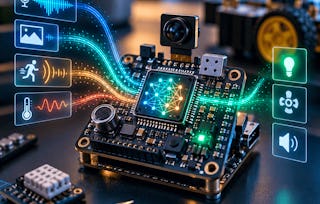
Machine learning (ML) allows us to teach computers to make predictions and decisions based on data and learn from experiences. In recent years, incredible optimizations have been made to machine learning algorithms, software frameworks, and embedded hardware. Thanks to this, running deep neural networks and other complex machine learning algorithms is possible on low-power devices like microcontrollers.

Introduction to Embedded Machine Learning

Introduction to Embedded Machine Learning
This course is part of Edge AI for Microcontrollers Specialization


Instructors: Shawn Hymel
56,560 already enrolled
Gain insight into a topic and learn the fundamentals.
769 reviews
Intermediate level
Recommended experience
Flexible schedule
2 weeks at 10 hours a week
Learn at your own pace
96%
Most learners liked this course
What you'll learn
The basics of a machine learning system
How to deploy a machine learning model to a microcontroller
How to use machine learning to make decisions and predictions in an embedded system
Skills you'll gain
Tools you'll learn
Details to know

Shareable certificate
Add to your LinkedIn profile
Assessments
14 assignments
Taught in English
See how employees at top companies are mastering in-demand skills

Build your subject-matter expertise
This course is part of the Edge AI for Microcontrollers Specialization
When you enroll in this course, you'll also be enrolled in this Specialization.
- Learn new concepts from industry experts
- Gain a foundational understanding of a subject or tool
- Develop job-relevant skills with hands-on projects
- Earn a shareable career certificate

There are 3 modules in this course
Earn a career certificate
Add this credential to your LinkedIn profile, resume, or CV. Share it on social media and in your performance review.
Instructors
Instructor ratings
(289 ratings)Offered by

Why people choose Coursera for their career

Felipe M.
Learner since 2018
"To be able to take courses at my own pace and rhythm has been an amazing experience. I can learn whenever it fits my schedule and mood."

Jennifer J.
Learner since 2020
"I directly applied the concepts and skills I learned from my courses to an exciting new project at work."

Larry W.
Learner since 2021
"When I need courses on topics that my university doesn't offer, Coursera is one of the best places to go."

Chaitanya A.
"Learning isn't just about being better at your job: it's so much more than that. Coursera allows me to learn without limits."
Learner reviews
- 5 stars
81.92%
- 4 stars
15.86%
- 3 stars
2.08%
- 2 stars
0%
- 1 star
0.13%
Showing 3 of 769
SK
5.0
Reviewed on Mar 31, 2024
This course was very helpful and gave me motivation to learn more about ML and apply to the embedded devices.
AP
4.0
Reviewed on Apr 19, 2022
i like the way course is designed.i tried all project explained in course without re-viewing cource material.
A
5.0
Reviewed on Jul 11, 2022
Highly recommended for anyone looking for embedded AI. For any starter, intermediate or advanced guys!