Probability Courses
Probability courses can help you learn statistical reasoning, risk assessment, hypothesis testing, and the fundamentals of random variables. You can build skills in interpreting data distributions, calculating expected values, and applying Bayes' theorem in various contexts. Many courses introduce tools like R, Python, and Excel for data analysis, along with methods for simulating probabilistic models and visualizing outcomes.
Popular Probability Courses and Certifications

University of London
Skills you'll gain: Relational Databases, Databases, Descriptive Statistics, Object Oriented Programming (OOP), Simulations, Statistical Inference, Data Literacy, Data Visualization Software, Statistical Hypothesis Testing, Exploratory Data Analysis, Probability Distribution, SQL, Tableau Software, Correlation Analysis, Data Storytelling, Algebra, Computational Logic, Calculus, Trigonometry, Logical Reasoning
 Status: Preview
Georgia Institute of Technology
Skills you'll gain: Game Theory, Combinatorics, Mathematical Theory & Analysis, Computational Logic, Mathematical Modeling
 Status: Preview
École Polytechnique
Skills you'll gain: Applied Mathematics, Differential Equations, Advanced Mathematics, Mathematical Theory & Analysis, Calculus, Derivatives

Johns Hopkins University
Skills you'll gain: Political Sciences, Policy Analysis, Social Justice, Social Sciences, Public Policies, Game Theory, Demography, Logical Reasoning, Applied Mathematics
Searches related to probability
In summary, here are 4 of our most popular probability courses
- International Foundation Programme for Computer Science (IFP): University of London
- Games without Chance: Combinatorial Game Theory : Georgia Institute of Technology
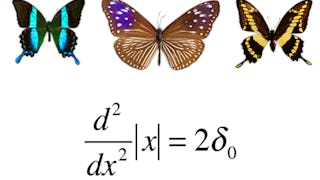
- Initiation à la théorie des distributions: École Polytechnique
- The Mathematics of Democracy, Politics and Manipulation: Johns Hopkins University










