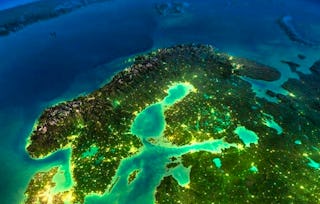
In many ways Scandinavian film and television is a global cultural brand, connected with and exporting some of the cultural and social values connected to a liberal and progressive welfare society. This course deals with the social, institutional and cultural background of film and television in Scandinavia and in a broader European and global context.
This module consists of two lessons. The first lesson offers an introduction to main trends in the contemporary Scandinavian film and television culture, focusing – among other things – on how the national film and television cultures relate to ideas of the welfare state. The module also addresses the international impact of film and television from Scandinavia. The second lesson deals with the early years of cinema in Scandinavia and the work of the Danish director Carl Th. Dreyer, from a silent film classic such as 'The Passion of Joan of Arc' to the sound film era.
1.1: Scandinavian cinema and the welfare state, by Professor Ib Bondebjerg•9 minutes
1.2: Scandinavian cinema: trends and international impact, by Professor Ib Bondebjerg•8 minutes
1.3: Scandinavian television culture, by Professor Ib Bondebjerg•12 minutes
2.1: The establishing of early cinema in Scandinavia, by Associate Professor Casper Tybjerg•11 minutes
2.2: The golden age of Swedish cinema and Dreyer, by Associate Professor Casper Tybjerg•11 minutes
2.3: Sound film and Dreyer's career as filmmaker, by Associate Professor Casper Tybjerg•14 minutes
2 readings•Total 20 minutes
Additional resources•10 minutes
2 assignments•Total 60 minutes
Contemporary Scandinavian Film and Television Culture: Main Trends•30 minutes
Carl Th. Dreyer and the Classical Scandinavian Cinema•30 minutes
3 discussion prompts•Total 30 minutes
Welcome to the course•10 minutes
Discussion: Public Funding•10 minutes
Discussion: Early Scandinavian Cinema•10 minutes
Ingmar Bergman and Lars von Trier
Module 2•3 hours to complete
Module details
'The Seventh Seal', 'Persona' and 'Cries and Whispers' are just some of the famous films by the acclaimed Swedish director Ingmar Bergman. The third lesson focuses on issues of influences, themes and style in his films as well as on Bergman's importance for the modern art cinema. The fourth lesson deals with the internationally renowned ideas and films by the Danish director Lars von Trier: 'The Europa-trilogy'; The TV series 'Riget'/'The Kingdom'; 'Breaking the Waves'; 'Dancer in the Dark' and 'Dogville'; The Dogma 95 Manifesto; 'Antichrist', 'Melancholia' and 'Nymphomaniac' ...
3.1: Bergman and the modern art cinema, by Associate Professor Johannes Riis•9 minutes
3.2: Bergman's film: Themes and style, by Associate Professor Johannes Riis•12 minutes
3.3: Chamber films, Persona and the influence of Strindberg, by Associate Professor Johannes Riis•10 minutes
4.1: Lars von Trier: The Early Years, by Associate Professor Peter Schepelern•13 minutes
4.2: Dogma 95, by Associate Professor Peter Schepelern•12 minutes
4.3: Lars von Trier: The Later Years, by Associate Professor Peter Schepelern•13 minutes
2 readings•Total 20 minutes
Additional resources•10 minutes
2 assignments•Total 60 minutes
Ingmar Bergman: Between Classicism and Modernism•30 minutes
Lars von Trier and Dogma 95•30 minutes
3 discussion prompts•Total 30 minutes
Discussion: Early Scandinavian Cinema•10 minutes
Discussion: Ingmar Bergman's Demons•10 minutes
Interview with Lars von Trier•10 minutes
New Wave, Art Cinema and Social Drama
Module 3•3 hours to complete
Module details
Many people have heard of the French new wave cinema, 'la nouvelle vague'. The fifth lesson deals with the main tendencies of the Scandinavian new wave cinema and some of its 'auteurs'. The sixth lesson focuses on different tendencies in the Scandinavian art film and social drama after 1990, ranging from award-winning heritage films to harsh stories from the contemporary Scandinavian welfare societies.
What's included
6 videos2 readings2 assignments
Show info about module content
6 videos•Total 75 minutes
5.1: Birth of new wave cinema, by Associate Professor Birger Langkjær•8 minutes
5.2: Scandinavian new wave: Main tendencies, by Associate Professor Birger Langkjær•10 minutes
5.3: Scandinavian new wave auteurs, by Associate Professor Birger Langkjær•14 minutes
6.1: And the Winner is ... Scandinavian heritage films, by Professor Ib Bondebjerg•14 minutes
6.2: Contemporary Scandinavian film success, by Professor Ib Bondebjerg•14 minutes
6.3: Modern Scandinavian art films, by Professor Ib Bondebjerg•14 minutes
2 readings•Total 20 minutes
Additional resources•10 minutes
2 assignments•Total 60 minutes
Scandinavian New Wave Cinema•30 minutes
Scandinavian Art Film and Social Drama after 1990•30 minutes
Documentary and Early TV Drama
Module 4•3 hours to complete
Module details
Scandinavian cinema has a long history of strong documentary film making. The seventh lesson moves from the early documentary filmmakers to the contemporary – global and digital – scene for Scandinavian documentaries. Television drama is important for the Scandinavian public service broadcasters, but the notions of good television drama have changed remarkably from the early days of television up until today. In the eighth lesson we focus on the main tendencies in these developments from 1960 to 2000.
What's included
6 videos2 readings2 assignments
Show info about module content
6 videos•Total 81 minutes
7.1: Discovering reality on film: The early documentary, by Professor Ib Bondebjerg•12 minutes
7.2: A new look at reality: The modern Scandinavian documentary, by Professor Ib Bondebjerg•12 minutes
7.3: Documentary in a global and digital world, by Professor Ib Bondebjerg•15 minutes
8.1: A medium for education: Early television drama, by Professor Ib Bondebjerg•10 minutes
8.2: The birth of modern television drama, by Professor Ib Bondebjerg•18 minutes
8.3: Stories by instalment: Television and serial narratives, by Professor Ib Bondebjerg•13 minutes
2 readings•Total 20 minutes
Additional resources•10 minutes
2 assignments•Total 60 minutes
The Scandinavian Documentary•30 minutes
Scandinavian Television Drama 1960-2000•30 minutes
Modern TV Drama and the Digital Revolution
Module 5•3 hours to complete
Module details
With 'Nordic Noir' such as 'Wallander' and 'Forbrydelsen/The Killing' becoming a 'brand' in the 2010s, some 'Scandi crime' series were suddenly of interest to international as well as national audiences. The ninth lesson focuses on Scandinavian television drama after the millennium and addresses some of the changes in the production framework that helped the series move from the national to the international realm. The tenth and final lesson discusses how to understand the contemporary Scandinavian film and television culture in a global and digital era. What might the transnational future bring?
(Please be advised that these lectures were filmed in 2014. Much has happened since then. We have put links about more recent developments in the resources.)
What's included
6 videos8 readings2 assignments
Show info about module content
6 videos•Total 66 minutes
9.1: Scandinavian television drama after the millennium, by Associate Professor Eva Novrup Redvall•12 minutes
9.2: Danish public service television drama in the 2000s, by Associate Professor Eva Novrup Redvall•13 minutes
9.3: Scandi-Crime and Nordic Noir, by Associate Professor Eva Novrup Redvall•12 minutes
10.1: The birth of a global online culture, by Professor Ib Bondebjerg•9 minutes
10.2: Is Nordic globally cool?, by Professor Ib Bondebjerg•12 minutes
10.3: Towards new horizons: Transnational futures, by Professor Ib Bondebjerg•9 minutes
8 readings•Total 80 minutes
Additional resources•10 minutes
Instructor profile: Casper Tybjerg•10 minutes
Instructor profile: Birger Langkjær•10 minutes
Instructor profile: Ib Bondebjerg•10 minutes
Instructor profile: Johannes Riis•10 minutes
Instructor profile: Peter Schepelern•10 minutes
Instructor profile: Eva Novrup Redvall•10 minutes
2 assignments•Total 60 minutes
Scandinavian Television and DR Production Practices•30 minutes
Global and Local Digital Economy - Trends and Tendencies•30 minutes
Instructor
Instructor ratings
Instructor ratings
We asked all learners to give feedback on our instructors based on the quality of their teaching style.
The University of Copenhagen is the oldest University in Denmark; founded in 1479, and with over 38,000 students and more than 9,000 employees. The purpose of the University is to conduct research and provide education to the highest academic level. Based in Denmark's capital city it is one of the top research institutions in Europe.
When will I have access to the lectures and assignments?
To access the course materials, assignments and to earn a Certificate, you will need to purchase the Certificate experience when you enroll in a course. You can try a Free Trial instead, or apply for Financial Aid. The course may offer 'Full Course, No Certificate' instead. This option lets you see all course materials, submit required assessments, and get a final grade. This also means that you will not be able to purchase a Certificate experience.
What will I get if I purchase the Certificate?
When you purchase a Certificate you get access to all course materials, including graded assignments. Upon completing the course, your electronic Certificate will be added to your Accomplishments page - from there, you can print your Certificate or add it to your LinkedIn profile.
Is financial aid available?
Yes. In select learning programs, you can apply for financial aid or a scholarship if you can’t afford the enrollment fee. If fin aid or scholarship is available for your learning program selection, you’ll find a link to apply on the description page.