When you enroll in this course, you'll also be enrolled in this Specialization.
Learn new concepts from industry experts
Gain a foundational understanding of a subject or tool
Develop job-relevant skills with hands-on projects
Earn a shareable career certificate
There are 5 modules in this course
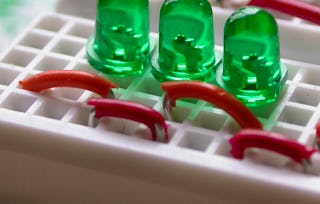
Hello, everyone! Welcome to this course on Adding Electronics to Rapid Prototypes. This is part of the Rapid Prototyping and Tooling specialization. In this course, I’ll cover the basics of electric circuits, breadboards, and multimeters. I’ll then discuss different options for connecting electrical components as well as discuss different types of motors and actuators. Finally, I’ll end this course by discussing microcontrollers and how to use them to make even more sophisticated prototypes.
By exploring both electrical simulations and many examples from different robotics projects I’ve had the opportunity to work on, by the end of this course, you should have a better understanding of the basics of electronics and how to add them to your designs to create high-quality prototypes. We have a lot of great content to cover, so without further ado, let’s dive into the world of rapid prototyping!
Hello, everyone! Welcome to this course on Adding Electronics to Rapid Prototypes. This is part of the Rapid Prototyping and Tooling specialization. In this course, I’ll cover the basics of electric circuits, breadboards, and multimeters. I’ll then discuss different options for connecting electrical components as well as discuss different types of motors and actuators. Finally, I’ll end this course by discussing microcontrollers and how to use them to make even more sophisticated prototypes. By exploring both electrical simulations and many examples from different robotics projects I’ve had the opportunity to work on, by the end of this course, you should have a better understanding of the basics of electronics and how to add them to your designs to create high-quality prototypes. We have a lot of great content to cover, so without further ado, let’s dive into the world of rapid prototyping!
What's included
3 videos2 readings
Show info about module content
3 videos•Total 5 minutes
Meet the Instructor: Daniel Frank•2 minutes
Specialization Introduction•2 minutes
Adding Electronics to Rapid Prototypes Course Introduction•1 minute
2 readings•Total 10 minutes
Instructor Bio•5 minutes
Course Tips•5 minutes
Module 1: Electric Circuit Basics
Module 2•1 hour to complete
Module details
In this module, you will learn about the basics of electric circuits, breadboards, and multimeters.
What's included
6 videos2 assignments
Show info about module content
6 videos•Total 54 minutes
Electric Circuits Basics•8 minutes
Components of a Simple Electric Circuit•10 minutes
Breadboards•9 minutes
Breadboards Demonstration•7 minutes
Multimeters•12 minutes
Multimeters Demonstration•6 minutes
2 assignments•Total 15 minutes
Electric Circuits Basics Graded Quiz•6 minutes
Electric Circuits Basics Practice Quiz•9 minutes
Module 2: Electrical Connections
Module 3•19 minutes to complete
Module details
In this module, you will learn about different options for connecting electrical components.
What's included
2 videos2 assignments
Show info about module content
2 videos•Total 4 minutes
Soldering•1 minute
Wire Connections•3 minutes
2 assignments•Total 15 minutes
Electrical Connections Graded Quiz•6 minutes
Electrical Connections Practice Quiz•9 minutes
Module 3: Motors
Module 4•1 hour to complete
Module details
In this module, you will learn about different types of actuators and how to select and control a DC motor.
What's included
6 videos2 assignments
Show info about module content
6 videos•Total 51 minutes
Motor Basics•6 minutes
Attaching to a Motor•6 minutes
Motor Selection•9 minutes
Servos and Other Actuators•4 minutes
H-Bridges•18 minutes
Motors and H-Bridge Demonstration•8 minutes
2 assignments•Total 15 minutes
Motors Graded Quiz•6 minutes
Motors Practice Quiz•9 minutes
Module 4: Microcontrollers
Module 5•1 hour to complete
Module details
In this module, you will learn about microcontrollers and how to use them to make sophisticated prototypes.
What's included
3 videos3 assignments
Show info about module content
3 videos•Total 28 minutes
What is a Microcontroller?•5 minutes
Analog and Digital Signals•7 minutes
Arduino Demonstration•15 minutes
3 assignments•Total 45 minutes
Microcontrollers Graded Quiz•6 minutes
Course 2 Quiz•30 minutes
Microcontrollers Practice Quiz•9 minutes
Earn a career certificate
Add this credential to your LinkedIn profile, resume, or CV. Share it on social media and in your performance review.
Arizona State University has developed a new model for the American Research University, creating an institution that is committed to excellence, access and impact. ASU measures itself by those it includes, not by those it excludes. ASU pursues research that contributes to the public good, and ASU assumes major responsibility for the economic, social and cultural vitality of the communities that surround it.
"To be able to take courses at my own pace and rhythm has been an amazing experience. I can learn whenever it fits my schedule and mood."
Jennifer J.
Learner since 2020
"I directly applied the concepts and skills I learned from my courses to an exciting new project at work."
Larry W.
Learner since 2021
"When I need courses on topics that my university doesn't offer, Coursera is one of the best places to go."
Chaitanya A.
"Learning isn't just about being better at your job: it's so much more than that. Coursera allows me to learn without limits."
Learner reviews
4.9
19 reviews
5 stars
89.47%
4 stars
10.52%
3 stars
0%
2 stars
0%
1 star
0%
Showing 3 of 19
A
AB
5·
Reviewed on Sep 9, 2023
this course is the basics of adding a electronics to the actual prototype. A basis introduction to microcontroller and arduino, their pins and the basics of programming.
When will I have access to the lectures and assignments?
To access the course materials, assignments and to earn a Certificate, you will need to purchase the Certificate experience when you enroll in a course. You can try a Free Trial instead, or apply for Financial Aid. The course may offer 'Full Course, No Certificate' instead. This option lets you see all course materials, submit required assessments, and get a final grade. This also means that you will not be able to purchase a Certificate experience.
What will I get if I subscribe to this Specialization?
When you enroll in the course, you get access to all of the courses in the Specialization, and you earn a certificate when you complete the work. Your electronic Certificate will be added to your Accomplishments page - from there, you can print your Certificate or add it to your LinkedIn profile.
Is financial aid available?
Yes. In select learning programs, you can apply for financial aid or a scholarship if you can’t afford the enrollment fee. If fin aid or scholarship is available for your learning program selection, you’ll find a link to apply on the description page.