IBM

The Accelerator Landscape

kurs ist nicht verfügbar in Deutsch (Deutschland)

Wir übersetzen es in weitere Sprachen.
IBM

The Accelerator Landscape

Bei Coursera PlusMehr erfahren enthalten

Verschaffen Sie sich einen Einblick in ein Thema und lernen Sie die Grundlagen.
Stufe Mittel

Empfohlene Erfahrung

3 Stunden zu vervollständigen
Flexibler Zeitplan
In Ihrem eigenen Lerntempo lernen
Verschaffen Sie sich einen Einblick in ein Thema und lernen Sie die Grundlagen.
Stufe Mittel

Empfohlene Erfahrung

3 Stunden zu vervollständigen
Flexibler Zeitplan
In Ihrem eigenen Lerntempo lernen

Was Sie lernen werden

  • ·Explain why AI workloads benefit from domain-specific accelerators using Amdahl's law and arithmetic intensity.

  • ·Compare execution and memory models across GPU, TPU, Cerebras, Groq, and IBM Spyre.

  • ·Use a roofline model to distinguish compute-bound from memory-bound workloads.

Kompetenzen, die Sie erwerben

  • Kategorie: Hardware Architecture
  • Kategorie: Performance Testing
  • Kategorie: Artificial Neural Networks
  • Kategorie: Dataflow
  • Kategorie: Computer Architecture
  • Kategorie: Large Language Modeling

Wichtige Details

Zertifikat zur Vorlage

Zu Ihrem LinkedIn-Profil hinzufügen

Kürzlich aktualisiert!

Oktober 2026

Bewertungen

2 Aufgaben

Unterrichtet in Englisch

Erfahren Sie, wie Mitarbeiter führender Unternehmen gefragte Kompetenzen erwerben.

 Logos von Petrobras, TATA, Danone, Capgemini, P&G und L'Oreal

Erweitern Sie Ihre Fachkenntnisse

Dieser Kurs ist Teil der Spezialisierung Spezialisierung „Dataflow Architectures for AI“
Wenn Sie sich für diesen Kurs anmelden, werden Sie auch für diese Spezialisierung angemeldet.
  • Lernen Sie neue Konzepte von Branchenexperten
  • Gewinnen Sie ein Grundverständnis bestimmter Themen oder Tools
  • Erwerben Sie berufsrelevante Kompetenzen durch praktische Projekte
  • Erwerben Sie ein Berufszertifikat zur Vorlage

In diesem Kurs gibt es 7 Module

This module introduces the course structure and the instructor. The course compares five accelerator architectures: NVIDIA GPUs, Google TPUs, the Cerebras Wafer-Scale Engine, the Groq LPU, and IBM Spyre. Each uses a different execution model to run the same PyTorch models. Each week examines one layer of the hardware and software stack and ends with a hands-on lab in Google Colab. Students also begin the Accelerator Landscape Map, a comparison table that is extended each week.

Das ist alles enthalten

1 Video

Since the end of Dennard scaling, single-thread processor performance has improved slowly, while the compute used to train AI models has doubled roughly every six months. This module covers the move from general-purpose processors to domain-specific hardware. It introduces Amdahl's law as a limit on acceleration, describes the properties that many AI workloads share, and defines arithmetic intensity. It then presents the roofline model, which uses arithmetic intensity to determine whether a workload is limited by compute or by memory bandwidth. The module closes by introducing the five accelerators used throughout the course.

Das ist alles enthalten

1 Video

Processors differ in when and where the next operation is selected. CPUs and GPUs select operations at runtime from an instruction stream. Many AI accelerators perform part or all of this scheduling in the compiler. This module compares instruction-driven, compiler-scheduled, and data-triggered execution. It describes the operation of a systolic array cycle by cycle and its implementation in the TPU matrix unit. The module concludes with a transformer block expressed as a dataflow graph and a comparison of the workloads suited to each execution model.

Das ist alles enthalten

1 Video

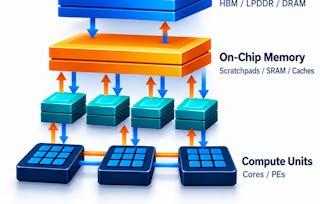
For many AI workloads, memory bandwidth and data placement limit performance more than peak compute. This module presents the memory hierarchy with measured figures from an NVIDIA H100 and traces the movement of one tensor through it. It compares hardware-managed caches with software-managed scratchpads and surveys the memory organization of all five accelerators, including the internal structure of an IBM Spyre chip. The module closes with the two phases of LLM inference, prefill and decode, and quantifies the weight traffic per generated token during small-batch decode.

Das ist alles enthalten

1 Video

Accelerator programming models range from kernel languages, which expose direct control of the hardware, to graph compilers, which provide portability across targets. This module positions CUDA, Triton, torch.compile, FX, and XLA within that range and describes the compilation path from a PyTorch model to vendor kernels. It describes the native programming model of each of the five accelerators. It then covers numeric formats such as FP8 and the conditions under which reduced precision improves performance.

Das ist alles enthalten

1 Video

This lab profiles LLM inference with Qwen 2.5 0.5B Instruct on a CPU and a GPU in Google Colab. Students build a benchmarking harness, identify the operators with the highest GPU time using PyTorch Profiler, and place the workload on a roofline for the assigned GPU. The lab concludes with the first row of the Accelerator Landscape Map. An optional Dataflow Deep Dive repeats the lab on IBM Spyre hardware for students in partnered programs.

Das ist alles enthalten

1 Aufgabe1 Unbewertetes Labor

This quiz covers all four modules of the course: why AI needs specialized hardware, control-flow and dataflow execution, memory hierarchies, and the path from a PyTorch model to an accelerator. It has 16 questions, including calculations with Amdahl's law, arithmetic intensity and the roofline model. Allow about 40 minutes and keep a calculator nearby. You need 80% to pass, and you can take the quiz up to 3 times. Your highest score counts.

Das ist alles enthalten

1 Aufgabe

Erwerben Sie ein Karrierezertifikat.

Fügen Sie dieses Zeugnis Ihrem LinkedIn-Profil, Lebenslauf oder CV hinzu. Teilen Sie sie in Social Media und in Ihrer Leistungsbeurteilung.

Dozent

Kaoutar El Maghraoui
6 Kurse73 Lernende

von

IBM

Warum entscheiden sich Menschen für Coursera für ihre Karriere?

Felipe M.

Lernender seit 2018
„Es ist eine großartige Erfahrung, in meinem eigenen Tempo zu lernen. Ich kann lernen, wenn ich Zeit und Nerven dazu habe.“

Jennifer J.

Lernender seit 2020
„Bei einem spannenden neuen Projekt konnte ich die neuen Kenntnisse und Kompetenzen aus den Kursen direkt bei der Arbeit anwenden.“

Larry W.

Lernender seit 2021
„Wenn mir Kurse zu Themen fehlen, die meine Universität nicht anbietet, ist Coursera mit die beste Alternative.“

Chaitanya A.

„Man lernt nicht nur, um bei der Arbeit besser zu werden. Es geht noch um viel mehr. Bei Coursera kann ich ohne Grenzen lernen.“

Was führt Sie heute zu Coursera?

Häufig gestellte Fragen