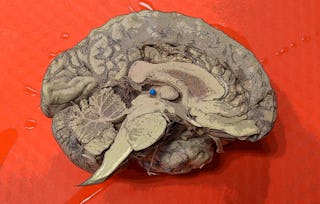
Discover how the human brain shapes the way we think, feel, learn, remember, and behave in this comprehensive introduction to Behavioural Neuroscience. This course explores the biological foundations of psychology by examining the structure and function of the nervous system, neural communication, sensory processing, learning and memory, emotion, sleep, stress, and human behaviour.

Brain and Behaviour
kurs ist nicht verfügbar in Deutsch (Deutschland)
Empfohlene Erfahrung
Was Sie lernen werden
Wichtige Details

Zu Ihrem LinkedIn-Profil hinzufügen
24 Aufgaben
Erfahren Sie, wie Mitarbeiter führender Unternehmen gefragte Kompetenzen erwerben.

In diesem Kurs gibt es 12 Module
This course introduces students to the biological foundations of Behaviour with a focus on the structure and function of the nervous system. It examines how brain processes influence perception, emotion, learning, memory, motivation, and Behaviour. Students will gain an understanding of neural communication, brain development, and the relationship between brain systems and psychological functions. The course also highlights applications of Behaviour al neuroscience in understanding mental health, neurological disorders, and everyday Behaviour, providing a scientific basis for advanced study in psychology. This module introduces the basic concepts of Behavioural neuroscience, focusing on the relationship between the brain, mind, and Behaviour. It covers the structure of the brain, early historical perspectives, the mind–body problem, and the role of genes and environment in shaping Behaviour. The module provides a foundation for understanding biological influences on psychological processes.
Das ist alles enthalten
7 Videos4 Lektüren2 Aufgaben1 Diskussionsthema
7 Videos•Insgesamt 45 Minuten
- Introduction to the Course•3 Minuten
- Meet Your Faculty (Dr. Smriti Pathak )•1 Minute
- The Origins of Behavioural Neuroscience•6 Minuten
- Mind – Body problem-Monism and Dualism •7 Minuten
- Helmholtz and the Electrical Brain •11 Minuten
- Localization Issue•8 Minuten
- Nature and Nurture- Biological Bases of Behavior•9 Minuten
4 Lektüren•Insgesamt 40 Minuten
- Meet Your Instructor (Dr. Smriti Pathak )•10 Minuten
- Course Overview•10 Minuten
- Honor Code•10 Minuten
- Readings for Module 1•10 Minuten
2 Aufgaben•Insgesamt 40 Minuten
- Quiz - 1•20 Minuten
- Assessment - 1•20 Minuten
1 Diskussionsthema•Insgesamt 10 Minuten
- Ungraded Discussion Prompt•10 Minuten
This module introduces students to the development, structure, and functional organization of the nervous system. It covers neural development, neurons and nerves, the peripheral and central nervous systems, cerebrospinal fluid and meninges, and the major divisions of the brain including the hindbrain, midbrain, forebrain, and limbic system. The module emphasizes how these structures support behaviour, sensation, movement, emotion, and cognition.
Das ist alles enthalten
5 Videos1 Lektüre2 Aufgaben1 Diskussionsthema
5 Videos•Insgesamt 49 Minuten
- Neuron and Nerves, Brain Surface Features•10 Minuten
- Development of the Nervous System: An Overview of Foundational Stages•9 Minuten
- Development of the Nervous System: Ventricles ,CSF And Meninges•9 Minuten
- Major Divisions of the Brain•10 Minuten
- Real-life Applications of Understanding the Development and Organization of the Nervous System•11 Minuten
1 Lektüre•Insgesamt 10 Minuten
- Readings for Module 2•10 Minuten
2 Aufgaben•Insgesamt 40 Minuten
- Quiz - 2•20 Minuten
- Assessment - 2•20 Minuten
1 Diskussionsthema•Insgesamt 10 Minuten
- Ungraded Discussion Prompt•10 Minuten
This module introduces students to the physiological basis of neural communication. It explains how neurons transmit information through action potentials and how communication occurs at the synapse using chemical neurotransmitters. The module covers the ionic basis of action potentials, factors affecting their speed, chemical transmission at synapses, and the role of excitatory, inhibitory, and modulatory neurotransmitters in neural functioning.
Das ist alles enthalten
6 Videos1 Lektüre2 Aufgaben1 Diskussionsthema
6 Videos•Insgesamt 57 Minuten
- The Cells of the Nervous System-Structure•10 Minuten
- The Cells of the Nervous System-Structure Continue•7 Minuten
- The Nerve Impulse- Resting potential•7 Minuten
- The Nerve Impulse- Action potential•9 Minuten
- Neurotransmitters and their Types•12 Minuten
- Excitation and Inhibition•11 Minuten
1 Lektüre•Insgesamt 10 Minuten
- Readings for Module 3•10 Minuten
2 Aufgaben•Insgesamt 40 Minuten
- Quiz - 3•20 Minuten
- Assessment - 3•20 Minuten
1 Diskussionsthema•Insgesamt 10 Minuten
- Ungraded Discussion Prompt•10 Minuten
This module introduces the major scientific methods used to study the relationship between brain structure, brain activity, genetics, and Behaviour . Students will learn how brain damage, brain stimulation, recording techniques, imaging methods, genetic approaches, and comparative studies help psychologists and neuroscientists understand Behaviour.
Das ist alles enthalten
5 Videos1 Lektüre2 Aufgaben1 Diskussionsthema
5 Videos•Insgesamt 46 Minuten
- Effect of Brain Damage •10 Minuten
- Effect of Stimulation to Brain Area•10 Minuten
- Recording Brain Activity•8 Minuten
- Recording Brain Activity Continue •8 Minuten
- Corelated Brain Anatomy with Behaviour and Genetic Methods•9 Minuten
1 Lektüre•Insgesamt 10 Minuten
- Readings for Module 4•10 Minuten
2 Aufgaben•Insgesamt 40 Minuten
- Quiz - 4•20 Minuten
- Assessment - 4•20 Minuten
1 Diskussionsthema•Insgesamt 10 Minuten
- Ungraded Discussion Prompt•10 Minuten
This module introduces students to the fundamental principles of sensation and perception, with a focused exploration of the visual and auditory sensory systems. It explains how physical stimuli such as light and sound are detected by specialized receptors, converted into neural signals through sensory transduction, and processed by specific neural pathways and cortical areas. Emphasis is placed on the anatomy, physiology, and functional organization of the visual and auditory systems, highlighting their role in perception, communication, and adaptive behaviour.
Das ist alles enthalten
8 Videos1 Lektüre2 Aufgaben1 Diskussionsthema
8 Videos•Insgesamt 66 Minuten
- Sensation & Perception- Difference Between Sensation and Perception, Sensory Receptors and Transduction•8 Minuten
- Visual System – Anatomy and Process-Structure of the Eye (Cornea, Lens, Retina),Photoreceptors: Rods and Cones•7 Minuten
- Visual System – Visual Transduction, Visual Pathways•7 Minuten
- Visual System – Anatomy and Process Continues •7 Minuten
- Auditory System - Hearing ,The Stimulus ,Variation in Sound :Pitch, Loudness, and Timbre, Anatomy of the Ear•9 Minuten
- The Auditory Cortex: Parallels and Difference to Visual Cortex•9 Minuten
- Auditory System :Sound Localization –Difference in Time of Arrival , Intensity and Phase Difference •10 Minuten
- Individual Difference in Auditory System, Pitch Perception – Place and Frequency Theory•9 Minuten
1 Lektüre•Insgesamt 10 Minuten
- Readings for Module 5•10 Minuten
2 Aufgaben•Insgesamt 40 Minuten
- Quiz - 5•20 Minuten
- Assessment - 5•20 Minuten
1 Diskussionsthema•Insgesamt 10 Minuten
- Ungraded Discussion Prompt•10 Minuten
This module focuses on the chemical senses (taste and smell) and mechanical senses (touch, balance, and pain). Students will learn how these sensory systems detect chemical and mechanical stimuli, transmit information through specific neural pathways, and contribute to perception, body awareness, and survival. The module emphasizes sensory integration and the functional significance of these systems in daily life and adaptive behaviour.
Das ist alles enthalten
7 Videos1 Lektüre2 Aufgaben1 Diskussionsthema
7 Videos•Insgesamt 60 Minuten
- Mechanical Senses – Anatomy and Process ,Vestibular Sensation and Somatosensation•10 Minuten
- Mechanical Senses – Mechanism of Itch, Pain, Emotional Pain Part - I•6 Minuten
- Mechanical Senses – Mechanism of Itch, Pain, Emotional Pain Part - II•5 Minuten
- Chemical Senses – Anatomy and Process of Taste Receptors,Psychological Significance of Taste•10 Minuten
- Chemical Senses –Type of Taste Receptor, Taste Coding in the Brain•11 Minuten
- Chemical Senses – Anatomy and Process, Olfactory Receptors and Smell Perception, Messages to the Brain•9 Minuten
- Chemical Senses – Individual Differences and Interesting Facts - Pheromones, Synesthesia•9 Minuten
1 Lektüre•Insgesamt 10 Minuten
- Readings for Module 6•10 Minuten
2 Aufgaben•Insgesamt 40 Minuten
- Quiz - 6•20 Minuten
- Assessment - 6•20 Minuten
1 Diskussionsthema•Insgesamt 10 Minuten
- Ungraded Discussion Prompt•10 Minuten
This module focuses on the neural control of movement and the biological mechanisms that enable voluntary and involuntary actions. It explores the structure and functioning of muscles, neuromuscular junctions, proprioceptors, and reflexes, along with the role of feedback in movement control. The module examines brain mechanisms involved in planning, executing, and inhibiting movement, with special emphasis on the cerebellum, motor cortical areas, and mirror neurons. It also introduces movement disorders, particularly Parkinson’s disease, to illustrate how disruptions in neural circuits affect motor behaviour. Through this module, students gain insight into how the brain coordinates precise, adaptive, and goal-directed movements.
Das ist alles enthalten
6 Videos1 Lektüre2 Aufgaben1 Diskussionsthema
6 Videos•Insgesamt 44 Minuten
- The Control of Movement -Muscles and Their Movements Units of Movement•9 Minuten
- Brain Mechanisms of Movement •10 Minuten
- Planning and Inhibiting the Movement•9 Minuten
- Mirror Neuron•8 Minuten
- Movement Disorder Part - I•5 Minuten
- Movement Disorder Part - II•4 Minuten
1 Lektüre•Insgesamt 10 Minuten
- Readings for Module 7•10 Minuten
2 Aufgaben•Insgesamt 40 Minuten
- Quiz - 7•20 Minuten
- Assessment - 7•20 Minuten
1 Diskussionsthema•Insgesamt 10 Minuten
- Ungraded Discussion Prompt•10 Minuten
This module focus on the biological and behavioural foundations of learning and memory. It examines how experience produces lasting changes in the nervous system and behaviour, beginning with basic forms of learning such as habituation, classical conditioning, and operant conditioning. The unit further explores different types of memory, including short-term, long-term, working, explicit, and implicit memory. Special emphasis is placed on the neural mechanisms of memory, including the role of the hippocampus, synaptic plasticity, Hebbian learning, and long-term potentiation. Clinical conditions such as amnesia, Korsakoff’s syndrome, Alzheimer’s disease, and infant amnesia are discussed to illustrate memory dysfunction. Experimental evidence from human case studies and animal research (Aplysia) is integrated to provide a comprehensive understanding of learning and memory processes.
Das ist alles enthalten
6 Videos1 Lektüre2 Aufgaben1 Diskussionsthema
6 Videos•Insgesamt 60 Minuten
- Different forms of Learning, Including Habituation, Classical Conditioning, and Operant Conditioning•9 Minuten
- Classification of Memory into Short-term, Long-term, Working, Explicit, and Implicit Memory•11 Minuten
- Memory Loss- Amnesia , Korsakoff’s Syndrome, Alzheimer , Infants Alzheimer•10 Minuten
- Memory Loss after Damage to the Hippocampus-Case studies•9 Minuten
- Habituation and Sensitization-Aplysia as an Experimental Animal•11 Minuten
- Methods to Improve Memory•11 Minuten
1 Lektüre•Insgesamt 10 Minuten
- Readings for Module 8•10 Minuten
2 Aufgaben•Insgesamt 40 Minuten
- Quiz - 8•20 Minuten
- Assessment - 8•20 Minuten
1 Diskussionsthema•Insgesamt 10 Minuten
- Ungraded Discussion Prompt•10 Minuten
This module introduces students to the biological mechanisms and Behaviour al functions of sleep and waking. It examines why sleep is essential, how sleep is regulated, and how brain activity changes across different sleep stages. The module covers circadian rhythms, sleep architecture, REM and non-REM sleep, and the neural structures involved in sleep–wake regulation, including the hypothalamus, brainstem, and reticular formation. Common sleep disorders such as insomnia, narcolepsy, sleep apnea, and parasomnias are discussed to illustrate disruptions in normal sleep processes. The unit emphasizes the role of sleep in cognitive functioning, memory consolidation, emotional regulation, and overall health.
Das ist alles enthalten
5 Videos1 Lektüre2 Aufgaben1 Diskussionsthema
5 Videos•Insgesamt 52 Minuten
- Endogenous Rhythms- Biological Clock, Circadian Rhythm•10 Minuten
- Stages of Sleep, Paradoxical or REM Sleep•12 Minuten
- Functions of Sleep •10 Minuten
- Biological Perspective on Dreaming •10 Minuten
- Sleep Disorder •10 Minuten
1 Lektüre•Insgesamt 10 Minuten
- Readings for Module 9•10 Minuten
2 Aufgaben•Insgesamt 40 Minuten
- Quiz - 9•20 Minuten
- Assessment - 9•20 Minuten
1 Diskussionsthema•Insgesamt 10 Minuten
- Ungraded Discussion Prompt•10 Minuten
This module explores the neural and biological basis of emotion, focusing on how emotions are generated, processed, expressed, and regulated by the brain. It introduces major theories of emotion and examines the role of key brain structures such as the amygdala, hypothalamus, hippocampus, prefrontal cortex, and the limbic system. The module highlights the interaction between emotion, cognition, and behaviour, and discusses emotional learning, regulation, and dysfunction. Emphasis is placed on understanding emotion from a Behaviour al neuroscience perspective, with relevance to mental health and everyday functioning.
Das ist alles enthalten
4 Videos1 Lektüre2 Aufgaben2 Diskussionsthemen
4 Videos•Insgesamt 44 Minuten
- Emotions and Autonomic Arousal- Is Physiological Arousal Necessary for Emotional Feelings? •12 Minuten
- Facial Feedback Hypothesis•9 Minuten
- Is Emotion a Useful Concept? The Functions of Emotion •11 Minuten
- Anxiety Disorder and PTSD -Brain and Biological Corelates•11 Minuten
1 Lektüre•Insgesamt 10 Minuten
- Readings for Module 10•10 Minuten
2 Aufgaben•Insgesamt 40 Minuten
- Quiz - 10•20 Minuten
- Assessment - 10•20 Minuten
2 Diskussionsthemen•Insgesamt 20 Minuten
- Ungraded Discussion Prompt•10 Minuten
This module examines the neural and biological mechanisms of stress and their impact on physical and mental health. It introduces the concept of stress and stressors and explains the body’s physiological response to stress. The module focuses on the role of the hypothalamic–pituitary–adrenal (HPA) axis, stress hormones such as cortisol, and key brain structures involved in stress regulation, including the amygdala, hippocampus, and prefrontal cortex. It further explores the effects of acute and chronic stress on brain functioning, behaviour, immunity, and health, and discusses stress-related mental health disorders.
Das ist alles enthalten
4 Videos1 Lektüre2 Aufgaben1 Diskussionsthema
4 Videos•Insgesamt 50 Minuten
- Stress and the General Adaptation Syndrome•11 Minuten
- Hypothalamus- Pituitary-Adrenal Cortex Axis•12 Minuten
- Immune System – Effect of Stress •13 Minuten
- Coping with Stress•12 Minuten
1 Lektüre•Insgesamt 10 Minuten
- Readings for Module 11•10 Minuten
2 Aufgaben•Insgesamt 40 Minuten
- Quiz - 11•20 Minuten
- Assessment - 11•20 Minuten
1 Diskussionsthema•Insgesamt 10 Minuten
- Ungraded Discussion Prompt•10 Minuten
This module examines the biological basis of sexual behaviour, focusing on the interaction between genes, hormones, brain structures, and behaviour. It covers the development of the reproductive system, the role of sex chromosomes and prenatal hormones, and the effects of sex hormones on brain organization and activation. The module also explores sex differences in brain structure and function, variations in sexual behaviour, gender identity, and sexual orientation. Clinical conditions such as Congenital Adrenal Hyperplasia (CAH) are included to illustrate the influence of hormones on sexual development.
Das ist alles enthalten
5 Videos2 Lektüren2 Aufgaben1 Diskussionsthema
5 Videos•Insgesamt 68 Minuten
- Sex and Hormone, Effect of Sex Hormones on Neuron•14 Minuten
- Effects of Sex Hormones on Nonsexual Characteristics•14 Minuten
- Sex Differences in the Brain•15 Minuten
- Variations in Sexual Behaviour•14 Minuten
- Sexual Orientation-Role of Genetics, Prenatal Influence and Brain Anatomy•11 Minuten
2 Lektüren•Insgesamt 20 Minuten
- Readings for Module 12•10 Minuten
- Course Wrap-Up•10 Minuten
2 Aufgaben•Insgesamt 40 Minuten
- Quiz - 12•20 Minuten
- Assessment - 12•20 Minuten
1 Diskussionsthema•Insgesamt 10 Minuten
- Ungraded Discussion Prompt•10 Minuten
Dozent

Warum entscheiden sich Menschen für Coursera für ihre Karriere?

Felipe M.

Jennifer J.

Larry W.

Chaitanya A.
Bringen Sie Ihre Karriere mit einem Online-Abschluss voran.
Erwerben Sie einen Abschluss von erstklassigen Universitäten – 100 % online
Häufig gestellte Fragen
To access course materials, assignments, and earn a Certificate, you'll need to purchase the Certificate experience when you enroll in a course. Eligible learners may also have the option to start with a Free Trial. Some courses may also offer a Full Course, No Certificate option. This lets you access course materials, submit required assessments, and receive a final grade, but you won't be able to earn or purchase a Certificate.
When you purchase a Certificate you get access to all course materials, including graded assignments. Upon completing the course, your electronic Certificate will be added to your Accomplishments page - from there, you can print your Certificate or add it to your LinkedIn profile.
Yes. In select learning programs, you can apply for financial aid or a scholarship if you can’t afford the enrollment fee. If fin aid or scholarship is available for your learning program selection, you’ll find a link to apply on the description page.
Weitere Fragen
Finanzielle Unterstützung verfügbar,