O.P. Jindal Global University

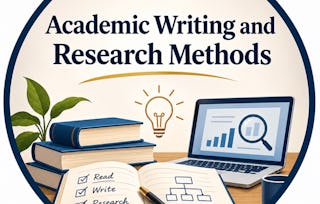
Academic Writing and Research Design

Développez des compétences très recherchées grâce à un abonnement d'un an à Coursera Plus, désormais à 239 $. Profitez-en dès maintenant.

Ce cours n'est pas disponible en Français (France)

Nous sommes actuellement en train de le traduire dans plus de langues.
O.P. Jindal Global University

Academic Writing and Research Design

Tahiba Banu

Instructeur : Tahiba Banu

Inclus avec Coursera PlusEn savoir plus

Obtenez un aperçu d'un sujet et apprenez les principes fondamentaux.
niveau Débutant

Expérience recommandée

4 semaines à compléter
à 10 heures par semaine
Planning flexible
Apprenez à votre propre rythme
Obtenez un aperçu d'un sujet et apprenez les principes fondamentaux.
niveau Débutant

Expérience recommandée

4 semaines à compléter
à 10 heures par semaine
Planning flexible
Apprenez à votre propre rythme

Ce que vous apprendrez

  • Develop clear, structured, and evidence-based academic and professional writing.

  • Design rigorous research projects using appropriate questions, methods, sampling, and conceptual frameworks.

  • Evaluate and communicate research effectively through literature reviews, proposals, policy writing, and academic publishing.

Compétences que vous acquerrez

  • Catégorie : Technical Communication
  • Catégorie : Policy Analysis, Research, and Development
  • Catégorie : Peer Review
  • Catégorie : Quantitative Research
  • Catégorie : Grant Applications
  • Catégorie : Journals
  • Catégorie : Research and Design
  • Catégorie : Proposal Writing
  • Catégorie : Research
  • Catégorie : Qualitative Research
  • Catégorie : Report Writing
  • Catégorie : Research Reports
  • Catégorie : Research Methodologies
  • Catégorie : Research Design
  • Catégorie : Social Sciences
  • Catégorie : Conceptual Design
  • Catégorie : Technical Writing
  • Catégorie : Writing
  • Catégorie : Grant Writing

Détails à connaître

Certificat partageable

Ajouter à votre profil LinkedIn

Récemment mis à jour !

novembre 2026

Évaluations

40 devoirs

Enseigné en Anglais

Découvrez comment les employés des entreprises prestigieuses maîtrisent des compétences recherchées

 logos de Petrobras, TATA, Danone, Capgemini, P&G et L'Oreal

Élaborez votre expertise du sujet

Ce cours fait partie de la Spécialisation "Academic Writing and Research Methods"
Lorsque vous vous inscrivez à ce cours, vous êtes également inscrit(e) à cette Spécialisation.
  • Apprenez de nouveaux concepts auprès d'experts du secteur
  • Acquérez une compréhension de base d'un sujet ou d'un outil
  • Développez des compétences professionnelles avec des projets pratiques
  • Obtenez un certificat professionnel partageable

Il y a 12 modules dans ce cours

This course on Research Design and Academic Writing is designed for professionals and students in the social sciences, public policy, and development sectors who wish to enhance their research capabilities and writing proficiency. It offers a structured approach to crafting explicit, coherent academic texts and designing rigorous, ethically sound research projects. The academic writing component focuses on developing skills in formulating research questions, structuring arguments, engaging with literature, and using evidence effectively. Participants will learn to adapt their writing for different audiences, including researchers and funding bodies, with a special emphasis on writing for peer-reviewed journals and grant proposals. Practical applications, such as hands-on activities in outlining papers, refining research questions, and citation management, ensure participants can write with clarity and precision. The modules on research design in this course introduces students to the critical foundations of research design in the social sciences. It examines how research questions emerge, how theory and methodology are intertwined, and how epistemological assumptions shape the process of inquiry. Through six modules, students will explore key debates around positionality, reflexivity, ethics, and validity understanding how knowledge is produced, represented, and legitimized. Combining conceptual discussion with reflective exercises, the course encourages students to think critically about their own research choices and the broader social and political contexts that inform them.

Inclus

5 vidéos7 lectures3 devoirs

This module is designed to equip graduate students and researchers with the essential skills and knowledge to navigate academic writing and publishing complexities. It covers the literature review process, the peer-review system, and strategies for target journal selection. Focus Areas: Literature Reviews: The module delves into the purpose, functions, and types of literature reviews, emphasising their role in scholarly research. Peer Review: A significant portion of the class is dedicated to understanding the peer-review process, its importance in maintaining academic integrity, and the roles of authors, reviewers, and editors. Journal Selection: The class offers strategic guidance on selecting appropriate target journals for research publication.

Inclus

4 vidéos1 lecture3 devoirs

This module is designed to equip students with the essential skills for effective policy writing. It introduces policy writing as a professional communication form that links knowledge, action, and decision-making, aiming to influence those in positions of power by providing clear, concise, and evidence-based guidance. The module emphasises that policy writing differs from academic writing by prioritising clarity, brevity, and direct actionability over theoretical depth. It underscores the importance of balancing rigorous analysis with strategic communication to address the urgent needs and feasibility of proposed solutions for busy decision-makers. Students will learn the key qualities of effective policy writing, including clarity, brevity, actionability, evidence-based reasoning, audience-centred communication, and a neutral yet persuasive tone.

Inclus

4 vidéos1 lecture3 devoirs

This module provides comprehensive guidance on the essential aspects of writing proposals for research funding. It begins by emphasizing the critical role of research funding in enabling academic and applied research. The module is structured to help researchers effectively identify suitable funding opportunities and navigate the complexities of the grant application process. Key areas covered in the module include: 1) Identifying Funding Sources 2) Searching for Funding Opportunities 3) Evaluating Funding Bodies 4) Grant Evaluation Criteria

Inclus

4 vidéos1 lecture3 devoirs

This module introduces the basic principles, emphasising clarity, conciseness, and precision in communicating complex information. It focuses on technical communication's visual and organisational aspects, teaching students how to create effective layouts, use typography, and incorporate visual aids to enhance readability and usability. It also discusses research, Data Visualization, and Citation, emphasising the importance of conducting thorough research, using data visualisation to improve understanding, and adhering to proper citation practices to maintain integrity and credibility. Writing for Industry and Emerging Technologies prepares students for the specific demands of technical writing in professional settings and the challenges of communicating about rapidly evolving technologies.

Inclus

4 vidéos1 lecture3 devoirs

This module is designed to help students master the art of op-ed and popular media writing. It emphasizes the importance of op-eds in shaping public discourse, raising awareness, and influencing policy debates in democratic societies. The module covers various aspects of op-ed writing, including understanding the purpose and structure of op-eds, identifying key rhetorical strategies, and recognising the role of op-eds in public engagement and democratic dialogue. It delves into the key features of op-eds, such as crafting clear and compelling arguments, using effective hooks or leads, employing accessible and transparent language, ensuring timeliness and relevance, and incorporating a strong call to action. It further explores the context of op-eds in public engagement and democratic dialogue, discussing their role in public scholarship, advocacy and activism, and creating counter-narratives. Additionally, the module guides reading and analysing op-eds, translating research into public arguments, and developing a personal voice in opinion writing.

Inclus

4 vidéos1 lecture3 devoirs

This module introduces students to the foundational principles, logic, and structure of research design in social sciences. It explores what research design is, why it matters, and how it has evolved historically within the social sciences. Beginning with the conceptual and epistemological underpinnings of design, the module guides students through the key components that make a research project coherent, rigorous, and ethically grounded.

Inclus

6 vidéos1 lecture4 devoirs

This module introduces students to the idea of a conceptual framework as the backbone of any well-designed research project. It explores how researchers move from abstract ideas and theories to clearly defined concepts that guide inquiry. Through engagement with classic and contemporary readings, students learn to identify, construct, and critically evaluate conceptual frameworks. The module emphasizes the interpretive and reflexive nature of conceptual framing in qualitative research, helping students connect theoretical insights with methodological choices and the lived realities they seek to study.

Inclus

6 vidéos1 lecture4 devoirs

This module focuses on the critical transition from identifying a research problem to formulating clear, focused, and researchable questions. It guides students through the intellectual and practical steps that shape the foundation of any research project. Beginning with an exploration of what constitutes a research problem, the module examines how problems emerge from broader social, theoretical, and empirical contexts, and how they can be refined to achieve clarity and focus.

Inclus

4 vidéos1 lecture3 devoirs

This module explores how research methods function as the practical and epistemological backbone of research design. It distinguishes between research design the overall strategy guiding inquiry and research methods the specific tools and techniques used to generate and interpret data. The module traces the historical and philosophical evolution of research methods, from positivist traditions emphasizing measurement and objectivity to interpretivist approaches centered on meaning, context, and reflexivity. Students will engage with quantitative, qualitative, mixed, and comparative methods to understand how methodological choices are shaped by the kinds of questions asked and the assumptions underlying them. The module also introduces emerging and digital methods that are reshaping the nature of fieldwork and data collection in the 21st century.

Inclus

6 vidéos1 lecture4 devoirs

This module introduces students to the logic and practice of sampling as a crucial element of research design. It explores how researchers strategically choose cases, participants, and sites to ensure that their findings are meaningful, rigorous, and aligned with their research questions. Moving from probability-based to non-probability and qualitative approaches, the module also examines mixed-methods and interdisciplinary designs, highlighting the trade-offs between representativeness, depth, and feasibility. Through comparative examples and practical exercises, students will learn how sampling decisions shape both the scope and validity of research outcomes.

Inclus

5 vidéos1 lecture3 devoirs

This module explores how researchers establish the validity and credibility of their knowledge claims. It examines different logics of reasoning deductive, inductive, and abductive and how they shape the link between theory, evidence, and interpretation. Moving beyond technical definitions, validity is approached as a practice of coherence, reflexivity, and transparency throughout the research process. By the end of the module, students will be able to evaluate the rigor of existing studies and articulate how their own claims are grounded, justified, and communicated.

Inclus

6 vidéos2 lectures4 devoirs

Obtenez un certificat professionnel

Ajoutez ce titre à votre profil LinkedIn, à votre curriculum vitae ou à votre CV. Partagez-le sur les médias sociaux et dans votre évaluation des performances.

Instructeur

Tahiba Banu
O.P. Jindal Global University
1 Cours20 apprenants

Offert par

En savoir plus sur Philosophy

Pour quelles raisons les étudiants sur Coursera nous choisissent-ils pour leur carrière ?

Felipe M.

Étudiant(e) depuis 2018
’Pouvoir suivre des cours à mon rythme à été une expérience extraordinaire. Je peux apprendre chaque fois que mon emploi du temps me le permet et en fonction de mon humeur.’

Jennifer J.

Étudiant(e) depuis 2020
’J'ai directement appliqué les concepts et les compétences que j'ai appris de mes cours à un nouveau projet passionnant au travail.’

Larry W.

Étudiant(e) depuis 2021
’Lorsque j'ai besoin de cours sur des sujets que mon université ne propose pas, Coursera est l'un des meilleurs endroits où se rendre.’

Chaitanya A.

’Apprendre, ce n'est pas seulement s'améliorer dans son travail : c'est bien plus que cela. Coursera me permet d'apprendre sans limites.’

Qu’est-ce qui vous amène sur Coursera aujourd’hui ?

Foire Aux Questions