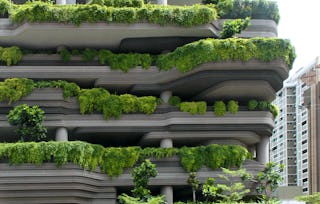
This course offers a comprehensive, interdisciplinary exploration of sustainability in architectural practice. Participants will gain foundational knowledge in the core components of sustainability evaluation (forming the initial analytical layer), alongside an understanding of contemporary trends shaping this field.
The curriculum is designed to empower students to construct a theoretical model of a neighborhood, enabling the assessment of performance metrics and urban planning strategies. The inaugural week focuses on equipping participants with the skills to build this conceptual model, starting from a building's fundamental architectural components, with a particular emphasis on material performance. The subsequent week delves into methodologies for optimizing this performance. Course content will elaborate on the specific requirements and limitations involved in selecting both building materials and urban infrastructure elements at the neighborhood scale (comprising the second analytical layer for green, blue, and gray infrastructure).
During the third week, learners will acquire essential tools for integrating energy considerations and quantifying their potential impact on climate change (specifically CO2 emissions). This introduces a new, third layer to our neighborhood sustainability model, approached from a global viewpoint. In the concluding fourth week, the course will investigate techniques for conducting a unified assessment, directly linking findings to relevant policy frameworks.
Inclus
3 vidéos2 lectures5 devoirs1 plugin
Afficher les informations sur le contenu du module
3 vidéos•Total 18 minutes
Architectural subsystems •6 minutes
Building typology•5 minutes
Built environment: energy and passive systems •7 minutes
2 lectures•Total 15 minutes
Key points•5 minutes
Key points•10 minutes
5 devoirs•Total 66 minutes
Architectural subsystems •2 minutes
Building typology•2 minutes
Built environment: energy and passive systems •2 minutes
Week 1 Test Exam•30 minutes
Week 1 Exam•30 minutes
1 plugin•Total 2 minutes
Introduction to Sustainability in Architecture•2 minutes
Week 2: Buildings, performance, functions and materials
Module 2•2 heures à terminer
Détails du module
Inclus
3 vidéos1 lecture5 devoirs
Afficher les informations sur le contenu du module
3 vidéos•Total 26 minutes
Green infrastructure •7 minutes
Facades constraints •9 minutes
Materials selection in architecture•11 minutes
1 lecture•Total 10 minutes
Key points•10 minutes
5 devoirs•Total 66 minutes
Green infrastructure •2 minutes
Facades constraints •2 minutes
Materials selection in architecture•2 minutes
Week 2 Test Exam•30 minutes
Week 2 Exam•30 minutes
Week 3: Efficiency, sustainability and architecture
Module 3•5 heures à terminer
Détails du module
Inclus
3 vidéos1 lecture5 devoirs
Afficher les informations sur le contenu du module
3 vidéos•Total 49 minutes
Carbon management •12 minutes
Energy Systems •26 minutes
Life cycle analysis •12 minutes
1 lecture•Total 15 minutes
Key points•15 minutes
5 devoirs•Total 216 minutes
Carbon management •2 minutes
Energy Systems •2 minutes
Life cycle analysis •2 minutes
Week 3 Test Exam•30 minutes
Week 3 Exam•180 minutes
Week 4: Objectives and assessment
Module 4•5 heures à terminer
Détails du module
Inclus
3 vidéos2 lectures5 devoirs
Afficher les informations sur le contenu du module
3 vidéos•Total 54 minutes
Integrative approaches to sustainability problems •23 minutes
Integrated design process•20 minutes
Business models for climate change strategies •11 minutes
2 lectures•Total 20 minutes
Key points•15 minutes
End of the course•5 minutes
5 devoirs•Total 216 minutes
Integrative approaches to sustainability problems •2 minutes
Integrated design process•2 minutes
Business models for climate change strategies •2 minutes
The Universitat Politècnica de València (UPV) operates as a public higher education institution, delivering contemporary, adaptable degree programs designed to fulfill current societal demands. It also provides official postgraduate qualifications, all subject to stringent educational quality assurance protocols.
Currently, the UPV's thriving academic community encompasses over 28,000 students, nearly 2,500 teaching and research professionals, and 1,500 administrative and service personnel. Its operations span three distinct campuses, located in València, Alcoi, and Gandia.
OK
En savoir plus sur Environmental Science and Sustainability
Pour quelles raisons les étudiants sur Coursera nous choisissent-ils pour leur carrière ?
Felipe M.
Étudiant(e) depuis 2018
’Pouvoir suivre des cours à mon rythme à été une expérience extraordinaire. Je peux apprendre chaque fois que mon emploi du temps me le permet et en fonction de mon humeur.’
Jennifer J.
Étudiant(e) depuis 2020
’J'ai directement appliqué les concepts et les compétences que j'ai appris de mes cours à un nouveau projet passionnant au travail.’
Larry W.
Étudiant(e) depuis 2021
’Lorsque j'ai besoin de cours sur des sujets que mon université ne propose pas, Coursera est l'un des meilleurs endroits où se rendre.’
Chaitanya A.
’Apprendre, ce n'est pas seulement s'améliorer dans son travail : c'est bien plus que cela. Coursera me permet d'apprendre sans limites.’
When will I have access to the lectures and assignments?
To access the course materials, assignments and to earn a Certificate, you will need to purchase the Certificate experience when you enroll in a course. You can try a Free Trial instead, or apply for Financial Aid. The course may offer 'Full Course, No Certificate' instead. This option lets you see all course materials, submit required assessments, and get a final grade. This also means that you will not be able to purchase a Certificate experience.
What will I get if I purchase the Certificate?
When you purchase a Certificate you get access to all course materials, including graded assignments. Upon completing the course, your electronic Certificate will be added to your Accomplishments page - from there, you can print your Certificate or add it to your LinkedIn profile.
Is financial aid available?
Yes. In select learning programs, you can apply for financial aid or a scholarship if you can’t afford the enrollment fee. If fin aid or scholarship is available for your learning program selection, you’ll find a link to apply on the description page.