Wenn Sie sich für diesen Kurs anmelden, werden Sie auch für diese Spezialisierung angemeldet.
Lernen Sie neue Konzepte von Branchenexperten
Gewinnen Sie ein Grundverständnis bestimmter Themen oder Tools
Erwerben Sie berufsrelevante Kompetenzen durch praktische Projekte
Erwerben Sie ein Berufszertifikat zur Vorlage
In diesem Kurs gibt es 6 Module
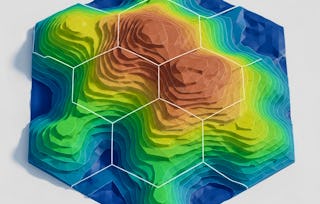
This intermediate-to-advanced course guides learners through the structured development of procedural surface systems in Unity using noise-based methods. Through six focused modules, participants will explore dimensional noise functions, gradient masks, resolution control, derivative computation, and flow visualization using particle systems and scripting.
Beginning with foundational practices in texture generation and noise sampling, learners will construct reusable components, apply multi-octave layering, and modify terrain using displacement techniques. As the course progresses, they will extract and use directional derivatives to simulate realistic surface behavior such as erosion or flow. Emphasis is placed on dynamically creating and visualizing directional data through smooth gradients, 3D particles, and flow scripts.
Throughout the course, learners will apply, construct, differentiate, validate, and develop noise-driven systems aligned with real-time feedback principles and visual continuity. By the end, they will have built a fully operational procedural surface and flow system that can be extended across games, simulations, or generative art.
This module introduces learners to the foundational concepts and practical setup for procedural noise generation in Unity. It covers the theory of noise, setting up a visual platform using quads, interfacing with the Texture Creator script via the Inspector, and understanding wrap modes. It also delves into how spatial transformations and resolution settings influence texture output and how deterministic methods like value duplication can ensure consistent sampling. By the end of this module, learners will have built the groundwork for more advanced procedural content systems by manipulating and configuring 2D texture behaviors programmatically.
Das ist alles enthalten
7 Videos3 Aufgaben
Infos zu Modulinhalt anzeigen
7 Videos•Insgesamt 63 Minuten
Introduction to Noise•4 Minuten
Creating Mat Quad•9 Minuten
Texture Creator Inspector•10 Minuten
Texture Wrap Mode•9 Minuten
Transform Point•11 Minuten
Texture Creator Resolution•10 Minuten
Duplicate Value Method•10 Minuten
3 Aufgaben•Insgesamt 50 Minuten
Graded: Introduction to Procedural Noise•30 Minuten
Basics of Noise and Texturing•10 Minuten
Transforming and Resolving Textures•10 Minuten
Delegates and Value Generation
Modul 2•2 Stunden abzuschließen
Moduldetails
This module introduces flexible programming constructs and foundational techniques for generating procedural noise in Unity. It begins with the use of delegates to abstract and pass custom noise functions dynamically, enabling modularity and reusability. Learners explore how to structure 2D and 3D float-returning functions to generate procedural values. The module then builds toward implementing Perlin noise and customizing value methods, culminating in the use of gradient masks to shape surface influence. These techniques provide the backbone for flexible, scalable procedural content systems that respond to both spatial and runtime dynamics.
Das ist alles enthalten
6 Videos3 Aufgaben
Infos zu Modulinhalt anzeigen
6 Videos•Insgesamt 55 Minuten
Public Delegate Float•11 Minuten
Float Value 2D•8 Minuten
3D Value Noise•8 Minuten
Perlin Method•9 Minuten
Changing Value Method•9 Minuten
Gradient Mask 2D•10 Minuten
3 Aufgaben•Insgesamt 50 Minuten
Graded: Delegates and Value Generation•30 Minuten
Delegates and 2D Values•10 Minuten
Perlin and Value Methods•10 Minuten
Dimensions and Frequency
Modul 3•2 Stunden abzuschließen
Moduldetails
This module focuses on customizing the spatial characteristics and complexity of procedural textures in Unity by manipulating texture dimensions, frequency, and layered noise. Learners will explore how to define texture resolutions, apply both 2D and 3D gradient masks for localized control, and refine procedural results through frequency scaling. The module concludes with the use of octaves to layer multiple noise functions for more realistic and organic outcomes, culminating in the creation of an isolated surface scene for controlled testing and visualization of procedural systems.
Das ist alles enthalten
5 Videos3 Aufgaben
Infos zu Modulinhalt anzeigen
5 Videos•Insgesamt 50 Minuten
Texture Creator Dimensions•11 Minuten
Gradient Mask 3D•9 Minuten
Texture Creator Frequency•10 Minuten
Changing Octaves•9 Minuten
Creating Surface Scene•10 Minuten
3 Aufgaben•Insgesamt 50 Minuten
Graded: Dimensions and Frequency•30 Minuten
Texture Creator Parameters•10 Minuten
Multi-Octave Control•10 Minuten
Surface Generation and Modification
Modul 4•2 Stunden abzuschließen
Moduldetails
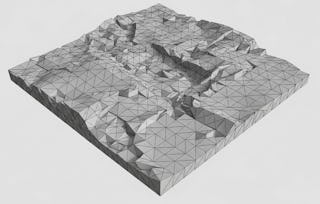
This module guides learners through the construction and refinement of procedural surfaces using Unity’s mesh manipulation and noise application systems. It covers how to generate a custom mesh grid, apply noise to create terrain-like displacement, and fine-tune results through parameters such as resolution, strength, and offset. Learners will also implement responsive update mechanisms using refresh methods, allowing real-time control and visualization of procedural changes. By the end of this module, learners will have built a flexible and adjustable system for generating dynamic surfaces in 3D space.
Das ist alles enthalten
6 Videos3 Aufgaben
Infos zu Modulinhalt anzeigen
6 Videos•Insgesamt 56 Minuten
Surface Creator•12 Minuten
Adjust Mesh Resolution•9 Minuten
Adding Some Noise•9 Minuten
Refresh Method•10 Minuten
Add Strength Variable•8 Minuten
Surface Creator Offset•8 Minuten
3 Aufgaben•Insgesamt 50 Minuten
Graded: Surface Generation and Modification•30 Minuten
Creating and Enhancing Surfaces•10 Minuten
Methods and Parameters•10 Minuten
Derivatives and Sampling
Modul 5•2 Stunden abzuschließen
Moduldetails
This module introduces the concept of sampling and derivatives in procedural noise systems to enhance visual detail and control in surface generation. Learners will explore how to extract directional information from noise fields, encapsulate both values and gradients using custom data structures, and implement static and dynamic noise samples for debugging and consistency. The module further covers how derivatives are computed for both value and Perlin noise, including the use of analytical methods to efficiently derive slope and flow characteristics in 2D and 3D spaces.
Das ist alles enthalten
6 Videos3 Aufgaben
Infos zu Modulinhalt anzeigen
6 Videos•Insgesamt 52 Minuten
Get Z Derivatives•9 Minuten
Creating Noise Sample•6 Minuten
Static Noise Sample•10 Minuten
Noise Sample Perlin•8 Minuten
Calculate Analytical Derivative•7 Minuten
Computing Derivatives in Value 2D•11 Minuten
3 Aufgaben•Insgesamt 50 Minuten
Graded: Derivatives and Sampling•30 Minuten
Working with Derivatives•10 Minuten
Perlin Sampling and Analysis•10 Minuten
Flow and Visual Output
Modul 6•2 Stunden abzuschließen
Moduldetails
This module focuses on converting procedural noise data into dynamic visual representations by integrating flow fields, derivative smoothing, and particle systems. Learners will validate noise type compatibility, smooth derivative transitions to improve surface continuity, and build flow visualization components that convey direction and intensity using visual elements. Through the use of particle trails, GameObjects, and scripting, the module teaches how to express flow dynamics in 3D environments using Unity’s rendering and scripting systems.
Das ist alles enthalten
6 Videos3 Aufgaben
Infos zu Modulinhalt anzeigen
6 Videos•Insgesamt 58 Minuten
Checking Perlin and Dimension•7 Minuten
Smooth Derivatives•7 Minuten
Create Surface Flow Component•12 Minuten
Particles Length•12 Minuten
Create Game Object•9 Minuten
Flow 3D Script•11 Minuten
3 Aufgaben•Insgesamt 50 Minuten
Graded: Flow and Visual Output•30 Minuten
Checking and Smoothing•10 Minuten
Particle and Script Integration•10 Minuten
Erwerben Sie ein Karrierezertifikat.
Fügen Sie dieses Zeugnis Ihrem LinkedIn-Profil, Lebenslauf oder CV hinzu. Teilen Sie sie in Social Media und in Ihrer Leistungsbeurteilung.
Welcome to EDUCBA, a place where knowledge is limitless! We provide a wide selection of instructive and engaging programmes designed to empower students of all ages and experiences. From the convenience of your home, start a revolutionary educational experience with our cutting-edge technologies courses and experienced instructors.
When will I have access to the lectures and assignments?
To access the course materials, assignments and to earn a Certificate, you will need to purchase the Certificate experience when you enroll in a course. You can try a Free Trial instead, or apply for Financial Aid. The course may offer 'Full Course, No Certificate' instead. This option lets you see all course materials, submit required assessments, and get a final grade. This also means that you will not be able to purchase a Certificate experience.
What will I get if I subscribe to this Specialization?
When you enroll in the course, you get access to all of the courses in the Specialization, and you earn a certificate when you complete the work. Your electronic Certificate will be added to your Accomplishments page - from there, you can print your Certificate or add it to your LinkedIn profile.
Is financial aid available?
Yes. In select learning programs, you can apply for financial aid or a scholarship if you can’t afford the enrollment fee. If fin aid or scholarship is available for your learning program selection, you’ll find a link to apply on the description page.