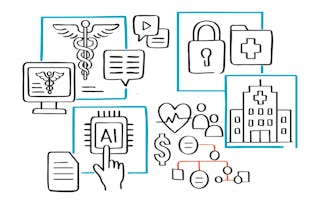
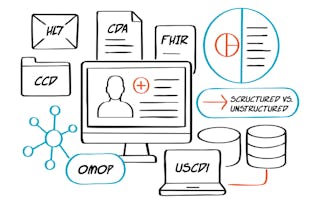
This course provides an introduction to health informatics, the discipline at the intersection of people, information, and technology in healthcare. Across four modules, it covers the transition from paper to electronic records and the distinctions among EMR, EHR, PHR, and CHR; how healthcare data is captured, organized, and stored, including database fundamentals, the components of the electronic health record, and the usability and workflow factors that determine whether systems succeed; the standards and terminologies that enable interoperability — HL7, FHIR, LOINC, SNOMED CT, ICD-10, and DICOM — along with health information exchange and information-blocking policy; and the application of informatics to clinical decision support and patient safety, telemedicine and telehealth, consumer and public health informatics, privacy and security, and artificial intelligence in healthcare.

Intro to Health Informatics and Health Information Systems
La Fête du Travail commence avec plus de 70 $ d'économies sur Coursera Plus. Bénéficiez de 40 % de réduction pendant 3 mois.

Intro to Health Informatics and Health Information Systems

Instructeur : Armando Cortez
Inclus avec En savoir plus
Obtenez un aperçu d'un sujet et apprenez les principes fondamentaux.
niveau Débutant
Aucune connaissance prérequise
1 semaine à compléter
à 10 heures par semaine
Planning flexible
Apprenez à votre propre rythme
Compétences que vous acquerrez
- Catégorie : ICD Coding (ICD-9/ICD-10)
- Catégorie : Responsible AI
- Catégorie : Healthcare Industry Knowledge
- Catégorie : Computerized Physician Order Entry
- Catégorie : Human Computer Interaction
- Catégorie : Medical Records
- Catégorie : Health Technology
- Catégorie : Informatics
- Catégorie : Health Information Management
- Catégorie : Health Care Procedure and Regulation
- Catégorie : Interoperability
- Catégorie : Health Systems
- Catégorie : Usability
- Catégorie : Electronic Medical Record
- Catégorie : Health Informatics
- Catégorie : Telehealth
- Catégorie : Health Information Management and Medical Records
- Catégorie : Health Care
- Catégorie : Clinical Informatics
Outils que vous découvrirez
- Catégorie : Electronic Medical Record System
Détails à connaître

Certificat partageable
Ajouter à votre profil LinkedIn
Récemment mis à jour !
juin 2026
Évaluations
19 devoirs
Enseigné en Anglais
Découvrez comment les employés des entreprises prestigieuses maîtrisent des compétences recherchées

Il y a 4 modules dans ce cours
Instructeur
Offert par

En savoir plus sur Health Informatics

Northeastern University

Northeastern University
Illinois Tech
Illinois Tech
Pour quelles raisons les étudiants sur Coursera nous choisissent-ils pour leur carrière ?

Felipe M.
Étudiant(e) depuis 2018
’Pouvoir suivre des cours à mon rythme à été une expérience extraordinaire. Je peux apprendre chaque fois que mon emploi du temps me le permet et en fonction de mon humeur.’

Jennifer J.
Étudiant(e) depuis 2020
’J'ai directement appliqué les concepts et les compétences que j'ai appris de mes cours à un nouveau projet passionnant au travail.’

Larry W.
Étudiant(e) depuis 2021
’Lorsque j'ai besoin de cours sur des sujets que mon université ne propose pas, Coursera est l'un des meilleurs endroits où se rendre.’

Chaitanya A.
’Apprendre, ce n'est pas seulement s'améliorer dans son travail : c'est bien plus que cela. Coursera me permet d'apprendre sans limites.’




Foire Aux Questions
Plus de questions
Aide financière disponible,