IBM

The Accelerator Landscape

IBM

The Accelerator Landscape

Included with Coursera PlusLearn more

Gain insight into a topic and learn the fundamentals.
Intermediate level

Recommended experience

3 hours to complete
Flexible schedule
Learn at your own pace
Gain insight into a topic and learn the fundamentals.
Intermediate level

Recommended experience

3 hours to complete
Flexible schedule
Learn at your own pace

What you'll learn

  • ·Explain why AI workloads benefit from domain-specific accelerators using Amdahl's law and arithmetic intensity.

  • ·Compare execution and memory models across GPU, TPU, Cerebras, Groq, and IBM Spyre.

  • ·Use a roofline model to distinguish compute-bound from memory-bound workloads.

Details to know

Shareable certificate

Add to your LinkedIn profile

Recently updated!

October 2026

Assessments

2 assignments

Taught in English

See how employees at top companies are mastering in-demand skills

 logos of Petrobras, TATA, Danone, Capgemini, P&G and L'Oreal

Build your subject-matter expertise

This course is part of the Dataflow Architectures for AI Specialization
When you enroll in this course, you'll also be enrolled in this Specialization.
  • Learn new concepts from industry experts
  • Gain a foundational understanding of a subject or tool
  • Develop job-relevant skills with hands-on projects
  • Earn a shareable career certificate

There are 7 modules in this course

This module introduces the course structure and the instructor. The course compares five accelerator architectures: NVIDIA GPUs, Google TPUs, the Cerebras Wafer-Scale Engine, the Groq LPU, and IBM Spyre. Each uses a different execution model to run the same PyTorch models. Each week examines one layer of the hardware and software stack and ends with a hands-on lab in Google Colab. Students also begin the Accelerator Landscape Map, a comparison table that is extended each week.

What's included

1 video

Since the end of Dennard scaling, single-thread processor performance has improved slowly, while the compute used to train AI models has doubled roughly every six months. This module covers the move from general-purpose processors to domain-specific hardware. It introduces Amdahl's law as a limit on acceleration, describes the properties that many AI workloads share, and defines arithmetic intensity. It then presents the roofline model, which uses arithmetic intensity to determine whether a workload is limited by compute or by memory bandwidth. The module closes by introducing the five accelerators used throughout the course.

What's included

1 video

Processors differ in when and where the next operation is selected. CPUs and GPUs select operations at runtime from an instruction stream. Many AI accelerators perform part or all of this scheduling in the compiler. This module compares instruction-driven, compiler-scheduled, and data-triggered execution. It describes the operation of a systolic array cycle by cycle and its implementation in the TPU matrix unit. The module concludes with a transformer block expressed as a dataflow graph and a comparison of the workloads suited to each execution model.

What's included

1 video

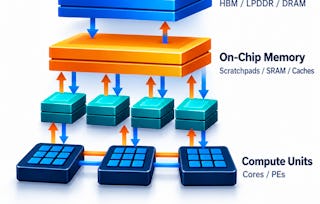
For many AI workloads, memory bandwidth and data placement limit performance more than peak compute. This module presents the memory hierarchy with measured figures from an NVIDIA H100 and traces the movement of one tensor through it. It compares hardware-managed caches with software-managed scratchpads and surveys the memory organization of all five accelerators, including the internal structure of an IBM Spyre chip. The module closes with the two phases of LLM inference, prefill and decode, and quantifies the weight traffic per generated token during small-batch decode.

What's included

1 video

Accelerator programming models range from kernel languages, which expose direct control of the hardware, to graph compilers, which provide portability across targets. This module positions CUDA, Triton, torch.compile, FX, and XLA within that range and describes the compilation path from a PyTorch model to vendor kernels. It describes the native programming model of each of the five accelerators. It then covers numeric formats such as FP8 and the conditions under which reduced precision improves performance.

What's included

1 video

This lab profiles LLM inference with Qwen 2.5 0.5B Instruct on a CPU and a GPU in Google Colab. Students build a benchmarking harness, identify the operators with the highest GPU time using PyTorch Profiler, and place the workload on a roofline for the assigned GPU. The lab concludes with the first row of the Accelerator Landscape Map. An optional Dataflow Deep Dive repeats the lab on IBM Spyre hardware for students in partnered programs.

What's included

1 assignment1 ungraded lab

This quiz covers all four modules of the course: why AI needs specialized hardware, control-flow and dataflow execution, memory hierarchies, and the path from a PyTorch model to an accelerator. It has 16 questions, including calculations with Amdahl's law, arithmetic intensity and the roofline model. Allow about 40 minutes and keep a calculator nearby. You need 80% to pass, and you can take the quiz up to 3 times. Your highest score counts.

What's included

1 assignment

Earn a career certificate

Add this credential to your LinkedIn profile, resume, or CV. Share it on social media and in your performance review.

Instructor

Kaoutar El Maghraoui
5 Courses4 learners

Offered by

IBM

Why people choose Coursera for their career

Felipe M.

Learner since 2018
"To be able to take courses at my own pace and rhythm has been an amazing experience. I can learn whenever it fits my schedule and mood."

Jennifer J.

Learner since 2020
"I directly applied the concepts and skills I learned from my courses to an exciting new project at work."

Larry W.

Learner since 2021
"When I need courses on topics that my university doesn't offer, Coursera is one of the best places to go."

Chaitanya A.

"Learning isn't just about being better at your job: it's so much more than that. Coursera allows me to learn without limits."

Frequently asked questions