When you enroll in this course, you'll also be enrolled in this Specialization.
Learn new concepts from industry experts
Gain a foundational understanding of a subject or tool
Develop job-relevant skills with hands-on projects
Earn a shareable career certificate
There are 5 modules in this course
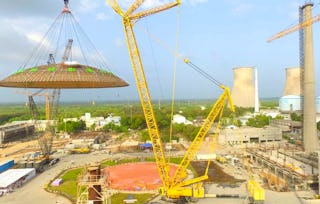
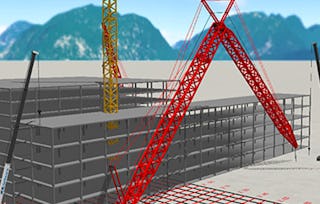
This course covers the evolution and application of heavy lifting techniques across various sectors. It starts with an introduction to the significance and engineering concepts of heavy lifts, detailing advanced machinery and sector-specific applications. Fundamental concepts of force handling, including horizontal and vertical movements, forces and equilibrium, and load estimation, are explored through case studies. The course delves into friction mechanics, mechanical advantage, reeving, and the lever principle, providing essential knowledge for load management. It introduces lifting gears, covering shackles, wire rope slings, and spreaders, and explores hydraulic systems, various jacks, and strand jacks. Real-world applications, including the installation of sky bridges and other heavy lifting scenarios, are examined to highlight the practical utility of these advanced technologies.
Target Learners:
• Undergraduate students of Civil Engineering
• Undergraduate students of Mechanical Engineering
• Post-Graduate Students in Civil and Mechanical Engineering.
• Practicing Engineers involved in heavy lifting in construction.
• Faculties in Civil and Mechanical Engineering.
• Professionals in construction industry
• Engineers and project managers involved in large projects
Prerequisites:
• Basics of Civil Engineering
• Basics of Mechanical Engineering
• Basics of Engineering Mechanics
• Understanding of Construction Techniques
This course module explores the evolution of heavy lifts, beginning with an introduction to their significance and the basic engineering concepts behind them. The module is divided into two parts, detailing these engineering applications. It then examines the machinery required for advanced lifting methods. The course further delves into sector-specific applications: heavy lifting in the power sector, hydrocarbon industry, power transmission and distribution, and the building and material handling sector. Additionally, it covers the role of heavy lifting in water and effluent treatment, as well as in the installation of statues, highlighting the broad utility of advanced lifting technologies.
What's included
11 videos1 assignment
Show info about module content
11 videos•Total 95 minutes
About the Specialization•4 minutes
About the Course•3 minutes
Evolution of heavy lifts •6 minutes
Introduction to Heavy Lifts - Application of Engineering Concepts - Part 1 •15 minutes
Application of Engineering Concepts - Part 2•11 minutes
Machines Required for Advanced Methods •15 minutes
Heavy Lifting in- Power Sector•4 minutes
Heavy Lifting in- Hydro Carbon Sector•8 minutes
Heavy Lifting in Power Transmission & Distribution Sector •6 minutes
Heavy Lifting in Buildings and Material Handling Sector •17 minutes
Heavy Lifting in Water & Effluent Treatment, Statues •7 minutes
1 assignment•Total 30 minutes
Assignment on Introduction to Heavy Lifting•30 minutes
Application of Engineering Mechanics -1
Module 2•2 hours to complete
Module details
This course module introduces the fundamental concepts of handling forces, focusing on both horizontal and vertical movements. It delves into the principles of forces and equilibrium, illustrated through case studies on the composition of forces and three-dimensional force systems. The module covers moments and couples, emphasizing their role in engineering mechanics. Additionally, it highlights the importance of accurate load estimation and understanding the center of gravity. A dedicated case study on the center of gravity further reinforces these concepts, providing practical insights and applications essential for mastering the complexities of force management in various engineering contexts.
What's included
9 videos1 assignment
Show info about module content
9 videos•Total 107 minutes
Introduction of Handling Forces- 1: Horizontal Movement •12 minutes
Introduction of Handling Forces- 2: Vertical Movement•11 minutes
Forces and Equilibrium•15 minutes
Forces and Equilibrium- Case Study - 1: Composition of Forces•17 minutes
Forces and Equilibrium- Case Study - 2: Three-Dimensional Force System•9 minutes
Moment and Couple•11 minutes
Importance of Load Estimation•9 minutes
Centre of Gravity•12 minutes
Centre of Gravity-Case Study•11 minutes
1 assignment•Total 30 minutes
Assignment on Application of Engineering Mechanics -1•30 minutes
Application of Engineering Mechanics -2
Module 3•2 hours to complete
Module details
This course module explores the fundamental concepts of sliding and rolling friction, providing a comprehensive understanding of their roles in mechanical systems. It delves into mechanical advantage in lifting and shifting systems, particularly focusing on reeving and its applications. The module also covers the lever principle, essential for understanding load distribution and manipulation. Additionally, it provides detailed guidance on calculating forces on load handling elements, split into two parts for thorough exploration. By the end of the course, learners will gain an understanding in friction mechanics and load management, crucial for efficient and safe handling operations in various engineering fields.
What's included
8 videos1 assignment
Show info about module content
8 videos•Total 99 minutes
Sliding Friction•14 minutes
Rolling Friction - 1•18 minutes
Rolling Friction - 2•11 minutes
Mechanical Advantage in Lifting and Shifting System - Reeving•10 minutes
Application of Reeving•13 minutes
Lever Principle•12 minutes
Calculating Forces on Load Handling Elements - 1•11 minutes
Calculating Forces on Load Handling Elements - 2•10 minutes
1 assignment•Total 30 minutes
Assignment on Application of Engineering Mechanics -2•30 minutes
Lifting Gears and Accessories
Module 4•2 hours to complete
Module details
This course module provides a comprehensive introduction to lifting gears and essential components used in rigging and lifting operations. It begins with an overview of shackles, exploring their types and applications. The module then covers wire rope slings in two parts, detailing their construction, configurations, and diverse applications across industries. Additionally, it delves into the specialized equipment of spreaders and lifting beams, discussing their design principles, functionalities, and practical applications through two comprehensive sections. By the end of the module, learners will have acquired fundamental knowledge and skills necessary for the safe and effective use of lifting gears in various lifting and rigging scenarios.
What's included
8 videos1 assignment
Show info about module content
8 videos•Total 108 minutes
Introduction to Lifting Gears•8 minutes
Shackles•8 minutes
Wire Rope Slings-1•11 minutes
Wire Rope Slings-2•18 minutes
Different Application of Wire Ropes-1•18 minutes
Different Application of Wire Ropes-2•15 minutes
Spreader/Lifting Beam-1•16 minutes
Spreader/Lifting Beam-2 •13 minutes
1 assignment•Total 30 minutes
Assignment on Lifting Gears and Accessories•30 minutes
Applications of Hydraulics
Module 5•2 hours to complete
Module details
This course module covers hydraulic systems and their basic components, providing a fundamental understanding essential for advanced applications. It explores various types of jacks and their specific applications, including special types used in unique lifting scenarios. The module introduces the principles of strand jacks, detailing their control systems and the advantages of computerized control. It further examines the application of strand jacks in lifting and installing sky bridges, showcasing their precision and reliability. Finally, it discusses real-world applications of strand jacks in heavy lifting contexts, highlighting their efficiency and versatility in modern engineering projects requiring precise and controlled lifting operations.
What's included
10 videos1 assignment
Show info about module content
10 videos•Total 118 minutes
Hydraulic Systems and Basic Components•15 minutes
Types of Jacks & applications•7 minutes
Special Types of Jacks and Applications•14 minutes
Basic Principles of Strand Jack•15 minutes
Strand Jack Control Systems•11 minutes
Advantages of Computer Control in Strand Jack System•8 minutes
Strand Jacks used for Lifting and Installation of Sky Bridges•2 minutes
Application of Strand Jacks for Heavy Lifts -1•16 minutes
Application of Strand Jacks for Heavy Lifts - 2•14 minutes
Application of Strand Jacks for heavy lifts - 3•16 minutes
1 assignment•Total 30 minutes
Assignment on Applications of Hydraulics•30 minutes
Earn a career certificate
Add this credential to your LinkedIn profile, resume, or CV. Share it on social media and in your performance review.
Larsen & Toubro popularly known as L&T is an Indian Multinational conglomerate. L&T has over 8 decades of expertise in executing some of the most complex projects including the World's tallest statue - the Statue of Unity. L&T has a wide portfolio that includes engineering, construction, manufacturing, realty, ship building, defense, aerospace, IT & financial services. L&T EduTech is a e learning platform within the L&T Group, that offers courses that are curated & delivered by industry experts.
In the world of engineering and technology, change and advancements are happening at the speed of light. Academia needs to keep pace with this change and career professionals need to adapt. This is the need gap L&T EduTech will fill. The vision for L&T EduTech is to be the bridge between academia and industry, between career professionals and ever-changing technology. L&T EduTech firmly believes that, only when these need gaps are filled, will we have truly empowered and knowledgeable workforce that will lead India in the future.
OK
Explore more from Environmental Science and Sustainability
When will I have access to the lectures and assignments?
To access the course materials, assignments and to earn a Certificate, you will need to purchase the Certificate experience when you enroll in a course. You can try a Free Trial instead, or apply for Financial Aid. The course may offer 'Full Course, No Certificate' instead. This option lets you see all course materials, submit required assessments, and get a final grade. This also means that you will not be able to purchase a Certificate experience.
What will I get if I subscribe to this Specialization?
When you enroll in the course, you get access to all of the courses in the Specialization, and you earn a certificate when you complete the work. Your electronic Certificate will be added to your Accomplishments page - from there, you can print your Certificate or add it to your LinkedIn profile.
Is financial aid available?
Yes. In select learning programs, you can apply for financial aid or a scholarship if you can’t afford the enrollment fee. If fin aid or scholarship is available for your learning program selection, you’ll find a link to apply on the description page.