Fine-tuning
Filter by
SubjectRequired
LanguageRequired
Learning ProductRequired
LevelRequired
DurationRequired
SubtitlesRequired
EducatorRequired
Hands-on LearningRequired
ToolsRequired
Results for "Fine-tuning"

Duke University
Skills you'll gain: Fine-tuning, MLOps (Machine Learning Operations), Model Deployment, Cloud Deployment, Pandas (Python Package), AWS SageMaker, NumPy, Microsoft Azure, Hugging Face, GitHub Copilot, Unit Testing, Data Engineering, DevOps, Cloud Computing, Python Programming, Machine Learning, GitHub, Big Data, Data Management, Data Analysis
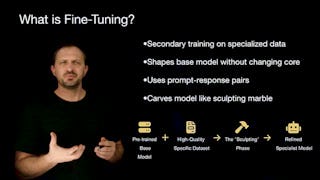
University of Colorado Boulder
From the course: Modern Applications of Generative AI·Lesson: Untitled Lesson
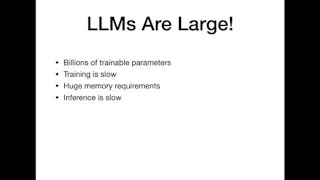
University of Colorado Boulder
From the course: Deep Learning for Natural Language Processing·Lesson: Large Language Models and How to Use Them
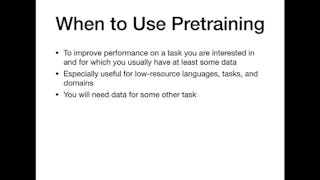
University of Colorado Boulder
From the course: Deep Learning for Natural Language Processing·Lesson: Pretraining, Finetuning, and Popular Pretrained Models

Duke University
From the course: Virtualization, Docker, and Kubernetes for Data Engineering·Lesson: Using Cloud Development Environments With GitHub
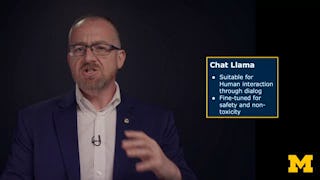
University of Michigan
From the course: Llama for Python Programmers·Lesson: Introduction to Llama 2: A High Quality Open Source Large Language Model

Duke University
From the course: Data Engineering with Rust·Lesson: Using Rust and Python for LLMs, ONNX, Hugging Face, and PyTorch Pipelines

Duke University
From the course: MLOps Tools: MLflow and Hugging Face·Lesson: Fine-Tuning and ONNX Exporting

Duke University
From the course: MLOps Tools: MLflow and Hugging Face

University of Colorado Boulder
Skills you'll gain: Generative AI, Generative AI Agents, Generative Model Architectures, Prompt Patterns, Prompt Engineering, AI literacy, Retrieval-Augmented Generation, Tool Calling, AI powered creativity, Responsible AI, AI Workflows, Model Evaluation, Context Engineering, Model Training, Agentic systems, Fine-tuning
University of Colorado Boulder
Skills you'll gain: Recurrent Neural Networks (RNNs), Generative AI, Fine-tuning, Model Training, Vision Transformer (ViT), Model Optimization, Large Language Modeling, Embeddings, Network Architecture

Duke University
From the course: Data Engineering with Rust·Lesson: Using Rust and Python for LLMs, ONNX, Hugging Face, and PyTorch Pipelines