Human Factors (Security)
Filter by
SubjectRequired
LanguageRequired
Learning ProductRequired
LevelRequired
DurationRequired
SubtitlesRequired
EducatorRequired
Hands-on LearningRequired
ToolsRequired
Results for "Human Factors (Security)"

University of Maryland, College Park
Skills you'll gain: Human Factors (Security), Usability, Human Computer Interaction, Authentications, Security Engineering, Usability Testing, Interaction Design, User Interface (UI), Human Factors, Information Privacy, Cybersecurity, Personally Identifiable Information, User Interface (UI) Design, Multi-Factor Authentication, User Centered Design, Design

From the course: AI for Cybersecurity·Lesson: Fundamentals of Cybersecurity

Macquarie University
Skills you'll gain: Cyber Governance, Safety Culture, Cyber Risk, Security Awareness, Human Factors (Security), Cyber Attacks, Dashboard, Computer Security Awareness Training, Cyber Threat Intelligence, Mobile Security, Cyber Security Strategy, Communication, Cybersecurity, Cyber Operations, Strategic Leadership, Leadership and Management, Leadership, Leadership Development, Organizational Leadership, Team Leadership
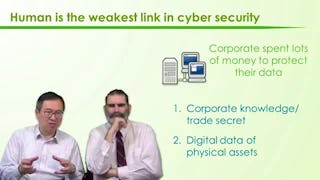
The Hong Kong University of Science and Technology
From the course: FinTech Security and Regulation (RegTech)·Lesson: Cybersecurity in FinTech
EC-Council
From the course: Information Security Fundamentals·Lesson: The Weakest Link and Security Awareness Training

Skills you'll gain: Identity and Access Management, Application Security, Enterprise Security, Threat Modeling, Security Management, DevSecOps, Security Strategy, Security Controls, Authentications, Cloud Security, Cybersecurity, Information Systems Security, Human Factors (Security), Security Software, Cryptographic Protocols, Security Testing, Cloud Management, Secure Coding, Governance, Business

Minnesota State University, Mankato
Skills you'll gain: Incident Response, Computer Security Incident Management, Cyber Security Strategy, Cybersecurity, Incident Management, Security Management, Cyber Attacks, Cyber Security Policies, Threat Management, Safety Culture, Cyber Security Assessment, Security Awareness, Computer Security, Threat Detection, Personally Identifiable Information, Cyber Risk, Crisis Management, Human Factors (Security), Policy Development, Employee Training

Royal Holloway, University of London
Skills you'll gain: Linux, Network Security, Cyber Governance, IT Security Architecture, OSI Models, Incident Management, Computer Security Incident Management, Incident Response, Security Management, Linux Commands, TCP/IP, Computer Systems, Threat Modeling, Command-Line Interface, Network Protocols, Computer Networking, Cybersecurity, Human Factors (Security), Cyber Threat Intelligence, Cyber Attacks

Skills you'll gain: AI Security, Security Engineering, Hardening, Agentic Workflows, AI Integrations, Application Security, DevSecOps, IT Security Architecture, Agentic systems, Responsible AI, Secure Coding, Security Controls, Threat Modeling, Human Factors (Security), Cybersecurity, Generative AI Agents, Continuous Monitoring, Security Awareness, Artificial Intelligence, Authorization (Computing)

Johns Hopkins University
From the course: Point of Care Testing for Sexually Transmitted Infections·Lesson: Untitled Lesson

From the course: Microsoft Cybersecurity Architect - SC-100 Exam Prep·Lesson: Advanced Security Best Practices in Azure Infrastructure

Skills you'll gain: Human Factors (Security), User Experience Design, Usability, User Experience, Threat Modeling, UI/UX Strategy, Application Security, Authentications, UI/UX Research, Human Centered Design, Security Strategy, User Story, Security Controls, Design Research, Multi-Factor Authentication, Security Awareness, Identity and Access Management, Cybersecurity, Safety Standards, Information Privacy