Pseudocode
Filter by
SubjectRequired
LanguageRequired
Learning ProductRequired
LevelRequired
DurationRequired
SubtitlesRequired
EducatorRequired
Hands-on LearningRequired
ToolsRequired
Results for "Pseudocode"

University of London
Skills you'll gain: Pseudocode, Algorithms, Computer Science, Data Structures, Diagram Design

Skills you'll gain: Pseudocode, Programming Principles, Program Development, Software Visualization, Computational Logic, Process Modeling, Diagram Design, Computer Programming Tools, Code Reusability, Computer Programming, Maintainability, Software Documentation, Software Installation
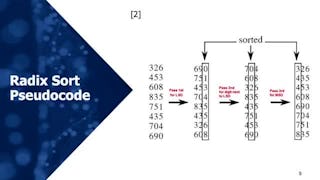
Johns Hopkins University
From the course: CUDA at Scale for the Enterprise·Lesson: CUDA Best Practices in Algorithm and Kernel Design
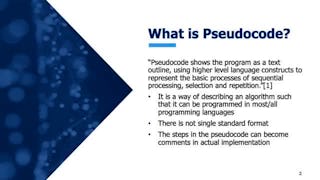
Johns Hopkins University
From the course: CUDA at Scale for the Enterprise·Lesson: Determining Sorting Algorithm Pseudocode
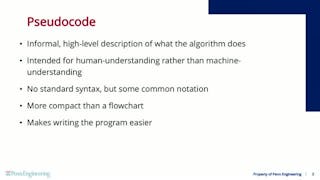
University of Pennsylvania
From the course: Computational Thinking for Problem Solving·Lesson: 3.5 Expressing Algorithms in Pseudocode

Skills you'll gain: Data Structures, Algorithms, Software Visualization, Pseudocode, Computational Thinking, Theoretical Computer Science, Computer Science, Technical Communication, Graph Theory, Communication

University of London
From the course: Problems, Algorithms and Flowcharts·Lesson: Pseudocode

University of London
From the course: Problems, Algorithms and Flowcharts·Lesson: Pseudocode

From the course: SQL Foundations·Lesson: Lesson 3: Exploring Tables and Their Structures

From the course: Shell Programming Essentials·Lesson: Interaction with Unix OS

University of London
From the course: Problems, Algorithms and Flowcharts·Lesson: Flowcharts to pseudocode

From the course: Foundations of Coding Back-End·Lesson: Coding for Simple Problem-Solving