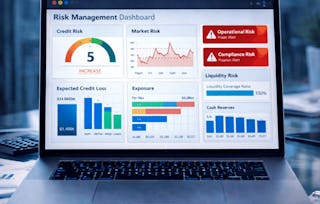
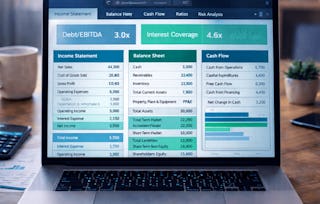
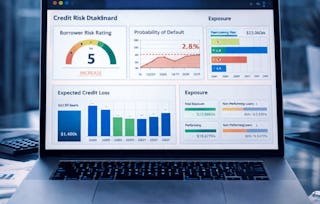
Master the ability to analyze, measure, and manage counterparty credit risk in modern financial markets. By the end of this course, learners will evaluate derivative exposures, calculate expected and unexpected losses, apply CVA adjustments, assess wrong way and gap risk, and interpret Basel regulatory capital frameworks.

Analyze & Manage Counterparty Credit Risk

Analyze & Manage Counterparty Credit Risk
This course is part of Advanced Credit Risk & Banking Analytics Specialization

Instructor: EDUCBA
Access provided by Coursera for Community Guides
Gain insight into a topic and learn the fundamentals.
13 reviews
2 weeks to complete
at 10 hours a week
Flexible schedule
Learn at your own pace
What you'll learn
Analyze counterparty credit risk and derivative exposure metrics (EE, EPE, PFE).
Apply CVA, VaR, and Monte Carlo methods for risk measurement.
Evaluate Basel frameworks, collateral, and CCP risk management practices.
Details to know

Shareable certificate
Add to your LinkedIn profile
Assessments
35 assignments
Taught in English
Recently updated!
April 2026
See how employees at top companies are mastering in-demand skills

Build your subject-matter expertise
This course is part of the Advanced Credit Risk & Banking Analytics Specialization
When you enroll in this course, you'll also be enrolled in this Specialization.
- Learn new concepts from industry experts
- Gain a foundational understanding of a subject or tool
- Develop job-relevant skills with hands-on projects
- Earn a shareable career certificate


Why people choose Coursera for their career

Felipe M.
Learner since 2018
"To be able to take courses at my own pace and rhythm has been an amazing experience. I can learn whenever it fits my schedule and mood."

Jennifer J.
Learner since 2020
"I directly applied the concepts and skills I learned from my courses to an exciting new project at work."

Larry W.
Learner since 2021
"When I need courses on topics that my university doesn't offer, Coursera is one of the best places to go."

Chaitanya A.
"Learning isn't just about being better at your job: it's so much more than that. Coursera allows me to learn without limits."
Learner reviews
- 5 stars
76.92%
- 4 stars
0%
- 3 stars
0%
- 2 stars
15.38%
- 1 star
7.69%
Showing 3 of 13
AG
5.0
Reviewed on May 5, 2026
Content progression is smooth, moving from fundamentals to more detailed concepts without confusion.
AB
5.0
Reviewed on Apr 23, 2026
Gives a good overview of how financial institutions monitor and control risk in practice.
NJ
5.0
Reviewed on May 9, 2026
A few sections could have included more real-world case studies for deeper understanding.