SS
4.0Reviewed Feb 9, 2026
A professionally designed course that delivers real value. Bayesian concepts are explained clearly, and the Excel-to-Python A/B testing workflow feels intuitive and industry-relevant.

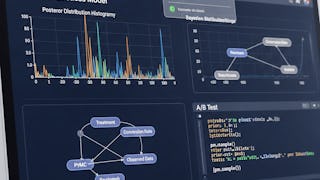
By the end of this course, learners will be able to apply Bayesian statistics for decision-making in both business and healthcare contexts, implement probabilistic models in Excel, and perform advanced A/B and multi-variant testing using Python. The course begins with a hands-on introduction to Bayesian reasoning in Excel, where you will learn to structure datasets, calculate joint and conditional probabilities, and update prior probabilities with real-world healthcare examples. You will practice building Bayesian probability tables, interpreting repeated test outcomes, and analyzing predictive performance for evidence-based decision-making. Next, the course transitions into computational Bayesian statistics with Python. You will gain practical experience with Markov Chain Monte Carlo (MCMC) sampling, approximate posterior distributions using PyMC, and explore hierarchical models for A/B and multi-variant testing. What sets this course apart is its dual approach: simple Excel-based foundations for immediate application, followed by advanced Python implementations for scalable experimentation and machine learning integration.
SS
A professionally designed course that delivers real value. Bayesian concepts are explained clearly, and the Excel-to-Python A/B testing workflow feels intuitive and industry-relevant.
JA
A transformative course for analysts seeking modern experimentation techniques. Bayesian thinking feels intuitive after this training.
HS
It transforms complex Bayesian ideas into actionable insights and smoothly guides learners from spreadsheet analysis to Python-based experimentation.
SD
The transition into Python for hierarchical modeling is exactly what is needed for modern, scalable healthcare data science projects.
IG
Rarely do you find a course that balances theory and practice so well. The progression from Excel tables to PyMC models is seamless, perfect for analysts upskilling in Bayesian statistics
BP
The course replaces confusing theory with actionable Python code, making Bayesian methods accessible to anyone comfortable with basic Excel formulas.
KK
A must-have for anyone aiming for a Data Scientist role. The ability to code Bayesian models in Python is a high-demand skill that sets you apart from the competition.
DS
The explanations are clear, and the hands-on examples make the concepts easy to apply. The Excel-to-Python transition is especially well designed.
RF
One of the best courses for understanding Bayesian statistics practically. The Excel-to-Python journey enhances clarity and builds analytical confidence.
PS
The instructor explains complex ideas in a straightforward way. This course truly elevates experimentation skills.
KN
The transition from spreadsheets to Python coding is seamless, making Bayesian A/B testing accessible and highly practical.
RP
Mastering Bayesian methods here gave me the edge in my senior analyst interview. The focus on real-world uncertainty is a game-changer for business strategy.
Showing: 20 of 27
This course makes Bayesian analysis approachable and practical. From spreadsheet calculations to Python automation, everything is explained with clarity and precision. It significantly improved my confidence in running data-driven experiments and interpreting results professionally.
It combines conceptual clarity with hands-on implementation. The Bayesian approach to A/B testing is presented in a practical, decision-focused way. Transitioning from Excel to Python was seamless and empowering for real-world analytics applications.
I particularly enjoyed the structured explanation of prior and posterior probabilities. The Excel exercises are beginner-friendly, and the Python section is well-paced. A highly recommended course for experimentation and analytics professionals.
A very structured and insightful course on Bayesian A/B testing. The progression from Excel modeling to Python implementation is smooth and logical. It strengthened my understanding of uncertainty, priors, and posterior analysis effectively.
I was intimidated by Bayesian math, but the step-by-step progression from Excel to Python was genius. I now confidently build A/B testing models that provide actionable business insights rather than just confusing p-values.
A thoughtfully designed course that simplifies probability concepts and applies them to experimentation. The practical focus ensures you can immediately implement Bayesian A/B testing strategies in business contexts.
One of the best courses for understanding Bayesian statistics in a business context. The structured path from Excel to Python coding builds confidence. The A/B testing lessons are practical and industry-relevant.
Rarely do you find a course that balances theory and practice so well. The progression from Excel tables to PyMC models is seamless, perfect for analysts upskilling in Bayesian statistics
A must-have for anyone aiming for a Data Scientist role. The ability to code Bayesian models in Python is a high-demand skill that sets you apart from the competition.
Perfect course for analysts wanting to learn Bayesian methods. The examples using Excel and Python helped reinforce concepts and made complex topics easier to grasp.
One of the best courses for understanding Bayesian statistics practically. The Excel-to-Python journey enhances clarity and builds analytical confidence.
The course replaces confusing theory with actionable Python code, making Bayesian methods accessible to anyone comfortable with basic Excel formulas.
The explanations are clear, and the hands-on examples make the concepts easy to apply. The Excel-to-Python transition is especially well designed.
The instructor explains complex ideas in a straightforward way. This course truly elevates experimentation skills.
A perfect blend of statistical theory and practical coding. The Bayesian approach is explained in a way that feels intuitive. Excel examples clarify concepts, and Python implementation enhances real-world usability. Great investment for career growth.
The instructor simplifies Bayesian thinking without oversimplifying the math. I loved the structured exercises and real-world A/B testing case studies. Moving from Excel models to Python code felt smooth and rewarding.
I appreciated the clear progression from spreadsheet intuition to Python automation. The course demystifies Bayesian inference and makes A/B testing more strategic and data-driven rather than guesswork-based.
A professionally designed course that delivers real value. Bayesian concepts are explained clearly, and the Excel-to-Python A/B testing workflow feels intuitive and industry-relevant.
An impressive course that balances theory and application, empowering learners to confidently perform Bayesian A/B testing from spreadsheets to Python scripts.
Mastering Bayesian methods here gave me the edge in my senior analyst interview. The focus on real-world uncertainty is a game-changer for business strategy.