NLP Courses
NLP courses can help you learn text processing, sentiment analysis, language modeling, and chatbot development. You can build skills in data preprocessing, feature extraction, and evaluating model performance. Many courses introduce tools like Python libraries such as NLTK and spaCy, as well as frameworks like TensorFlow and PyTorch, that support implementing NLP techniques and developing applications that utilize artificial intelligence.
Popular NLP Courses and Certifications

DeepLearning.AI
Skills you'll gain: Natural Language Processing, Supervised Learning, Transfer Learning, Recurrent Neural Networks (RNNs), Markov Model, Embeddings, Applied Machine Learning, Dimensionality Reduction, Large Language Modeling, Text Mining, Statistical Machine Learning, Artificial Neural Networks, Classification Algorithms, Data Preprocessing, Deep Learning, Tensorflow, Machine Learning Methods, Logistic Regression, Feature Engineering, Keras (Neural Network Library)

Skills you'll gain: PyTorch (Machine Learning Library), Large Language Modeling, Embeddings, Generative AI, Natural Language Processing, Generative Model Architectures, Transfer Learning, Model Optimization, Responsible AI, Data Ethics, Text Mining, Model Training, Artificial Neural Networks, Classification Algorithms, Model Evaluation, Feature Engineering
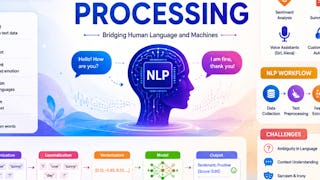
Birla Institute of Technology & Science, Pilani
Skills you'll gain: Natural Language Processing, Large Language Modeling, Embeddings, Text Mining, Semantic Web, Data Preprocessing, LLM Application, Artificial Intelligence and Machine Learning (AI/ML), ChatGPT, Data Processing, Artificial Intelligence, Artificial Neural Networks, Statistical Machine Learning, Generative AI, Deep Learning, Model Training, Dependency Analysis, Model Evaluation

Skills you'll gain: Pandas (Python Package), Matplotlib, NumPy, Embeddings, Statistical Visualization, Machine Learning Algorithms, Natural Language Processing, Applied Machine Learning, Data Manipulation, Pivot Tables And Charts, Model Optimization, Machine Learning Methods, Linear Algebra, Deep Learning, Text Mining, Unstructured Data, Classification Algorithms, Markov Model, Data Preprocessing, Python Programming
Skills you'll gain: Natural Language Processing, Large Language Modeling, Fine-tuning, Model Evaluation, Recurrent Neural Networks (RNNs), Data Ethics, Responsible AI, Text Mining, Transfer Learning, PyTorch (Machine Learning Library), Artificial Neural Networks, Data Preprocessing, Artificial Intelligence and Machine Learning (AI/ML), Deep Learning, Classification Algorithms, Applied Machine Learning, Data Processing, Machine Learning, Data Analysis, Data Cleansing

What brings you to Coursera today?

Skills you'll gain: Prompt Engineering, Prompt Patterns, Unit Testing, Large Language Modeling, LangChain, Generative AI, Retrieval-Augmented Generation, Data Wrangling, Responsible AI, Exploratory Data Analysis, Unsupervised Learning, Model Evaluation, Generative Model Architectures, PyTorch (Machine Learning Library), LLM Application, Keras (Neural Network Library), Supervised Learning, Vector Databases, Fine-tuning, Data Import/Export
Skills you'll gain: Natural Language Processing, Supervised Learning, Embeddings, Dimensionality Reduction, Machine Learning Methods, Text Mining, Statistical Machine Learning, Classification Algorithms, Logistic Regression, Feature Engineering

Skills you'll gain: Fine-tuning, Vision Transformer (ViT), Prompt Engineering, PyTorch (Machine Learning Library), Model Deployment, Transfer Learning, Hugging Face, Natural Language Processing, MLOps (Machine Learning Operations), Large Language Modeling, Cloud Deployment, Computer Vision, Generative AI, Image Analysis, Generative Model Architectures, LLM Application, Application Deployment, Model Training, Embeddings, Data Preprocessing
Skills you'll gain: Responsible AI, Machine Learning Methods, Generative AI Agents, Generative AI, Generative Model Architectures, Prompt Engineering Tools, AI literacy, AI Enablement, Risking, Retrieval-Augmented Generation, LLM Application, AI powered creativity, AI Workflows, Agentic systems, Agentic Workflows, Natural Language Processing
Google Cloud
Skills you'll gain: Natural Language Processing, Large Language Modeling, Transfer Learning, Tensorflow, Google Cloud Platform, Keras (Neural Network Library), Recurrent Neural Networks (RNNs), Embeddings, Deep Learning, AI Workflows, Artificial Neural Networks, Cloud API, Feature Engineering, Model Training
Skills you'll gain: Data Preprocessing, Classification Algorithms, Applied Machine Learning, Embeddings, Machine Learning Methods, Model Evaluation, Dependency Analysis

Skills you'll gain: Prompt Engineering, Apache Spark, Large Language Modeling, Retrieval-Augmented Generation, PyTorch (Machine Learning Library), Computer Vision, Unsupervised Learning, Generative Model Architectures, Prompt Patterns, Generative AI, PySpark, Model Optimization, Keras (Neural Network Library), Supervised Learning, LLM Application, Vector Databases, Fine-tuning, Machine Learning, Python Programming, Data Science
What brings you to Coursera today?
Best Nlp courses from IBM
Top-rated Nlp courses offered by IBM on Coursera.
- Gen AI Foundational Models for NLP & Language UnderstandingIBMIntermediate1 - 4 WeeksIBM
- IBM Generative AI EngineeringIBMBeginner3 - 6 MonthsIBM
- Introduction to Artificial Intelligence (AI)IBMBeginner1 - 4 WeeksIBM
Best Nlp certificate programs
Earn a certificate in Nlp from top universities and companies.
- Natural Language ProcessingDeepLearning.AIIntermediate3 - 6 MonthsSpecialization
- Natural Language Processing with Real-World ProjectsPacktBeginner3 - 6 MonthsSpecialization
- Mastering NLP: Tokenization, Sentiment Analysis & Neural MTEdurekaIntermediate3 - 6 MonthsSpecialization










