Taipei Medical University

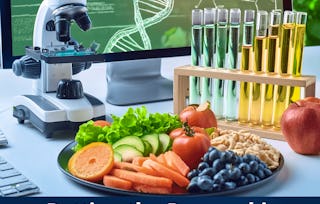
The Development and Application of Functional Foods

Zum Labor Day gibt es bei Coursera Plus Rabatte von über 70 $. Sparen Sie 3 Monate lang 40 %.

kurs ist nicht verfügbar in Deutsch (Deutschland)

Wir übersetzen es in weitere Sprachen.
Taipei Medical University

The Development and Application of Functional Foods

Kuan-Hung Lu

Dozent: Kuan-Hung Lu

Bei Coursera PlusMehr erfahren enthalten

Verschaffen Sie sich einen Einblick in ein Thema und lernen Sie die Grundlagen.
Stufe Anfänger

Empfohlene Erfahrung

9 Stunden zu vervollständigen
Flexibler Zeitplan
In Ihrem eigenen Lerntempo lernen
Verschaffen Sie sich einen Einblick in ein Thema und lernen Sie die Grundlagen.
Stufe Anfänger

Empfohlene Erfahrung

9 Stunden zu vervollständigen
Flexibler Zeitplan
In Ihrem eigenen Lerntempo lernen

Was Sie lernen werden

  • Define functional foods and distinguish them from dietary supplements and nutraceuticals.

  • Explain how fermentation improves food quality and identify factors shaping microbial communities.

  • Apply gut immunity and extraction principles to evaluate functional food design and applications.

Kompetenzen, die Sie erwerben

  • Kategorie: Health Assessment
  • Kategorie: Food Safety and Sanitation
  • Kategorie: Microbiology
  • Kategorie: Immunology
  • Kategorie: Nutrition Education
  • Kategorie: Clinical Nutrition
  • Kategorie: Chronic Diseases
  • Kategorie: Food Quality Assurance And Control
  • Kategorie: Environment
  • Kategorie: Biology
  • Kategorie: Sustainable Systems
  • Kategorie: Biochemistry
  • Kategorie: Scientific Methods
  • Kategorie: Pharmacology
  • Kategorie: Medical Science and Research
  • Kategorie: Nutrition and Diet
  • Kategorie: Good Manufacturing Practices
  • Kategorie: Nutritional Assessment
  • Kategorie: Regulatory Compliance
  • Kategorie: Life Sciences

Wichtige Details

Zertifikat zur Vorlage

Zu Ihrem LinkedIn-Profil hinzufügen

Kürzlich aktualisiert!

September 2026

Bewertungen

6 Aufgaben

Unterrichtet in Englisch

Erfahren Sie, wie Mitarbeiter führender Unternehmen gefragte Kompetenzen erwerben.

 Logos von Petrobras, TATA, Danone, Capgemini, P&G und L'Oreal

In diesem Kurs gibt es 4 Module

This module introduces the concept and development of functional foods. Learners will explore what functional foods are, how the term originated in Japan in 1984 with the creation of Food for Specific Health Uses (FOSHU), and how functional foods differ from dietary supplements. The module explains why functional foods act as a bridge between everyday nutrition and pharmaceutical treatment, and why they are gaining growing attention worldwide, driven by factors such as preventive healthcare trends and consumer preference for natural solutions. Finally, learners will be introduced to the functional food development cycle, a structured four-stage approach covering definition, design, evaluation, and market development.

Das ist alles enthalten

5 Videos3 Lektüren2 Aufgaben1 Diskussionsthema

This module introduces the science of designing functional foods through fermentation. You will explore what defines functional foods and fermented foods, the historical and evolutionary role of fermentation, and how it improves flavor, preservation, detoxification, and nutritional value. You will then examine the fundamentals of mucosal immunity, including the gut's immune barriers and secretory IgA, and see how these concepts guide real research on fermented by-products like wheat bran and rice bran to support gut health.

Das ist alles enthalten

9 Videos3 Lektüren1 Aufgabe2 Diskussionsthemen

This module introduces the fundamentals of functional and fermented foods through the "Microbial Upgrade" model — picturing fermentation as microbes running a small factory that transforms raw, low-value ingredients into more valuable products. The module covers why fermentation is used, including improved flavor, preservation, detoxification, and nutritional value, followed by the ecological factors that shape microbial communities during fermentation. Two case studies then demonstrate the model in action: fermented wheat bran, shown to raise levels of bioactive compounds and protect against intestinal inflammation, and dual-fermented rice bran, shown to improve glucose and insulin metabolism in a diabetes model. By the end of this module, learners will understand how fermentation transforms food matrices and how these transformations translate into functional health benefits.

Das ist alles enthalten

7 Videos2 Lektüren1 Aufgabe1 Diskussionsthema

This module introduces the concept of turning agricultural waste into functional ingredients using "The Recycling Bin Model" — the idea that discarded material can be sorted, refined, and repurposed into something valuable. Using adlay (Job's tears) hull and testa as the central case study, this module explains how solvent partitioning is used to isolate bioactive compounds from waste, and how these extracts are then tested for real physiological effects — particularly in uterine leiomyoma, dysmenorrhea, and polycystic ovary syndrome (PCOS). By the end of this module, learners will understand how agricultural by-products can be scientifically evaluated and applied as functional ingredients for women's health.

Das ist alles enthalten

6 Videos2 Lektüren2 Aufgaben2 Diskussionsthemen

Dozent

Kuan-Hung Lu
Taipei Medical University
1 Kurs46 Lernende

Mehr von Nutrition entdecken

Warum entscheiden sich Menschen für Coursera für ihre Karriere?

Felipe M.

Lernender seit 2018
„Es ist eine großartige Erfahrung, in meinem eigenen Tempo zu lernen. Ich kann lernen, wenn ich Zeit und Nerven dazu habe.“

Jennifer J.

Lernender seit 2020
„Bei einem spannenden neuen Projekt konnte ich die neuen Kenntnisse und Kompetenzen aus den Kursen direkt bei der Arbeit anwenden.“

Larry W.

Lernender seit 2021
„Wenn mir Kurse zu Themen fehlen, die meine Universität nicht anbietet, ist Coursera mit die beste Alternative.“

Chaitanya A.

„Man lernt nicht nur, um bei der Arbeit besser zu werden. Es geht noch um viel mehr. Bei Coursera kann ich ohne Grenzen lernen.“


Häufig gestellte Fragen