Anatomy of the Head and Spine is the part of a series of courses from Yale covering the anatomy of the entire body as well as the fundamentals of diagnostic imaging. It provides an in-depth exploration of the anatomical structures of the head and spine through a combination of theoretical instruction and virtual laboratory dissections.

Anatomy of the Head and Spine
La Fête du Travail commence avec plus de 70 $ d'économies sur Coursera Plus. Bénéficiez de 40 % de réduction pendant 3 mois.

Anatomy of the Head and Spine


Instructeurs : Shanta Kapadia
9 803 déjà inscrits
Inclus avec En savoir plus
Demander à Coursera
Obtenez un aperçu d'un sujet et apprenez les principes fondamentaux.
46 avis
niveau Débutant
Expérience recommandée
2 semaines à compléter
à 10 heures par semaine
Planning flexible
Apprenez à votre propre rythme
Ce que vous apprendrez
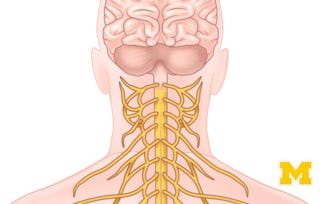
This course covers the spine, spinal cord, vertebrae, skull, cranial nerves, brain, vasculature, CSF pathways, skull base, sinuses, oral and airway.
Détails à connaître

Certificat partageable
Ajouter à votre profil LinkedIn
Évaluations
6 devoirs
Enseigné en Anglais
Découvrez comment les employés des entreprises prestigieuses maîtrisent des compétences recherchées

Il y a 6 modules dans ce cours
Instructeurs
Évaluations de l’enseignant
(15 évaluations)Offert par

En savoir plus sur Basic Science
University of Michigan
Yale University
Yale University
Pour quelles raisons les étudiants sur Coursera nous choisissent-ils pour leur carrière ?

Felipe M.
Étudiant(e) depuis 2018
’Pouvoir suivre des cours à mon rythme à été une expérience extraordinaire. Je peux apprendre chaque fois que mon emploi du temps me le permet et en fonction de mon humeur.’

Jennifer J.
Étudiant(e) depuis 2020
’J'ai directement appliqué les concepts et les compétences que j'ai appris de mes cours à un nouveau projet passionnant au travail.’

Larry W.
Étudiant(e) depuis 2021
’Lorsque j'ai besoin de cours sur des sujets que mon université ne propose pas, Coursera est l'un des meilleurs endroits où se rendre.’

Chaitanya A.
’Apprendre, ce n'est pas seulement s'améliorer dans son travail : c'est bien plus que cela. Coursera me permet d'apprendre sans limites.’
Avis des étudiants
- 5 stars
91,30 %
- 4 stars
6,52 %
- 3 stars
0 %
- 2 stars
0 %
- 1 star
2,17 %
Affichage de 3 sur 46
GC
Révisé le 23 juil. 2025
Good introduction to anatomy as a high school student:)
IY
Révisé le 11 mars 2025
I really liked the course! Very interesting, informative, detailed for my level of knowledge.
SV
Révisé le 24 juin 2025
Very comprehensive introductory course, lots of new terms




Foire Aux Questions
Plus de questions
Aide financière disponible,