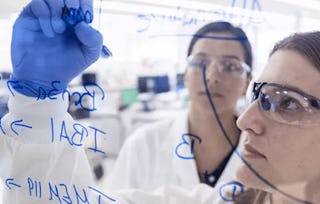
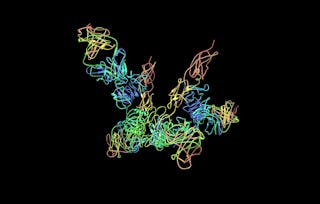
What does it take to advance a new drug from the laboratory bench to the patient’s bedside? Historically, drugs were discovered serendipitously and were usually isolated from natural sources. Today, drug discovery efforts take many years and cost hundreds of millions of dollars. They also require the input of dozens of specialists from a multitude of backgrounds to ensure that therapeutic molecules are efficacious and safe.
This four-week course takes a high-level tour of what it takes to research and develop a new drug. We will meet different scientists and professionals across the drug discovery value chain as we explore the different stages of discovery and development, including the different tools and technologies that are influencing how we think about new medicines today.
Starting off with the needs of the patient and the early phases of drug discovery, we will cover drug metabolism, pharmacokinetics and drug safety all the way to clinical development and beyond. This course is relevant for scientists who are new to drug discovery research or already have some experience, health professionals, or anyone who is interested in knowing what had to happen to ensure that their medicine is effective and safe.
This week covers an introduction to the drug discovery and development process. It starts off by considering the patient, as the ultimate beneficiary of new and improved drugs, to ensure that they are kept at the centre of and integrated into all subsequent decision-making. Through a case study, the concept of an unmet medical need is introduced and provides a backdrop for understanding further critical concepts which underlie drug discovery and development. An overview of various drug discovery strategies is presented, along with approaches to screening and hit discovery. Various scientific, medical and humanitarian considerations need to be taken into account if effective delivery of new and improved drugs is to be achieved. Some of the challenges are presented, and a panel discussion highlights different, and similar, perspectives in the academic and industry approach to drug discovery projects.
Inclus
9 vidéos9 lectures2 devoirs3 sujets de discussion
Afficher les informations sur le contenu du module
9 vidéos•Total 90 minutes
Course introduction•3 minutes
Introduction to week 1•2 minutes
Case study 1: Malaria •10 minutes
History and overview of drug discovery•11 minutes
Different approaches in drug discovery•9 minutes
Identifying a good drug candidate •9 minutes
Panel discussion: How do academia and industry select and prioritise projects in the global health space?•19 minutes
Conclusion for week 1•1 minute
A day in the life of a drug discovery researcher (VIDEO)•26 minutes
9 lectures•Total 87 minutes
How the course works•2 minutes
About the H3D Foundation, H3D Centre and Global Health at Merck KGaA, Darmstadt, Germany •3 minutes
Meet the course team•10 minutes
Concepts in week 1•10 minutes
Reference infographic: Drug discovery and development value chain•10 minutes
The four levels of validation in infectious disease drug discovery programmes•10 minutes
Case study: MMV390048 – from a hit to the clinic•12 minutes
Additional readings for week 1•30 minutes
A day in the life of a drug discovery researcher (PODCAST)•0 minutes
2 devoirs•Total 60 minutes
Practice quiz for week 1•30 minutes
Graded quiz for week 1•30 minutes
3 sujets de discussion•Total 35 minutes
Identify characteristics of an unmet medical need•15 minutes
Identify disciplines involved in the various phases of drug discovery•10 minutes
Are you considering a career as a drug discovery researcher?•10 minutes
The early phases of drug discovery
Module 2•3 heures à terminer
Détails du module
This week explores the early phases of drug discovery. As outlined previously, the starting point is always the needs of the patient and their biomedical realities. Understanding disease biology is a critical next step and sets the scene for mapping the context for immune response and the origins of ill health and how the progression of disease can be controlled or arrested. Case studies, particularly in the context of tuberculosis (TB), demonstrate the rationale behind molecular biology studies of the pathogen and the host. Key concepts such as the essentiality and vulnerability of targets and their 'druggability' are introduced. Medicinal chemistry drives the chemical modification of drug-like molecules to improve their activity and safety. The various tools and approaches that the medicinal chemist has at their disposal, including the value of the screening cascade, will be discussed.
Inclus
10 vidéos4 lectures2 devoirs1 sujet de discussion
Afficher les informations sur le contenu du module
10 vidéos•Total 86 minutes
Introduction to week 2•2 minutes
Case study 2: Tuberculosis (TB)•6 minutes
Disease biology and understanding mechanism of action•6 minutes
Druggable targets and target vulnerability in various physiological environments •4 minutes
Differentiating between host and pathogen biology•6 minutes
Medicinal chemistry optimisation•11 minutes
Interview with chemists in the lab as they optimise different physicochemical and biological properties•10 minutes
Introduction to screening cascades•11 minutes
Panel discussion: Industry versus academic approaches to early-stage drug discovery•28 minutes
Concluding week 2•2 minutes
4 lectures•Total 26 minutes
Concepts in week 2•10 minutes
Introduction to medicinal chemistry•1 minute
Continuing the MMV390048 case study•15 minutes
Additional resources for week 2•0 minutes
2 devoirs•Total 60 minutes
Practice quiz for week 2•30 minutes
Graded quiz for week 2•30 minutes
1 sujet de discussion•Total 15 minutes
Disease area and target product profile considerations •15 minutes
Drug metabolism, pharmacokinetics and drug safety
Module 3•6 heures à terminer
Détails du module
This week picks up the drug discovery and development story at the point at which promising drug candidates have already been identified. The crucial importance in this phase of investigating the pharmacokinetics and pharmacodynamics of potential drugs is introduced, as these are key parameters for the effectiveness of a new drug and a positive patient experience. These properties have a bearing on bioavailability and metabolic processes and provide a backdrop for animal model studies, and the extent to which the biological properties of the drug are retained in mammalian systems. The ethical considerations and technological advances pertaining to in vivo testing are discussed. Drug testing, safety profiling, and toxicology and efficacy in preparation for clinical trials are presented, and an introduction to process optimization and API manufacturing is also discussed.
Inclus
10 vidéos4 lectures2 devoirs1 évaluation par les pairs
Afficher les informations sur le contenu du module
10 vidéos•Total 76 minutes
Introduction to week 3•2 minutes
Introduction to in vitro absorption, distribution, metabolism and excretion (ADME)•6 minutes
Introduction to drug metabolism and pharmacokinetics (DMPK)•6 minutes
In vivo efficacy (NSG mouse model)•6 minutes
Panel discussion: The role of animal testing in drug discovery•16 minutes
Introduction to pharmacokinetic/pharmacodynamic (PK/PD) modelling and human dose predictions•8 minutes
Preclinical development: Selecting a compound for clinical trials•5 minutes
Panel discussion: Process chemistry and API manufacturing•19 minutes
Concluding week 3•1 minute
4 lectures•Total 45 minutes
Concepts in week 3•10 minutes
Supplementary reading: ADME and DMPK•15 minutes
Additional readings for week 3•10 minutes
Information about the Honors peer-reviewed assessment•10 minutes
2 devoirs•Total 60 minutes
Practice quiz for week 3•30 minutes
Graded quiz for week 3•30 minutes
1 évaluation par les pairs•Total 180 minutes
Selecting an antimalarial drug candidate for development•180 minutes
Development phase
Module 4•4 heures à terminer
Détails du module
This week outlines and examines the clinical development phase. Once a drug candidate has successfully progressed through the phases outlined previously, it qualifies for filing as an Investigational New Drug (IND) and a Clinical Trial Application (CTA) and the accompanying review process. An overview is given of the regulatory framework governing this, and a description of the various phases of clinical trials. The extensive teamwork that is required during the clinical trial is outlined, as well as the various role-players in this process, and some of the critical aspects, such as the submission and approval process, protocols that need to be established, informed consent and site management, are described. Finally, we look to the future and consider how new technologies are changing the face of drug discovery and development and how this may ultimately bring newer and safer medicines to the patient more rapidly.
Inclus
10 vidéos8 lectures2 devoirs
Afficher les informations sur le contenu du module
10 vidéos•Total 131 minutes
Introduction to week 4•2 minutes
Introduction to clinical trials•7 minutes
Panel discussion: Submission and approval by authorities to conduct clinical trials in humans•11 minutes
Panel discussion: Informed consent process at the clinical research site •17 minutes
Optional - Panel discussion: Site dynamics during the conduct of a clinical trial•15 minutes
Panel discussion: Study management budgets, contracts and vendors•15 minutes
Panel discussion: Data management and quality oversight during clinical trials•14 minutes
Commercial considerations in global health•24 minutes
Panel discussion: New technologies changing the landscape of drug discovery and development•24 minutes
The University of Cape Town is the oldest university in South Africa and is one of the leading research universities on the African continent. UCT has over 28 000 students, of whom 30% are postgraduate students. We offer degrees in six faculties: Commerce, Engineering & the Built Environment, Health Sciences, Humanities, Law, and Science. We pride ourself on our diverse student body, which reflects the many cultures and backgrounds of the region. We welcome international students and are currently home to thousands of international students from over 100 countries. UCT has a tradition of academic excellence that is respected world-wide and is privileged to have more than 30 A-rated researchers on our staff, all of whom are recognised as world leaders in their field. Our aim is to ensure that our research contributes to the public good through sharing knowledge for the benefit of society. Past students include five Nobel Laureates – Max Theiler, Alan Cormack, Sir Aaron Klug, Ralph Bunche and, J M Coetzee.
Pour quelles raisons les étudiants sur Coursera nous choisissent-ils pour leur carrière ?
Felipe M.
Étudiant(e) depuis 2018
’Pouvoir suivre des cours à mon rythme à été une expérience extraordinaire. Je peux apprendre chaque fois que mon emploi du temps me le permet et en fonction de mon humeur.’
Jennifer J.
Étudiant(e) depuis 2020
’J'ai directement appliqué les concepts et les compétences que j'ai appris de mes cours à un nouveau projet passionnant au travail.’
Larry W.
Étudiant(e) depuis 2021
’Lorsque j'ai besoin de cours sur des sujets que mon université ne propose pas, Coursera est l'un des meilleurs endroits où se rendre.’
Chaitanya A.
’Apprendre, ce n'est pas seulement s'améliorer dans son travail : c'est bien plus que cela. Coursera me permet d'apprendre sans limites.’
Avis des étudiants
4.8
112 avis
5 stars
82,14 %
4 stars
16,07 %
3 stars
0,89 %
2 stars
0,89 %
1 star
0 %
Affichage de 3 sur 112
S
SS
4·
Révisé le 2 août 2024
most helpful course to improve the skill in area of pharma field .
S
SS
4·
Révisé le 9 juil. 2024
Did not provide answers to my questions over all course was good and instructors are also through the point.
V
VU
5·
Révisé le 1 avr. 2024
Great course structure and outstanding explanation of the hard things in easy language.
When will I have access to the lectures and assignments?
To access the course materials, assignments and to earn a Certificate, you will need to purchase the Certificate experience when you enroll in a course. You can try a Free Trial instead, or apply for Financial Aid. The course may offer 'Full Course, No Certificate' instead. This option lets you see all course materials, submit required assessments, and get a final grade. This also means that you will not be able to purchase a Certificate experience.
What will I get if I purchase the Certificate?
When you purchase a Certificate you get access to all course materials, including graded assignments. Upon completing the course, your electronic Certificate will be added to your Accomplishments page - from there, you can print your Certificate or add it to your LinkedIn profile.
Is financial aid available?
Yes. In select learning programs, you can apply for financial aid or a scholarship if you can’t afford the enrollment fee. If fin aid or scholarship is available for your learning program selection, you’ll find a link to apply on the description page.