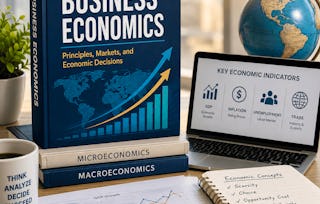
Welcome to the Microeconomics course! This course will help you develop an in-depth understanding of the microeconomics principles and market mechanisms. It provides the tools and framework you need to understand the economy at large and decision-making at the individual unit level.
In a world with infinite calls on finite resources, the choice is the central problem of public policy. The tools and techniques of economics are critical in addressing it. A microeconomic model can help you analyze and evaluate any problem associated with a choice, be it climate change, inequality, or which color jeans to buy. A choice, however, only makes sense if we are aware of the available options. The (dismal) science of economics helps there too, by hard coding limitations into these optimization efforts.
This course helps you dive deep into the economic elements, even if you have little or no previous exposure to formal economics. This course enables you to use the basic framework of incentives, trade-offs, prices, markets, and underlying modern microeconomics to understand the economy at large. The economic theories from the course will help you contextualize the current pressing concerns of public policy, which will further aid in the development of a more precise formulation of policy-relevant problems and potential solutions.
This module introduces you to the essential tools that economists use to think about and analyze problems. You will learn how to identify the components of choice analysis and how to characterize choice as a problem. You will gain an understanding of what incentives and trade-offs are and how opportunity costs measure trade-offs. It will also help you learn how to make sensible decisions when faced with challenging policy options.
Inclus
10 vidéos4 lectures7 devoirs
Afficher les informations sur le contenu du module
10 vidéos•Total 94 minutes
Course Introduction•3 minutes
What is the Use of Microeconomics?•13 minutes
Types of Reasoning•14 minutes
Scarcity and Choice•8 minutes
What Drives Choices?•10 minutes
How to Decide Between A and B?•7 minutes
Measuring Trade-offs•8 minutes
Broken Window Fallacy•9 minutes
Can You be More Rational? •13 minutes
Difficult Policy Choices•9 minutes
4 lectures•Total 40 minutes
Course Overview•10 minutes
Recommended Reading: Choice and Incentives•10 minutes
Recommended Reading: Opportunity Cost•10 minutes
Essential Reading•10 minutes
7 devoirs•Total 105 minutes
Practice Questions: The Economy versus Economics•20 minutes
Practice Questions: Choice and Incentives•5 minutes
Practice Questions: Trade-offs•5 minutes
Practice Questions: Opportunity Cost•5 minutes
Practice Questions: Being Rational•5 minutes
Practice Questions: Free Travel for Women Passengers in Delhi Transport Corporation Buses•5 minutes
Graded Quiz: Basic Toolkit•60 minutes
Consumer Choice
Module 2•4 heures à terminer
Détails du module
In this module, you will learn about the consumer choice theory that analyzes how individuals decide how many goods to consume and how much labor to supply. The module will help you comprehend how the economic environment influences these choices. It will also help you explore the income, substitution effect, and labor supply curve, also known as backward bending.
Inclus
10 vidéos3 lectures6 devoirs
Afficher les informations sur le contenu du module
10 vidéos•Total 106 minutes
Categorical versus Marginal Choices•7 minutes
Utility: Total and Marginal•15 minutes
Properties of Indifference Curves•14 minutes
Some Peculiar Indifference Curves •10 minutes
Feasible Set•12 minutes
Optimal Choice•14 minutes
Income Effect•7 minutes
Substitution Effect•10 minutes
Classifying Types of Goods•7 minutes
Income and Substitution Effect of a Rise in Wages •11 minutes
3 lectures•Total 30 minutes
Recommended Reading: Income and Substitution Effect•10 minutes
Recommended Reading: The Cost of Leisure: Labor Supply Curve (Backward Bending) •10 minutes
Essential Reading: The Cost of Leisure: Labor Supply Curve (Backward Bending)•10 minutes
6 devoirs•Total 90 minutes
Practice Questions: Objective Function, Preferences, and Rationality•5 minutes
Practice Questions: Formalizing Preferences: Indifference Curves•5 minutes
Practice Questions: Budget Constraint and Optimality•5 minutes
Practice Questions: Income and Substitution Effect•10 minutes
Practice Questions: The Cost of Leisure: Labour Supply Curve (Backward Bending) •5 minutes
Graded Quiz: Consumer Choice•60 minutes
Producer Choice
Module 3•4 heures à terminer
Détails du module
In this module, you will learn about the producer choice theory that analyzes a firm’s behavior. You will learn how to identify the components of decisions that producers make. You will learn how a producer can maximize profits. It will also help you understand the changes in the firm’s supply and demand choices in response to changes in the economic environment.
Inclus
11 vidéos3 lectures6 devoirs
Afficher les informations sur le contenu du module
11 vidéos•Total 96 minutes
Production Decisions•11 minutes
Cost Structure: Fixed, Variable, and Sunk Costs•6 minutes
Diminishing Product, Average and Marginal Costs•13 minutes
Iso-cost and Isoquants•9 minutes
Costs and Profit•6 minutes
Revenue and Marginal Revenue•8 minutes
Optimal Production Choice•8 minutes
Shutdown Price•7 minutes
Economies and Diseconomies of Scale•9 minutes
Impact of Innovation•8 minutes
What Besides Profit do Producers Care for?•10 minutes
3 lectures•Total 30 minutes
Recommended Reading: Economies of Scale and Innovation•10 minutes
Recommended Reading: Objective Function of a Not-for-Profit•10 minutes
Essential Reading•10 minutes
6 devoirs•Total 95 minutes
Practice Questions: Costs: Average and Marginal•5 minutes
Practice Questions: Production Possibility Frontier and Iso-profit Curves•5 minutes
Practice Questions: Profit Maximization •10 minutes
Practice Questions: Economies of Scale and Innovation•5 minutes
Practice Questions: Objective Function of a Not-for-profit•10 minutes
Graded Quiz: Producer Choice•60 minutes
Perfectly Competitive Market and Basic Policy Toolkit
Module 4•4 heures à terminer
Détails du module
In this module, you will gain an in-depth understanding of how prices affect the allocation of scarce resources in the economy. You will learn the techniques for analyzing several markets operating simultaneously. It will help you compare the effects of market changes on partial versus general equilibrium. It will also enable you to comprehend the impact of policy interventions in markets.
Inclus
9 vidéos3 lectures6 devoirs
Afficher les informations sur le contenu du module
9 vidéos•Total 92 minutes
What does Price do? •9 minutes
Diamond Water Paradox•8 minutes
Key Assumptions and Results•10 minutes
What if Assumptions are Unmet?•15 minutes
Simple Changes in a Market•11 minutes
Interconnected Changes Across Markets•10 minutes
Emergence of Grey or Black Markets•7 minutes
Emergence of Patronage•8 minutes
Vaccine Delivery Policy•13 minutes
3 lectures•Total 30 minutes
Recommended Reading: Partial versus General Equilibrium Effects•10 minutes
Recommended Reading: Simple Policy Interventions in a Market•10 minutes
Essential Reading•10 minutes
6 devoirs•Total 90 minutes
Practice Questions: Price as an Allocation Mechanism•5 minutes
Practice Questions: The Assumptions Underlying Perfect Competition•5 minutes
Practice Questions: Partial versus General Equilibrium Effects•5 minutes
Practice Questions: Simple Policy Interventions in a Market•5 minutes
Practice Questions: Can you Allocate Better Than the Market? •10 minutes
Graded Quiz: Perfectly Competitive Market and Basic Policy Toolkit•60 minutes
Social Choice and Welfare
Module 5•4 heures à terminer
Détails du module
This module introduces you to the social choice theory, which is the technique for aggregating the preferences of individuals (who make up the society) to reflect society’s collective choices. You will learn how to identify the various aspects of perfectly competitive markets. It will also help you grasp the fundamental theorem of welfare economics and utilitarianism. It will enable you to examine the challenges that can arise when addressing social welfare objectives.
Inclus
9 vidéos3 lectures7 devoirs
Afficher les informations sur le contenu du module
9 vidéos•Total 98 minutes
Undesirable Aspects of Perfectly Competitive Markets•8 minutes
Desirable Aspects of Perfectly Competitive Markets•10 minutes
First Fundamental Theorem of Welfare Economics•10 minutes
Social Welfare functions•13 minutes
The Role of Politics•11 minutes
The Trolley Problem•12 minutes
Deontology – Moral Injunctions•8 minutes
Rawlsian – Worst-off•9 minutes
What is the Case for (and Against) UBI?•18 minutes
3 lectures•Total 30 minutes
Recommended Reading: What is a Good Outcome?•10 minutes
Recommended Reading: Utilitarianism•10 minutes
Essential Reading•10 minutes
7 devoirs•Total 90 minutes
Practice Questions: Is Perfect Competition Desirable?•5 minutes
Practice Questions: (Pareto) Efficiency•5 minutes
Practice Questions: What is a Good Outcome?•5 minutes
Practice Questions: Utilitarianism•5 minutes
Practice Questions: Other Possible Social Welfare Functions•5 minutes
Practice Questions: Universal Basic Income•5 minutes
Graded Quiz: Social Choice and Welfare•60 minutes
Social Strategic Interactions
Module 6•4 heures à terminer
Détails du module
In this module, you will learn about strategic games, an equilibrium concept that helps us solve strategic games and their applications. You will learn how to define strategic interactions and comprehend the significance of the movement order. It will enable you to examine the impact of asymmetric information on decision-making. It will also empower you to analyze the principle-agent problem in the market.
Inclus
10 vidéos3 lectures6 devoirs
Afficher les informations sur le contenu du module
10 vidéos•Total 106 minutes
Decision Theory versus Game Theory•9 minutes
Rules of a Game•10 minutes
Prisoner’s Dilemma•12 minutes
Tragedy of Commons•12 minutes
The Order Matters•7 minutes
Backward Induction•11 minutes
Adverse Selection•10 minutes
Moral Hazard•15 minutes
Principal-Agent Problem I•9 minutes
Principal-Agent Problem II•11 minutes
3 lectures•Total 30 minutes
Recommended Reading: Choice with Incomplete or Imperfect Information•10 minutes
Recommended Reading: Signaling with Education Degrees •10 minutes
Essential Reading: Signaling with Education Degrees•10 minutes
6 devoirs•Total 100 minutes
Practice Question: No (Wo)man is an Island•5 minutes
Practice Questions: Tragedy of Commons and Nash Equilibrium•10 minutes
Practice Questions: Sequential Games and Game Trees•10 minutes
Practice Questions: Choice with Incomplete or Imperfect Information•5 minutes
Practice Questions: Signaling with Education Degrees•10 minutes
Graded Quiz: Social Strategic Interactions•60 minutes
Introduction to Imperfect Competition
Module 7•4 heures à terminer
Détails du module
In this module, you will discover the problems that arise when one deviates from the competitive equilibrium assumption of infinite firms supplying goods in the economy. You will learn how to describe simple models of imperfect competition and the impact of changes in market structure. It will help you explore the strategic interactions between producers. It will also help you understand how to examine the influence of competition policy interventions.
Inclus
8 vidéos4 lectures7 devoirs
Afficher les informations sur le contenu du module
8 vidéos•Total 90 minutes
Monopolist’s Problem•12 minutes
Outcomes in a Monopoly Market•13 minutes
Are Monopolies Desirable?•16 minutes
Monopsony in the Labor Market•7 minutes
Nash Equilibrium in a Duopoly•12 minutes
Introduction to Competition Policy•8 minutes
Abuse of Dominant Position and Price Discrimination•11 minutes
Practice Questions: Monopoly and Social Welfare•5 minutes
Practice Questions: Natural Monopoly•5 minutes
Practice Questions: Monopsony•5 minutes
Practice Questions: Duopolies and Cournot Competition•5 minutes
Practice Questions: Cartels•5 minutes
Practice Quiz: Competition Policy•10 minutes
Graded Quiz: Introduction to Imperfect Competition•60 minutes
Préparer un diplôme
Ce site cours fait partie du (des) programme(s) diplômant(s) suivant(s) proposé(s) par O.P. Jindal Global University. Si vous êtes admis et que vous vous inscrivez, les cours que vous avez suivis peuvent compter pour l'apprentissage de votre diplôme et vos progrès peuvent être transférés avec vous.¹
Consulter les diplômes éligibles
Préparer un diplôme
Ce site cours fait partie du (des) programme(s) diplômant(s) suivant(s) proposé(s) par O.P. Jindal Global University. Si vous êtes admis et que vous vous inscrivez, les cours que vous avez suivis peuvent compter pour l'apprentissage de votre diplôme et vos progrès peuvent être transférés avec vous.¹
¹La réussite de la candidature et de l'inscription est requise. Les conditions d'admissibilité s'appliquent. Chaque établissement détermine le nombre de crédits reconnus en complétant ce contenu qui peut compter pour les exigences du diplôme, en tenant compte de tout crédit existant que vous pourriez avoir. Cliquez sur un cours spécifique pour plus d'informations.
O.P. Jindal Global University is recognised as an Institution of Eminence by the Ministry of Education, Government of India. It is also ranked the No. 1 Private University in India in the QS World University Rankings 2021. The university has 9000+ students across 12 schools that offer 52 degree programs. The university maintains a 1:9 faculty-student ratio.
It is a research-intensive university, deeply committed to institutional values of interdisciplinary and innovative learning, pluralism and rigorous scholarship, globalism, and international engagement.
Pour quelles raisons les étudiants sur Coursera nous choisissent-ils pour leur carrière ?
Felipe M.
Étudiant(e) depuis 2018
’Pouvoir suivre des cours à mon rythme à été une expérience extraordinaire. Je peux apprendre chaque fois que mon emploi du temps me le permet et en fonction de mon humeur.’
Jennifer J.
Étudiant(e) depuis 2020
’J'ai directement appliqué les concepts et les compétences que j'ai appris de mes cours à un nouveau projet passionnant au travail.’
Larry W.
Étudiant(e) depuis 2021
’Lorsque j'ai besoin de cours sur des sujets que mon université ne propose pas, Coursera est l'un des meilleurs endroits où se rendre.’
Chaitanya A.
’Apprendre, ce n'est pas seulement s'améliorer dans son travail : c'est bien plus que cela. Coursera me permet d'apprendre sans limites.’
When will I have access to the lectures and assignments?
To access the course materials, assignments and to earn a Certificate, you will need to purchase the Certificate experience when you enroll in a course. You can try a Free Trial instead, or apply for Financial Aid. The course may offer 'Full Course, No Certificate' instead. This option lets you see all course materials, submit required assessments, and get a final grade. This also means that you will not be able to purchase a Certificate experience.
What will I get if I purchase the Certificate?
When you purchase a Certificate you get access to all course materials, including graded assignments. Upon completing the course, your electronic Certificate will be added to your Accomplishments page - from there, you can print your Certificate or add it to your LinkedIn profile.
Is financial aid available?
Yes. In select learning programs, you can apply for financial aid or a scholarship if you can’t afford the enrollment fee. If fin aid or scholarship is available for your learning program selection, you’ll find a link to apply on the description page.