What is design? How is it a deeply human endeavor? How can we design better products, services, and experiences in our communities? If you’re interested in helping create a more equitable and accessible world, this Center for Computational Thinking module on Open Design is for you.
In this introductory module to Open Design, you’ll learn how you can center equity in your design processes. You’ll learn how the iterative four mindsets of Open Design — understand, create, evaluate, and share — will guide you to meaningfully impact your community. The principles at the heart of Open Design — active inclusivity, transparency, and collaboration — are applicable to work in all fields, providing you with a reflective framework as you make important decisions.
This module provides the background on Open Design and its relationship to similar methodologies. After completing this introductory module, you should have the knowledge necessary to explain Open Design to others — and continue your Open Design journey with other learning opportunities.
What is design? How is it a deeply human endeavor? How can we design better products, services, and experiences in our communities? If you’re interested in helping create a more equitable and accessible world, this Center for Computational Thinking module on Open Design is for you.
In this introductory module to Open Design, you’ll learn how you can center equity in your design processes. You’ll learn how the iterative four mindsets of Open Design — understand, create, evaluate, and share — will guide you to meaningfully impact your community. The principles at the heart of Open Design — active inclusivity, transparency, and collaboration — are applicable to work in all fields, providing you with a reflective framework as you make important decisions.
This module provides the background on Open Design and its relationship to similar methodologies. After completing this introductory module, you should have the knowledge necessary to explain Open Design to others — and continue your Open Design journey with other learning opportunities.
Inclus
3 vidéos15 lectures2 devoirs4 sujets de discussion1 plugin
Afficher les informations sur le contenu du module
3 vidéos•Total 18 minutes
What Is Open Design?•6 minutes
Design with the Other•5 minutes
Ways of Being in the World•8 minutes
15 lectures•Total 190 minutes
Welcome to Open Design!•10 minutes
Discussion Guidelines•10 minutes
Open Design: What Is It, And Why Does It Matter?•10 minutes
Design Methodologies•10 minutes
Examples of Community-Centered Design•50 minutes
Report a problem with the course•10 minutes
Design with the Other: What Do We Mean by Equity-Centered Design?•10 minutes
Empathy vs. Sympathy•10 minutes
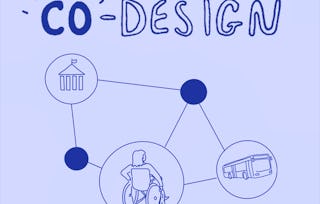
Co-Design•10 minutes
Advancing Racial Equity in Design•10 minutes
Open Design Mindsets: Ways of Being in the World•10 minutes
Divergent and Convergent Thinking •10 minutes
Open Design in the World: CSbyUs•10 minutes
Module Resources•10 minutes
Share your learning experience•10 minutes
2 devoirs•Total 60 minutes
Using Open Design in Real World Scenarios•30 minutes
Duke University has about 13,000 undergraduate and graduate students and a world-class faculty helping to expand the frontiers of knowledge. The university has a strong commitment to applying knowledge in service to society, both near its North Carolina campus and around the world.
Pour quelles raisons les étudiants sur Coursera nous choisissent-ils pour leur carrière ?
Felipe M.
Étudiant(e) depuis 2018
’Pouvoir suivre des cours à mon rythme à été une expérience extraordinaire. Je peux apprendre chaque fois que mon emploi du temps me le permet et en fonction de mon humeur.’
Jennifer J.
Étudiant(e) depuis 2020
’J'ai directement appliqué les concepts et les compétences que j'ai appris de mes cours à un nouveau projet passionnant au travail.’
Larry W.
Étudiant(e) depuis 2021
’Lorsque j'ai besoin de cours sur des sujets que mon université ne propose pas, Coursera est l'un des meilleurs endroits où se rendre.’
Chaitanya A.
’Apprendre, ce n'est pas seulement s'améliorer dans son travail : c'est bien plus que cela. Coursera me permet d'apprendre sans limites.’
Avis des étudiants
4.7
15 avis
5 stars
66,66 %
4 stars
33,33 %
3 stars
0 %
2 stars
0 %
1 star
0 %
Affichage de 3 sur 15
A
AL
4·
Révisé le 3 avr. 2025
I liked the course as the majority of materials was readings, instead of video lectures.
When will I have access to the lectures and assignments?
To access the course materials, assignments and to earn a Certificate, you will need to purchase the Certificate experience when you enroll in a course. You can try a Free Trial instead, or apply for Financial Aid. The course may offer 'Full Course, No Certificate' instead. This option lets you see all course materials, submit required assessments, and get a final grade. This also means that you will not be able to purchase a Certificate experience.
What will I get if I purchase the Certificate?
When you purchase a Certificate you get access to all course materials, including graded assignments. Upon completing the course, your electronic Certificate will be added to your Accomplishments page - from there, you can print your Certificate or add it to your LinkedIn profile.
Is financial aid available?
Yes. In select learning programs, you can apply for financial aid or a scholarship if you can’t afford the enrollment fee. If fin aid or scholarship is available for your learning program selection, you’ll find a link to apply on the description page.