Lorsque vous vous inscrivez à ce cours, vous êtes également inscrit(e) à cette Spécialisation.
Apprenez de nouveaux concepts auprès d'experts du secteur
Acquérez une compréhension de base d'un sujet ou d'un outil
Développez des compétences professionnelles avec des projets pratiques
Obtenez un certificat professionnel partageable
Il y a 5 modules dans ce cours
In this second course of the Introduction to Robotics specialization, "Robotic Mapping and Trajectory Generation", you will learn how to perform basic inverse kinematics of (non-)holonomic systems using a feedback control approach. You will also learn how to process multi-dimensional sensor signals such as laser range scanners for mapping. Additionally, you will apply the overarching focus of mechanisms and sensors as sources of uncertainty and gain techniques to how to model and control them.
It is recommended that you complete the first course of this specialization, “Introduction to Robotics: Basic Behaviors”, before beginning this one.
This course can be taken for academic credit as part of CU Boulder’s MS in Computer Science degrees offered on the Coursera platform. These fully accredited graduate degrees offer targeted courses, short 8-week sessions, and pay-as-you-go tuition. Admission is based on performance in three preliminary courses, not academic history. CU degrees on Coursera are ideal for recent graduates or working professionals. Learn more:
MS in Computer Science: https://coursera.org/degrees/ms-computer-science-boulder
Welcome to Robotic Mapping and Trajectory Generation. In this first week of the course, you will get started by being introduced to the class of "range finder" devices, which have important applications in mapping, as well as the concept of homogeneous transforms to perform coordinate transformations.
Inclus
8 vidéos8 lectures5 devoirs1 sujet de discussion
Afficher les informations sur le contenu du module
8 vidéos•Total 61 minutes
Introduction to the Specialization•2 minutes
Meet the Instructor•2 minutes
Introduction to "Robotic Mapping and Trajectory Generation"•1 minute
Range Finders and Homogeneous Transforms•20 minutes
Set Up a Range Finder in Webots•7 minutes
Range Sensing•5 minutes
Transforming 1D-Range Images into World Coordinates•13 minutes
Homogeneous Transforms•11 minutes
8 lectures•Total 66 minutes
Course Updates and Accessibility Support•1 minute
Earn Academic Credit for your Work!•10 minutes
Course Support•10 minutes
Assessment Expectations•10 minutes
AI Citation and Acknowledgement•10 minutes
Course Activities•5 minutes
Laser Range Finders•10 minutes
About Homogeneous Transforms•10 minutes
5 devoirs•Total 160 minutes
Homogeneous Transforms Practice•20 minutes
AI Policy Quiz•5 minutes
Hands On: Commissioning the Range Finder•60 minutes
Hands-On: Transforming World Coordinates in Webots•45 minutes
Range Finder Devices•30 minutes
1 sujet de discussion•Total 10 minutes
Introduce Yourself!•10 minutes
Mapping: Basic Representations
Module 2•6 heures à terminer
Détails du module
In this week, you will begin to understand basic discrete map representations and their implementation.
Inclus
2 vidéos4 lectures3 devoirs1 plugin
Afficher les informations sur le contenu du module
2 vidéos•Total 24 minutes
Mapping•18 minutes
Basic Mapping: Overview•6 minutes
4 lectures•Total 40 minutes
Map Representations•10 minutes
Topological Maps•10 minutes
Grid Maps and Graphs•10 minutes
QuadTrees•10 minutes
3 devoirs•Total 276 minutes
Hands-On: Mapping Part I - Basic Mapping •180 minutes
Topological Maps and Graphs•6 minutes
QuadTrees•90 minutes
1 plugin•Total 20 minutes
Example QuadTree Implementation•20 minutes
Mapping: Probabilistic Representations and Configuration Space
Module 3•3 heures à terminer
Détails du module
This week introduces simple ways to encode obstacles in terms of probability, the concept of "configuration space", and a simple algorithm for collision checking.
Inclus
1 vidéo3 lectures2 devoirs
Afficher les informations sur le contenu du module
1 vidéo•Total 23 minutes
Probabilistic Mapping and Configuration Space•23 minutes
3 lectures•Total 35 minutes
Probabilistic Map Representations•10 minutes
Configuration Space•10 minutes
Bresenham's Line Algorithm•15 minutes
2 devoirs•Total 150 minutes
Hands-On: Mapping Part II -Probabilistic Mapping•60 minutes
Hands-On: Mapping Part III - Configuration Space•90 minutes
Inverse Kinematics: Trajectory Following
Module 4•5 heures à terminer
Détails du module
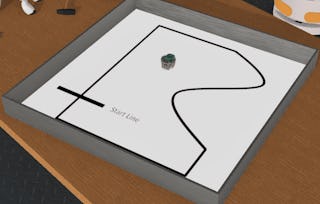
In this week you will learn to define a robot trajectory based on a series of waypoints and implement a basic proportional controller in Webots to navigate in a 2D environment.
Inclus
4 vidéos4 lectures4 devoirs
Afficher les informations sur le contenu du module
4 vidéos•Total 52 minutes
Trajectory Following•22 minutes
Trajectory Following - Set Up•6 minutes
Trajectory Following - Computing Error•12 minutes
Control•12 minutes
4 lectures•Total 50 minutes
Trajectory Following•10 minutes
Euclidian Distance and Heading Error•10 minutes
Proportional Control•10 minutes
PID Control•20 minutes
4 devoirs•Total 225 minutes
Setup "supervisors" and markers in Webots•45 minutes
Hands-On: Distance and Heading Error•45 minutes
Control•120 minutes
PID Control•15 minutes
Implementing Mapping and Trajectory Generation
Module 5•7 heures à terminer
Détails du module
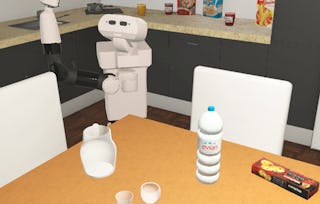
In this module you will transfer your mapping and trajectory following skills to a commercial robotic platform in a kitchen environment, introducing you to additional constraints of sensor integration on a real robotic platform.
Inclus
1 vidéo1 évaluation par les pairs
Afficher les informations sur le contenu du module
1 vidéo•Total 31 minutes
Differential Kinematics and Control•31 minutes
1 évaluation par les pairs•Total 360 minutes
Implementing Mapping and Trajectory Generation•360 minutes
Obtenez un certificat professionnel
Ajoutez ce titre à votre profil LinkedIn, à votre curriculum vitae ou à votre CV. Partagez-le sur les médias sociaux et dans votre évaluation des performances.
Préparer un diplôme
Ce site cours fait partie du (des) programme(s) diplômant(s) suivant(s) proposé(s) par University of Colorado Boulder. Si vous êtes admis et que vous vous inscrivez, les cours que vous avez suivis peuvent compter pour l'apprentissage de votre diplôme et vos progrès peuvent être transférés avec vous.¹
Consulter les diplômes éligibles
Préparer un diplôme
Ce site cours fait partie du (des) programme(s) diplômant(s) suivant(s) proposé(s) par University of Colorado Boulder. Si vous êtes admis et que vous vous inscrivez, les cours que vous avez suivis peuvent compter pour l'apprentissage de votre diplôme et vos progrès peuvent être transférés avec vous.¹
¹La réussite de la candidature et de l'inscription est requise. Les conditions d'admissibilité s'appliquent. Chaque établissement détermine le nombre de crédits reconnus en complétant ce contenu qui peut compter pour les exigences du diplôme, en tenant compte de tout crédit existant que vous pourriez avoir. Cliquez sur un cours spécifique pour plus d'informations.
CU Boulder is a dynamic community of scholars and learners on one of the most spectacular college campuses in the country. As one of 34 U.S. public institutions in the prestigious Association of American Universities (AAU), we have a proud tradition of academic excellence, with five Nobel laureates and more than 50 members of prestigious academic academies.
Pour quelles raisons les étudiants sur Coursera nous choisissent-ils pour leur carrière ?
Felipe M.
Étudiant(e) depuis 2018
’Pouvoir suivre des cours à mon rythme à été une expérience extraordinaire. Je peux apprendre chaque fois que mon emploi du temps me le permet et en fonction de mon humeur.’
Jennifer J.
Étudiant(e) depuis 2020
’J'ai directement appliqué les concepts et les compétences que j'ai appris de mes cours à un nouveau projet passionnant au travail.’
Larry W.
Étudiant(e) depuis 2021
’Lorsque j'ai besoin de cours sur des sujets que mon université ne propose pas, Coursera est l'un des meilleurs endroits où se rendre.’
Chaitanya A.
’Apprendre, ce n'est pas seulement s'améliorer dans son travail : c'est bien plus que cela. Coursera me permet d'apprendre sans limites.’
When will I have access to the lectures and assignments?
To access the course materials, assignments and to earn a Certificate, you will need to purchase the Certificate experience when you enroll in a course. You can try a Free Trial instead, or apply for Financial Aid. The course may offer 'Full Course, No Certificate' instead. This option lets you see all course materials, submit required assessments, and get a final grade. This also means that you will not be able to purchase a Certificate experience.
What will I get if I subscribe to this Specialization?
When you enroll in the course, you get access to all of the courses in the Specialization, and you earn a certificate when you complete the work. Your electronic Certificate will be added to your Accomplishments page - from there, you can print your Certificate or add it to your LinkedIn profile.
Is financial aid available?
Yes. In select learning programs, you can apply for financial aid or a scholarship if you can’t afford the enrollment fee. If fin aid or scholarship is available for your learning program selection, you’ll find a link to apply on the description page.