5.0
Reviewed Jun 15, 2026This course provides a solid introduction to the foreign exchange (Forex) market and its global importance.

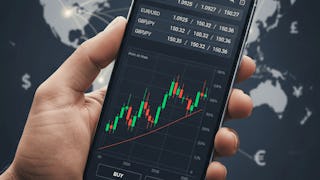
Learners will be able to analyze foreign exchange markets, evaluate key participants, interpret currency quotations, and apply trading mechanisms such as spot and forward transactions in real-world scenarios. This course provides a comprehensive understanding of how forex markets function within investment banking operations, focusing on both foundational concepts and practical applications. By completing this course, learners will gain the ability to support international trade transactions, manage currency risk, and make informed decisions using bid-ask pricing and exchange rate systems. The structured approach—from fundamentals to execution—ensures clarity and practical skill development. What makes this course unique is its strong alignment with real-world banking operations, combining conceptual knowledge with transaction-level insights. Designed for aspiring finance professionals, it bridges the gap between theory and practice, enabling learners to confidently navigate the dynamic and fast-paced forex environment.
This course provides a solid introduction to the foreign exchange (Forex) market and its global importance.
Practical examples help learners understand trade execution, order types, and trading mechanisms.
The content suits beginners who want to understand Forex trading and financial markets
The course is very well organized and progresses smoothly from basic concepts to transaction-level execution. The practical examples enhance understanding significantly.
It explains how currency pairs work and how economic and political factors influence exchange rates.
Technical and fundamental analysis techniques are introduced to help evaluate market movements.
Risk management strategies are emphasized to help reduce potential trading losses.
This course provides a strong foundation in forex trading concepts and market operations. The explanations of spot and forward transactions are especially clear and easy to apply.
Learners gain a clear understanding of major, minor, and exotic currency pairs.
A highly informative course that bridges theory with practical forex applications. It helped me better understand exchange rates, bid-ask pricing, and currency risk management.
Overall, this course offers valuable insights into Forex markets and trading practices, helping learners build a strong foundation in currency trading.
It explains how exchange rates are determined and the factors that influence currency price movements.
Showing: 17 of 17
Analyze Forex Markets & Apply Trading Mechanisms is an excellent course that explains foreign exchange markets in a clear, structured, and highly practical way. The real-world banking focus makes the learning experience very valuable.
This course provides a strong foundation in forex trading concepts and market operations. The explanations of spot and forward transactions are especially clear and easy to apply.
A highly informative course that bridges theory with practical forex applications. It helped me better understand exchange rates, bid-ask pricing, and currency risk management.
The course is very well organized and progresses smoothly from basic concepts to transaction-level execution. The practical examples enhance understanding significantly.
Overall, this course offers valuable insights into Forex markets and trading practices, helping learners build a strong foundation in currency trading.
This course provides a solid introduction to the foreign exchange (Forex) market and its global importance.
It explains how exchange rates are determined and the factors that influence currency price movements.
The course explains how traders use charts, indicators, and market trends to make trading decisions.
It explains how currency pairs work and how economic and political factors influence exchange rates.
This course provides a comprehensive introduction to the Forex market and global currency trading.
Learners gain knowledge of key Forex trading concepts such as pips, spreads, leverage, and margin.
Practical examples help learners understand trade execution, order types, and trading mechanisms.
Technical and fundamental analysis techniques are introduced to help evaluate market movements.
The content suits beginners who want to understand Forex trading and financial markets
The course simply and understandably covers major, minor, and exotic currency pairs.
Risk management strategies are emphasized to help reduce potential trading losses.
Learners gain a clear understanding of major, minor, and exotic currency pairs.