BP
Reviewed Apr 24, 2020
Really lots of new knowledge,But not exactly not relevent from my field but learn alot new things that very helpfull for my further study.Thank you COURSERA for upgrade my knowledge.

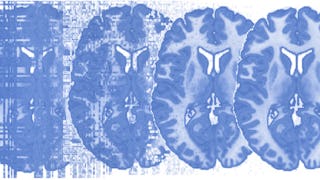
Functional Magnetic Resonance Imaging (fMRI) is the most widely used technique for investigating the living, functioning human brain as people perform tasks and experience mental states. It is a convergence point for multidisciplinary work from many disciplines. Psychologists, statisticians, physicists, computer scientists, neuroscientists, medical researchers, behavioral scientists, engineers, public health researchers, biologists, and others are coming together to advance our understanding of the human mind and brain. This course covers the design, acquisition, and analysis of Functional Magnetic Resonance Imaging (fMRI) data, including psychological inference, MR Physics, K Space, experimental design, pre-processing of fMRI data, as well as Generalized Linear Models (GLM’s). A book related to the class can be found here: https://leanpub.com/principlesoffmri.
BP
Really lots of new knowledge,But not exactly not relevent from my field but learn alot new things that very helpfull for my further study.Thank you COURSERA for upgrade my knowledge.
ZH
It's not really a beginners course. Reviews most of the important fMRI statistical analysis concepts. Additionally, the information regarding MR Physics involved was invaluable.
SS
Thanks for organising such course. I am very happy in attending this course. But It would be excellent if some more explanations on the concepts are clear.
SP
A very well structured course starting from the basics of fMRI. It is of great help in understanding what goes into fMRI analysis
K
I learnt a lot from the course, even if it is just a surface understanding. It'll really help with when I need to pick up selective content for reals in the future.
AP
Amazing course. More advanced than I thought it would be, which was excellent. Interested students should know that it has a lot of statistics in it.
YL
This is a great online resource that efficiently introduce me to the field of fMRI analysis, which is a completely new field to me.
KY
The information covered in this course provides a deep understanding of approaching a fMRI data. Instructors provide clear explanations throughout the course.
JA
Heavier on the statistics than I expected, but that's not a bad thing. A sort of wake-up call that I need to brush up on my biostatistics background.
DM
It was very much informative video about mri system and advancement in the mri system.Thank you so much for your informative videos.
MD
Taken in concert, the lectures and the reading are thorough if complex. However, this is a complex topic. Probably should be listed as an intermediate course at least, but a very good introduction.
DM
It was a wonderful beginning to a topic details of which were unknown to me. Thank you to both the instructors for making the videos crisp, informative and understandable. Thank you very much.
Showing: 20 of 163
Too much theory. No practice and practical online sessions on SPM for example.
Simple things are explained in difficult way. Too much definitions, not enough explained in own words.
It's not really a beginners course. Reviews most of the important fMRI statistical analysis concepts. Additionally, the information regarding MR Physics involved was invaluable.
Instructors tend to talk too fast and read off the slides verbatim instead of thoroughly explaining the topic
While I enjoy a tough course, this course was actually pretty tough to follow because of the huge amount of statistical knowledge required to be able to understand each module. I think that the course description was a bit misleading for us because I really thought that we would come across examples of fmri studies for us to interpret rather than get into the statistical aspects of these medical machines.
A very good introduction, but you would need some decent knowledge in statistics to fully understand the methods part. Standard undergrad psychology courses in statistics should be enough.
Very clear introductory course about fMRI. It touches almost every concept needed to understand an MRI experiment. Many complex topics were explained in a very clear and concise way.
Whenever examples were given, things became much clearer, but there often weren't examples. In many instances it would have been nice if there had been a second take of the video taken to prevent potentially confusing mis-speaking from making it into the lectures. Obviously you get what you pay for, and it's great that I got a vague overview of the subject for free, but I easily aced the course without feeling like I'm at all prepared to run an fMRI experiment.
Very densly packed course with many great information. Sometimes it went a bit too fast, though. I wish there was a bit more explanation for some of the more advanced ideas. Still a very good course that made me confident to start analyzing some fMRI data that I have at hand.
As a person who actually studied physics and knows a little about data science, I am literally baffled the way information presented and lectures speak. Really don't recommend this cource at all. because Week 1 materals is a imcomprehenisble mess full of incorrect explanation and vague definitions.
Really lots of new knowledge,But not exactly not relevent from my field but learn alot new things that very helpfull for my further study.Thank you COURSERA for upgrade my knowledge.
Very fasinat
The first half of the course is informative and easy enough to follow. However, the last half (which is all about statistical analysis) I feel could have been laid out differently or could have used more practical examples over theory.
Even if you start with the first course in the series of four for the specialization, this course seems to require more background knowledge when it comes to experimentation and statistics if you want to really understand it.
The order in which things were presented was sometimes confusing. For example, there are instances when terminology is defined well-after it has already been used to explain concepts. For example, things like t-tests, p-values, and 'power' were talked about in Week 3 as if they should already be known, only to be explicitly defined near the end of Week 4.
Also, not a huge complaint, but sometimes it seemed like the instructors relied on the presentation slides a little too much; reading word for word and not expanding on it much.
Good information overall, but the teaching could be improved.
This is a great course to have available. However, I do think that in order to truly grasp many of the concepts, you need to either have a good baseline statistical background (ie, more than one college stats course), or be willing to spend a lot more time looking up many of the concepts (though many can only be found referenced in papers). For those who are engaged in applied statistics/signal processing, this would probably be fine. The course was very interesting, but I do wish they spent a bit more time breaking down the statistical measures and more examples/figures/analogies to make the course overall more coherent, and encourage a deeper understanding from a big picture perspective. It would be helpful if they had optional supplementary videos that dive deeper into the stats for those who could use it.
I found it hard to follow at times. I would have greatly appreciated some pdf to compliment the videos. There was a LOT of information presented each week, hard to remember it all when it came to quiz time. Given these points, I’m less inclined to do the second course even though I think it would be interesting.
I feel like this course could have been improved with an actual run through of examples, rather than just going by the board, ie. screen capturing the data analysis operations. It was all-in-all very helpful though!
Thank you so much! Its not a nightmare anymore when I begin to think about dealing with fMRI statistics! Step by step you opened all tricky (maybe not all but I feel that I am able to face all of them now) moments in this field. I feel really happy that I have found this course and I'm very greateful for such opportunity! Thank to all of the people who are making such opportunities possible!
This is an excellent course. Really helpful for future neuroimaging fMRI studies. Nicely explained the theoretical and practical cases of various fMRI models and techniques. It would be more helpful if the statistical data analysis part was more elaborative or given reference content. Enjoyed the full course and thanks to the Professors and Coursera.
Very nice course - very detailed and well structured, thank you very much for offering! I enjoyed all lectures and also learned while trying to pass the quiz ;) ..only a small criticism, sometimes the subtitles have small (verbal) mistakes in it and I prefer having one compact lecture as I could already see it will be made in fMRI principles 2.
A pretty challenging but interesting course. It also tells me I should pump up my data science knowledge before studying further neuroimaging in the future. :') A small point but I also love this course compared to the previous one as it did not hide available options in the quiz feedback. Thank you so much to the instructors Tor and Martin!