5.0
Reviewed May 2, 2018It's a challenging subject. Don't expect to walk away from the course with a complete grasp of systems biology. However, this course is a fantastic place to start.
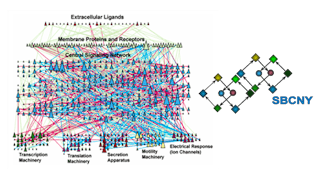
This course will introduce the student to contemporary Systems Biology focused on mammalian cells, their constituents and their functions. Biology is moving from molecular to modular. As our knowledge of our genome and gene expression deepens and we develop lists of molecules (proteins, lipids, ions) involved in cellular processes, we need to understand how these molecules interact with each other to form modules that act as discrete functional systems. These systems underlie core subcellular processes such as signal transduction, transcription, motility and electrical excitability. In turn these processes come together to exhibit cellular behaviors such as secretion, proliferation and action potentials. What are the properties of such subcellular and cellular systems? What are the mechanisms by which emergent behaviors of systems arise? What types of experiments inform systems-level thinking? Why do we need computation and simulations to understand these systems? The course will develop multiple lines of reasoning to answer the questions listed above. Two major reasoning threads are: the design, execution and interpretation of multivariable experiments that produce large data sets; quantitative reasoning, models and simulations. Examples will be discussed to demonstrate “how” cell- level functions arise and “why” mechanistic knowledge allows us to predict cellular behaviors leading to disease states and drug responses.
It's a challenging subject. Don't expect to walk away from the course with a complete grasp of systems biology. However, this course is a fantastic place to start.
The content of this course is quiet good, but is little bit hard to digest. Overall, I gained a lot of things from this course.
Coursera make it different...I'm pretty lucky to find a systems biology course like this.
I have learned a lot from this course, thank you very much
Great foundational material and insights from Prof. Iyengar that supports the 'disruptive' trends underway at the intersection of Computational Biology and Medicine.
Really helpful in both gaining confidence and knowledge! Such a wonderful online platform to expand our knowledge in our field of interest
This course has been a very instructive course for me. I would like to thank ISM and Dr. Iyengar for his sacrifice for sharing his knowledge!!!
Excellent course, could be improved by explaining the more difficult concepts in greater depth, e.g. ODE and PDE math.
This online course is very helpful and very educational.
Great introduction and overview. Exams are especially well thought out.
Nice course, a little boring at the beginning with so much data about cell signaling, (kinases names, and specific routes).
Very useful course in order to learn the basics in systems biology. You only need some training in biology to understand the concepts but the course is easy to follow and very complete.
Showing: 20 of 117
Although I am thankful to the Icahn School of Medicine at Mount Sinai, Ravi Iyengar & colleagues and especially Coursera for providing the such courses online,
I have to say after taking this course that I did not find this helpful and would not really recommend it to anyone. The course is sort of a bird's eye view of the field of systems biology such that a beginner would not understand much of anything and an experienced researcher would also not really benefit from it either. In my view the course is sort of a "Review of certain handpicked literature" and it does not Explain well the basic concepts of system biology.
Having completed somewhere in the region of 70 online courses I can say with complete honesty that "Introduction to Systems Biology" is the worst online course I have ever taken. The videos are a rambling sprawl with little coherence and are in need of serious editing. The amount of prior knowledge assumed is absurd for a course of this scope - and comments in the discussion forums seems to indicate that many others feel the same. In over 4 years since the course first started, there has not been a single post by the instructor and the lecture notes are as equally muddled as the lecture viedos. In all honesty, a prospective student would be better off buying one of the many excellent monographs on Systems Biology and taking a random page at KEGG and studying that. Frustrating and did not in any way meet my objective of gaining a good grounding in Systems Biology.
Let me start by saying that I appreciate that Icahn School of Medicine at Mount Sinai, Prof. Ravi Iyengar & colleagues and Coursera’s tried to provide a course on such a potentially interesting topics. However, this course is a disaster. There are problems with the target audience of the course, the pedagogy, the technical aspects of the realisation, the quizzes… everything. To quote Prof. Iyengar, it is ‘a sort of kind of’ inconclusive and confusing. Let me try to be more specific.
First of all, it says it’s an introductory level course: Well, before this course I have refreshed genetics, physiology, biology, neurology, anatomy, network theory, etc. None of that prepared me for this course. I did not manage to consolidate a single new concept besides those I already knew. This, despite passing the quizzes. I really fail to see which audience the course is supposed to target. Perhaps, if you have previous undergraduate (or graduate?) education in molecular biology, and a deep understanding of how cell biological systems work, the course may be adapted to you, but I am not sure. It’s all jargon, acronyms, mechanisms that you are supposed to be familiar with, mentioned in a quick way, without a clear path.
Second (and main problem): The pedagogical approach. It’s not a course. It literally explains nothing from the ground up. It is more like a series of informal seminars given to peers, who needs refreshing a specific topic. You get the impression of superficially reading the abstracts of a series of articles on a specialised journal. The coherence between chapters is very loose. If it aimed at being a bird's eye view of systems biology, it failed since it lacks clarity, coherence, and purpose. An alternative and very effective pedagogical approach would have been to limit the scope to covering one or a few aspects in some depth, e.g. discuss a paradigmatic system from a general biology approach, a traditional physiological approach, and compare that with a systems biology study approach, explaining step by step the modelling via a set of ordinary differential equations or a simple network. That would have given a concrete example of what’s the ‘added value’ of the discipline. An experienced researcher would not benefit from it either: She would learn nothing concrete that can be used in her research. None of the mathematical techniques mentioned are explained in a constructive approach. Hours are dedicated to list websites where to retrieve data, for instance, or to name techniques and concepts never explained (microarrays, phosphorylation, endless kinases…). Knowledge is not transmitted by simply naming things, that's pedagogy 101...
The more you follow, if you manage to keep going, the more it turns into a “review of handpicked literature" whose rationale to understand basic concepts of system biology(but do they exist, one is left wondering?) is not manifest.
The technical aspects: Shooting in what appears to be a basement, giving the impression that somebody has kidnapped the Professor, with the noise of a truck passing by once every other lecture covering the monotonous and slow tone. Looks like a B-movie.
Miscellanea: At least two thirds of the quizzes are concerning details of papers sometimes barely mentioned in the lectures, rather than big concepts. Slides are hard to read (diagrams too small, for instance, most of the acronyms left for the student to figure out…). No mentor intervention in the forums. Ever. It’s a first course in a specialization whose capstone is not accessible anymore, bordering a hoax…
I thought that Systems Biology was at the intersection of Physiology with Biophysics, with an approach based on mathematical modelling and focused on capturing quantitatively the dynamics of the object of study, via numerical techniques and exploiting big data. Now, not so sure anymore. Perhaps it is, but I fail to see how researchers in this field could form their competences based on such types of courses. I definitely did not find the course helpful and would not really recommend it to anyone. It’s in the lowest 10% of the courses I have followed on Coursera (close to ~100).
Two stars, only to have made most articles (as well as the slides) available.
It's a challenging subject. Don't expect to walk away from the course with a complete grasp of systems biology. However, this course is a fantastic place to start.
Tests do not reflect course information. Even if the title is "introduction" it asumes the user is familiar with a lot of topics. It is probably good for people that just need a reminder of something that they studied previousely.
They teach basic theory and then require the student to know much more on exams. Maybe this course should be done last in the specialization. (I'm hoping the others are better)
The lecture quality should be dramatically improved. Even at 2x speed, I feel Iyengar should further practice is presentation and redo the videos. In the conclusion, Iyengar states that no textbooks are available for the field because it is "new", but an Amazon search shows several seem to exist, and many of the studies referenced in this course are years old, even more than a decade in some cases... so I think better materials for more organized slides must exist. I've taken more than 5 coursera classes, and this has been my least satisfying. ... I do appreciate the introduction this provided, for free, and plan to keep learning in this space, though not in this course sequence.
I think the course's goal is to make the students familiar with the concepts and terms in system's biology. At first it made me think that the subjects are not as connected as they should be. To be honest, if someone asks me about what exactly I learned from this course, I don't have any answer. It's like I have learned some diffuse ideas and concepts and I can't put them all together. but what I am certain about, is that this course made me look at things differently. And that is indeed what every class and course should do isn't it?:)
Nice course, a little boring at the beginning with so much data about cell signaling, (kinases names, and specific routes).
The lecturer is bad at communicating , The material is hard to understand , and he skims through the contents , The Quizzes are not related to the materials sometimes
Solution : No doubt that the lecturer is a distinguished person , but this kind of material should be taught by a young faculty member that can communicate much better with the students , the current lecturer can supervise the material and answer questions in the discussion boards
This course is difficult. Often very difficult. Sometimes extremely difficult. However, the assessments are reasonably accessible for someone who is not highly experienced in the relevant fields (i.e molecular biology, biochemistry or mathematical modelling). I enjoyed the course tremendously. The content of the course was stellar, and delivered to me exactly what I was hoping for from this course. When I first began the course I was quite surprised at the level of detail (this is my first time using Coursera, and I had thought the course would be a lot more "fluffy" or "wishy-washy" than it was). The level of detail was paired (almost always) with a description by Ravi Iyengar which was simple and captured the main "take-home" points. This I imagine is only possible thanks to the eminence and experience of Dr Iyengar and the hard-work by the rest of the team behind the scenes. Many aspects can be a little daunting (I did not understand anything with great deepness, I often did not understand things very much, but I rarely did not understand things at all - thanks to the emphasis on take-home points). I think an essential course for anyone who wants a taste of all things systems and networks.
Quizzes do not contain feedback for wrong answers, and the amount of detail is sometimes overwhelming. Wouldn't recommend for complete beginners!
Boring voice. A lot of overcomplicated terms, where you can describe your idea in a much more simple way. In result i feel that lector read this material not to teach people, but just to read it. Disgusting.
I could not understand instructor. Using subtitles didn't help either as many words came up unintelligible.
An excellent introduction to Systems Biology. I studied electrical engineering for undergrad and neglected to take more than the single biology course that was required, so I was a little unsure of how the course would go. There are actually many parallels with systems biology and engineering, so most of the material was intuitive or could be easily fitted with my previous knowledge. I had to spend additional time for nomenclature and rechecking exam questions to make sense of the answers, but the class is organized in a way that you can actually acquire the information you need to build a foundation and be able to consider what researchers from various backgrounds are concerned with.
A good introduction to this topic for sure. As others have said, this is perhaps more like an "advanced" course than intermediate (I already have a masters in biochemistry and a lot of programming experience) but for me it's perfect. He does talk slowly though so I've been increasing the play speed to 1.5x
An exceptional course for anyone interested in the area of bioinformatics, cell biology, biotechnology, etc. I think it is very valuable to have some background in molecular biology but if you are interested, do not doubt to take it.
The required readings are stellar. I didn't know all this stuff, and there's a real open-source philosophy. The bio stuff is challenging for an engineer like myself, but worth Googling and learning in the long run
This course has been a very instructive course for me. I would like to thank ISM and Dr. Iyengar for his sacrifice for sharing his knowledge!!!
This is a good course, overall - it starts off with a lot of technical detail about network, but I honestly encourage anyone to keep going with it as the second half of the course is full of really interesting material on signalling networks and modelling, and having finished it, I certainly feel much more informed. However, the assessments can be tricky - they often require rote learning of specific detail from the lectures (often, detail which isn't highlighted a particularly important). They also occasionally involve difficult to understand questions, and several questions have had spelling or grammatical errors.
However, overall, I'd recommend this if you have previous undergraduate education in molecular biology, and a general understanding of how cell biological systems work.
The course material seems a little bit outdated, and could benefit from update.