SS
4.0Reviewed May 28, 2017
The course is easy to understand and the lecturer are well read about the subject. It will be very helpful to me in near future working as a public health worker

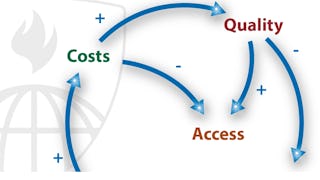
This course provides an introduction to systems thinking and systems models in public health. Problems in public health and health policy tend to be complex with many actors, institutions and risk factors involved. If an outcome depends on many interacting and adaptive parts and actors the outcome cannot be analyzed or predicted with traditional statistical methods. Systems thinking is a core skill in public health and helps health policymakers build programs and policies that are aware of and prepared for unintended consequences. An important part of systems thinking is the practice to integrate multiple perspectives and synthesize them into a framework or model that can describe and predict the various ways in which a system might react to policy change. Systems thinking and systems models devise strategies to account for real world complexities. This work was coordinated by the Alliance for Health Policy and Systems Research, the World Health Organization, with the aid of a grant from the International Development Research Centre, Ottawa, Canada. Additional support was provided by the Department for International Development (DFID) through a grant (PO5467) to Future Health Systems research consortium. © World Health Organization 2014 All rights reserved. The designations employed and the presentation of the material in this publication do not imply the expression of any opinion whatsoever on the part of the World Health Organization concerning the legal status of any country, territory, city or area or of its authorities, or concerning the delimitation of its frontiers or boundaries. Dotted and dashed lines on maps represent approximate border lines for which there may not yet be full agreement. The mention of specific companies or of certain manufacturers’ products does not imply that they are endorsed or recommended by the World Health Organization in preference to others of a similar nature that are not mentioned. Errors and omissions excepted, the names of proprietary products are distinguished by initial capital letters. All reasonable precautions have been taken by the World Health Organization to verify the information contained in this publication. However, the published material is being distributed without warranty of any kind, either expressed or implied. The responsibility for the interpretation and use of the material lies with the reader. In no event shall the World Health Organization be liable for damages arising from its use. Johns Hopkins University Bloomberg School of Public Health has a non-exclusive license to use and reproduce the material.
SS
The course is easy to understand and the lecturer are well read about the subject. It will be very helpful to me in near future working as a public health worker
OA
The course is very insightful. I learnt a lot of new concepts and I hope to spend more time to master the skill of using the great tools for creating models.
MJ
Coming from a lean background, this really helped drive a deeper understanding and showed me some things I can add to my own practice with more confidence.
RS
This course is well structured and informative. The contents have been laid out in a clear and concise manner to help the learner gain and retain information with ease.
SV
The course is one of the best that I've attended on Coursera. This will be highly useful in my current course "Healthcare Operations Management" that I am offering for MBA students in India.
JA
Excellent perspectives and helpful references; and because its an introductory course it opens up possibilities to utilize the knowledge in different public health related problems.
GL
I was hoping to get a perspective on the origin and theories of systems thinking, however the course does not focus on that. The course is a practical tool to apply systems thinking in one's work.
VP
This is a good course to pick up knowledge and skills on causal loop diagrams, stock and flow diagrams, agent based modelling and the relevant software needed to develop these.
TS
Great introduction to Systems Thinking as applied to public health problems and policy-making, with some basic hands-on experience in different modelling techniques.
ID
It gives a very deep perspective of a particular program along with developing personal skills and also the course develops understanding the needs and necessaties around.
MS
An extremely amazing course and the way the instructors have gone about explaining the things has been crystal clear. It gave me a lot of insight into this topic.
NM
This is an excellent-excellent course and provides a good primer even to somebody (like me) who has only a very limited exposure to public health and none to the concepts of systems thinking.
Showing: 20 of 349
For everyone involved in Public Health (and not only), complexity is obvious. Dealing with complexity is not! This highly pedagogical course offers all the necessary knowledge and tools to deal with it, while leaving behind the linear abstractive way of thinking. The lectures are analytical, highly informative, finely structured and well focused. Not boring even for a moment. I highly recommend it!
I have learned a lot throughout this course, and this course gave me the epiphany that Public Health is what I earnestly want to study in college. The way of using the background knowledge from various subjects was definitely awe-inspiring. It felt like learning macroeconomics integrated with history and biology. It was truely a novel experience. I am so glad I chose to take this course!
This course is brilliant and Im so glad i had the opportunity to learn from it. Thank you for taking the time to create such a course, there truly is a great need for this knowledge!
I have an interest in systems thinking and complexity that dates back over four decades. With the arrival of COVID-19 I've gotten a lot more interested in public health and epidemiology. This course was a perfect next step after completing courses in basic epidemiology and contact tracing. The instructors were really excellent and the use of real world examples greatly added to applying theory to practice. The introduction to the modeling tools was also a plus. I would recommend this course to anyone who wants to develop a broader view of public health.
As someone already experienced in healthcare system finance and operations, lean, and financial modeling, this class opened up a new paradigm of thinking. The key lesson from this course is understanding the types and importance of engagement with various stakeholders. Without it, even the most illuminating modeling an analysis will go unused and have little impact. Awesome course!!! Thank you Dr. Bishai and Dr. Paina!
Good, brief introduction to systems thinking and potential applications in public health, with plenty of time spent on examples. A bit too much repetition of content for me personally, as I would have preferred the time to be spent on delving into systems thinking more deeply. An excellent course to do after Model Thinking, especially as some models are referenced here without being explained.
Excellent course, highly recommended for any who would begin to apply Systems Thinking in the Public Health domain. In addition to Causal Loop Diagrams as a major technique for static conceptual mapping of a proposed solution, the course reviews Dynamic mechanism, Stock-and-Flow techniques. The introduction of the learner to a free version of a commercial tool, Vensim, which can implement both techniques is well worth the price to get a certificate in this course!
I found this course useful as it corresponds to many approaches that I use or intend to use in my work on understanding the life cycles of technologies. The course instructors have carefully compiled relevant examples to make it easy to understand many tricky concepts. Tutorials at the end of 3rd and 4th week are pretty useful.
I would love to attend a course with more involvement of students through peer assignments etc.
I thought this course was a wonderful introduction and overview of Systems Thinking in Public Health, with many valuable insights and real-world examples for the practical applications of the lecture topics. I would certainly recommend this to a friend or colleague. The supporting materials and vensim program were very accessible.
Extreme high quality content and presentation. Requires concentration and focus to receive full benefit.
There is a lot of value to be gained for those who want to be introduced to the vocabulary of Public Health Systems Thinking. I appreciate all the work that went into creating this course, thanks again.
Excellent course that gives a systematic insight into what to consider when looking at dynamic and complex systems in public health settings.
Would recommend this course to anyone who is looking at not just public health settings but also general policy settings within industry.
Excellent course on how to better understand Public Health problems using systems thinking. The lectures were short and to the point, but the option to pause and revisit was really helpful. The pitch perfectly suited my level of understanding. The Causal Loop Diagram tutorials and the simulation of a participatory model building session were particularly useful for me, as these research methods will be incorporated into my PhD project. The stock and flow stuff was probably more complicated than I required, but it is useful to have a basic understanding of the modelling and systems dynamics potential. I loved that the final series brought in a 'real world' element and looked at the role academics play in the wider trivariate which is essential in the development of sustainable policy. The quiz format really worked for me, as it made sure I was unable to gloss over parts that I perhaps didn't understand. Overall, I'm amazed that I was able to do this course for free! And am very grateful to all those who contributed as the content will really help shape my PhD methodology. Thanks!
This is an amazing course that introduced me to the basics in understanding systems thinking and complexity including practice in system dynamics modeling. Whilst I am not from the public health sector, the understanding developed, lessons learnt, and practical experience with systems dynamics models will help me apply the lessons learns to other sectors. The instruction and additional resources were superb! Thank you Johns Hopkins and all the instructors for this informative and profound norm-changing experience that has enabled be to upscale my game in my post-graduate research.
During this pandemic, I spend most of the time at home, having online-classes. These left me plenty of time to look for an opportunity and learn new things like taking an online course at Coursera. As a prospective health worker, the existence of a pandemic which is a major problem in the field of public health makes me curious about how public health practitioners, the ones who are working overtime right now, dealing with this pandemic. This course definitely makes me relishing the prospects of public health. Thank you Coursera and Johns Hopkins University
Very applicable to veterinary medicine. As a livestock veterinarian i essentially develop health policy for large populations of animals. Predictably DVMs deal with many unintended consequences at the system level.
This should be required material for veterinarians.
Great introduction to system thinking concepts, methods and tools. Accessible and very useful.
this course is really helped me with the way in thinking thank you so much
It was a great introductory course on systems thinking in public health. Lots of good materials to read, great tutorials on vensim (although at one point I was not able to recreate one model due due to different version of Vensim used in the tutorial and what was available online; however understood the concept). Great job and thanks for making it free.
even if you do not use system thinking immediately, it is very useful to realise that finally, the complexity of the real world is acknowledged, and we are making progress in better understanding and representing this complexity. This is one of the best, most interesting course / information I had for many years
A very interesting course. Congratulations to all teachers for their clear and entertaining expositions. Software skills were a fantastic added value.
My only issue with this course was the choice of thinning it out eliminating some lessons in this revised edition. I would have loved to hear more.