KK
Reviewed Dec 6, 2025
The course is good enough if your goal is to get a starting point in AI with Python, but don’t expect very detailed coverage of advanced techniques.

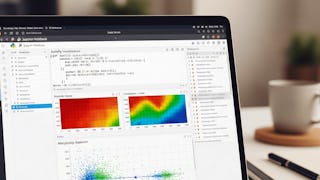
Build a strong foundation for Artificial Intelligence by learning the essential Python tools used for data handling and visualization. In Master AI Foundations with Python: Build, Analyze & Visualize, you will begin by setting up your Python development environment with Anaconda Navigator and Jupyter Notebook, creating an efficient workflow for AI projects. You will then develop practical skills with NumPy to create, index, filter, and manipulate arrays for AI-related data analysis. As you progress, you will explore Python data visualization with Matplotlib and Seaborn. Learn to create line, bar, and histogram charts before advancing to statistical visualizations such as scatter plots, heatmaps, and box plots that help uncover patterns, trends, and relationships within datasets. Designed for beginners starting their AI journey, this course combines environment setup, numerical computing, and data visualization into a structured, hands-on learning experience. By the end of the course, you will be able to configure a Python AI workspace, manipulate data efficiently with NumPy, and create meaningful visualizations that support AI data exploration. Whether you are preparing for more advanced Artificial Intelligence studies or building a solid computational foundation, this course equips you with the practical skills and confidence to take the next step.
KK
The course is good enough if your goal is to get a starting point in AI with Python, but don’t expect very detailed coverage of advanced techniques.
CC
Suitable for students, beginners, and aspiring data science professionals.
GK
I appreciated the step-by-step approach. Videos explain concepts clearly and you’re not rushed through things — which makes it easy if you’re switching from Python basics into data analysis and AI.
JJ
Instead of only theory, the course emphasizes building and visualizing models, which really helps in understanding how AI works in real scenarios.
KS
The emphasis on setting up real environments (Anaconda, Jupyter) gives strong practical grounding rather than just theory.
DD
Visualization is a strong part of the course; showing model outputs through charts and plots makes the learning much clearer and more intuitive.
SH
The visualization part is a good addition, as it helps in understanding data patterns and AI outputs in a more intuitive way.
RP
The teaching style is clear, concise, and focused on practical understanding rather than heavy jargon.
CP
It made AI feel approachable even if you’re new to the field.
MM
Good choice for learners who want to understand how AI works internally rather than just using ready-made libraries.
SM
A few videos are super fast — I needed to pause and re-watch to truly absorb concepts.
KJ
The progression from basic Python skills to core AI concepts is smooth and well structured.
Showing: 17 of 17
I appreciated the step-by-step approach. Videos explain concepts clearly and you’re not rushed through things — which makes it easy if you’re switching from Python basics into data analysis and AI.
Many find visualizing data fundamentals helps cement understanding of patterns and AI behavior — for example, seeing scatter plots or heat maps makes AI concepts less abstract.
Instead of only theory, the course emphasizes building and visualizing models, which really helps in understanding how AI works in real scenarios.
Visualization is a strong part of the course; showing model outputs through charts and plots makes the learning much clearer and more intuitive.
The emphasis on setting up real environments (Anaconda, Jupyter) gives strong practical grounding rather than just theory.
Good choice for learners who want to understand how AI works internally rather than just using ready-made libraries.
The teaching style is clear, concise, and focused on practical understanding rather than heavy jargon.
The progression from basic Python skills to core AI concepts is smooth and well structured.
A few videos are super fast — I needed to pause and re-watch to truly absorb concepts.
Suitable for students, beginners, and aspiring data science professionals.
It made AI feel approachable even if you’re new to the field.
great
The explanations are clear enough, and the examples help you understand how things actually work. I liked that it’s not too long and focuses on essential skills like plotting with Matplotlib and Seaborn.
The course is good enough if your goal is to get a starting point in AI with Python, but don’t expect very detailed coverage of advanced techniques.
The visualization part is a good addition, as it helps in understanding data patterns and AI outputs in a more intuitive way.
Visualizations are simple yet effective, helping learners interpret data patterns and model behavior better.
Very sub-par learning material, explained extremely basic stuff, showed basic code with no conceptual explanations. There is no 'AI' here. The quality of assigments was even lower, extremely common sensical questions, which anyone could answer even without taking the course. Please do not waste your time on this.