5.0
Reviewed Mar 19, 2018Fascinating subject. The content of this course is offered no where else. The course is well organized and presented with enthusiasm by Dr. Barber

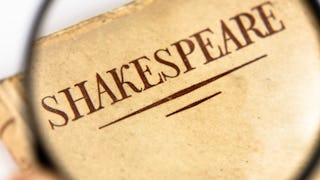
This course from the University of London explores critical thinking, and the interpretation of texts, through the Shakespeare authorship question. Using doubt about Shakespeare’s authorship as our playground, we will explore the key concept of authorship attribution, while developing skills in literary analysis, interpretation, and argument. Through forensic exploration of key texts, you will learn why Shakespeare’s authorship is questioned, and what evidence is cited on both sides of the debate. For those of you interested in exploring the works of Shakespeare from a new angle, or just wanting to hone your analytical thinking skills, this course offers an introduction to a fascinating area of interest. Those of you already interested in the Shakespeare authorship question will be encouraged to question your own assumptions in fruitful ways. Whether undertaken as a standalone course, or as preparation for the University of London BA in English, this course will be food for thought.
Fascinating subject. The content of this course is offered no where else. The course is well organized and presented with enthusiasm by Dr. Barber
The course was fantastic! I did this not really knowing what I was getting into, but I thoroughly enjoyed it.I cannot wait to start another course.
A Very Detailed Course on this existing question. The content was good, solid, and the quizzes were slightly tricky.
I want to know about who wrote Shakespeare, I never imagined that such easy way to know that and get certified internationally. Thank you, You made my life!!
Brilliant course, excellently delivered and full of fascinating content - and I speak as one who is not convinced by its basic premise!
Fascinating course! wonderful professor who was like a private investigator, probing while encouraging us to think and be open minded
I really enjoyed this course, and appreciate all the time and effort from everyone involved. Thank you.
This was an extremely interesting course. I loved that it questioned traditional thinking. I truly believe that more courses like this should exist. Excellent
interesting course that presented interesting perspectives on why Shakespeare may not have authored his works
good but in the quiz's when showing the answers its important to show the multiple choice answers too
Utterly brilliant, except where towards the end it gets bogged down by conspiracy theories involving the Knights Templar, Rosicrucians and Freemasons.
Excellent! advances the position that the Authorship Question is a valid and necessary subject for Academic research!
Showing: 20 of 126
The description of this course states that it “explores critical thinking, and the interpretation of texts, through the Shakespeare authorship question. Using doubt about Shakespeare’s authorship as our playground, we will explore the key concept of authorship attribution, while developing skills in literary analysis, interpretation, and argument. Through forensic exploration of key texts, by both Shakespeare and other writers of the period, you will learn why Shakespeare’s authorship is questioned, and what evidence is cited on both sides of the debate.”
The course failed based on its stated goals.
-- There was little exploration of critical thinking. Instead, a brief introduction to pop psychology warned against bias and the effects of cognitive dissonance.
-- The “skill development” took the form of stating certain rules for interpreting historical evidence. But there was no effort made to actually cover the historical method; one of the rules that was discussed is entirely unsupported by any historical authority; the one scholar named in the lecture, when contacted, strongly disagreed with the spin placed on his words.
-- The discussion of evidence on both sides took the form generally of setting up strawman arguments on the side of Shakespeare’s authorship for the purpose of knocking them down. Often the pro-Shakespeare arguments were taken out of context or given strained and illogical interpretations.
-- For instance, the lecturer devoted a quarter of the first module (A.3.) to a discussion of “the broker theory.” The idea was that, though Shakespeare was repeatedly named as a “player” in contemporary records and cast lists, he was really a “play-broker” who bought and sold plays, but neither wrote nor performed them. Nobody at the time was described as a “play-broker,” nor is there evidence that describing someone as a player really meant that the person was a “play-broker.” This entire line of discussion was apparently developed in order to identify Shakespeare as the target of a derisive poem that referred to “brokage” -- a word that meant something quite different from “brokerage” in the seventeenth century.
The instructor was quite clear that this course was intended to promote the fringe belief that a Shakespeare’s authorship of the plays and poems is seriously questioned. Though the description suggests that an even-handed approach would be observed, the lecturer chose to mispronounce Shakespeare’s name to distinguish the author from the man from Stratford; the comment section of the course was carefully scrubbed of pro-Shakespeare comments and even comments that complained about the quality of the course and materials -- in violation of the policies of Coursera.
Overall, this was a poorly organized, inadequately researched mess. The lecturer has no academic credentials in the area, and was frequently corrected by course participants who had a better grasp of the material. My recommendation is to drop this course entirely and start over, or just give it up.
Beginning with a lecture on Confirmation Bias was a brave way to start this course. Attributing the reasons behind people's enthusiasms to confirmation bias and cognitive dissonance is a comfortable way for contrarians to convince themselves that outrageous contradictions of accepted scholarship and buccaneering interpretations of the historical record are not intrinsically ridiculous.
In the 1990s, a group of mathematicians made a small fortune (they were caught early) by betting on the odds of a Hole in One in major golf tournaments. Unwary bookmakers would offer 500:1 or even 1000:1 when the actual odds were close to evens.A hole in one seemed much more unlikely than it actually was from thousands of tees shots played by hundreds of the best golfers in the world. Fans of the Authorship question try the same trick. Over and over and over. Only without the solid mathematical support. Each time a new tidbit appears—Weever's epigram, Sogliardo's identity, New Place malt stocks, Hampton Court as Avon, the Droueshout sleeves, suggestive numerology, the apparent solution of abstruse codes— articles are written about the "discovery" and websites filled with comment, support and argument. Yet amongst all the encyclopaedias of hopeful assertion, there is still no hard evidence supporting any alternative candidate. If there were, it would certainly have appeared in a four week attempt to legitimise doubt over Shakespeare's authorship—but check back. There is none. Nothing.There is no point in assessing the strength of the case for Shakespeare based on these materials. Dr Barber did not invite anyone to make it and could not have delivered a more feeble effort to make it herself. Items of evidence for Shakespeare are either challenged by the presentation of suggestive minutiae (rather than examined in their context) or waved away as part of a conspiracy to confuse and conceal the truth from everyone not possessed of the true eye for suggestive detail. Improbably, this includes almost everyone who studies and writes about Shakespeare (or ever has). Confirmation bias at work is the implication.Attributing significance to the insignificant is the business of the anti-Shakespearean. Arranging collections of suggestive nuggets in curiosity-inducing albums is the Art of the Doubter. "Oh look!" cries Barber, "I've found another Marian Hacket. Doubt!!" Then "Another Thomas Russell! Doubt!" and "a Warwickshire word in use in Newcastle! Doubt!". The doubt discussed in this MOOC is entirely created by of the tutors, who foster it with selective misinterpretation of the historical record, false parallelisms, wildly imaginative interpretations of contemporary references, and serious abuse of probability theory, all of which you will find in Dr Barber's modules.
The activity doesn't damage the case for Shakespeare.
In examining anti-Shakespearean method using this type of doubter methodology, the learning opportunities on this course lie entirely in the study of how irrational people think.
I would like to see Dr.Barber give a course in her fields of expertise, poetry and fictional literature, not in historical fields she doesn't understand. Historical research is a meticulous regimen. In pursuing the Shakespeare Authorship Question, Dr. Barber not only bypassed the history of the original authorship questions, she completely repeated the first questioners' mistakes, and continues down the paths of old dried-up ideas that lead nowhere. There have been legitimate and truly possible answers to the SAQ over the past century, developed by professional historical research. Co-authors of Shakespeare's plays, both definitely identified and quite possible, have been named. In this course these real possibilities are ignored in favor of unsubstantiated romances with the rich and famous. The SAQ arguments today aren't debatable arguments at all - they are complaints which can be summed up in these few words: "We are not being taken seriously." Dr. Barber's course has proven, once again, there is a good reason for that lack of acceptance. The only thing I received from this course was conversation with a very few participants who know how to ask questions and not insist that their favorite answers be the right ones. That was refreshing. But the course itself was stale, useless, and nothing I can recommend to anyone. Not even those who really, really want their favorite answers to the questions to be true. They've already been through all this before.
I've decided to discontinue my participation in the course, "Introduction to Who Wrote Shakespeare" conducted by Ros Barber. My reasons are that the course is too sloppily prepared. The typographical errors within the transcripts is extraordinarily high indicating that no one with authoritative knowledge has even read them, let alone proofread them. Entire transcripts don't even match the video at all. Class discussions posts are deleted for the pettiest of reasons. Threads attempting to find answers to some of this errors are locked for no valid reason.
In short this course is a massive disappointment for me.
The quizzes are too cryptic for me and the admitted error combined with all the transcription errors is just too much as it's just too difficult to sort it all out.
I'm a graduate in Music History from the University of Colorado, have 60 college hours beyond that, and 34 years of teaching experience and can say with absolute certainty that the pedagogical methodology of this course is abysmally substandard.
To be blunt this course is so far from unacceptable to a university standard, it is absolutely shocking.
This mooc is way below the standard of any mooc that I have ever encountered. The course information is inaccurate. It states >Through forensic exploration of key texts, by both Shakespeare and other writers of the period, you will learn why Shakespeare’s authorship is questioned, and what evidence is cited on both sides of the debate<. That is totally untrue, no Shakespeare texts at all are examined and a one-sided account of the debate is presented, that ignores well-established documentary evidence to the contrary. The quizzes are very badly designed and the scholarly standard deplorable. As another learner says below: >To be blunt this course is so far from unacceptable to a university standard, it is absolutely shocking<!
Sent from my iPad
Only because it won't accept a minus figure :-)
This was an extremely interesting course. I loved that it questioned traditional thinking. I truly believe that more courses like this should exist. Excellent
I want to know about who wrote Shakespeare, I never imagined that such easy way to know that and get certified internationally. Thank you, You made my life!!
The course was fantastic! I did this not really knowing what I was getting into, but I thoroughly enjoyed it.
I cannot wait to start another course.
I learnt many new information about shakespeare from this course. It is very helpful.
Captured my interest and changed my views
Two stars because I'm generous, and I'm no expert. I think there should be more indications of the time that some material was first mooted - e.g. so and so said this in, say, 1889 and then an indication that research has moved on since (or. tell the student where it hasn't). i think the course should start with the incumbent and then chip away from there. With this method, I feel there would be the sense of a journey rather than a feeling of scatter gun.
This was a fantastic course by Dr Ros Barber that was academically rigorous and exceedingly well-balanced, with plenty of extra material including incisive and incredibly detailed video interviews with Peter Dawkins, Mark Rylance, Professor William Leahy, Alexander Waugh and others. As someone who'd previously only been able to pursue research on this subject independently, including primary and secondary text sources, and even YouTube videos about the authorship question (including the excellent Shakespeare Authorship Trust SAT conference videos), being able to study this in an academic context gave me the assurance of what I already knew as well as, crucially, significantly expanding and deepening that knowledge. I feel it's absolutely crucial that many more people are able to learn from this course and discover this amazing subject. Exploring the issues of authorship can only enrich our knowledge of the plays, the period and the author, and has immediate relevance for our current times as well in so many areas. I also hope that there is the possibility of following up this introduction with further courses exploring the many illuminating academic strands of research that continue into the authorship question. Sincere thanks to Dr Barber and everyone who contributed to an excellent course.
For anyone seeking to discuss the Shakespeare authorship question this is a great course. If you do not believe this question should ever dare be asked it isn't the course for you. The course does not trumpet one "candidate" over any other, but encourages one to look closely at anything provided, on all sides, as evidence. It does ask one to question things we may have previously accepted with little query. There were some technical difficulties to begin with but the course leaders worked hard to sort them. The skill and joy of Shakespeare is never in doubt but who exactly Shakespeare might be is.
Great Course with many interesting and innovative concepts. Thanks to all the folks who must have worked hard and long to put this course on the internet. Dr Quincy
I just wish that I could give this course ten stars, as five doesn’t do justice to how much I’ve enjoyed participating in it! I thought I had a reasonable knowledge of Shakespeare (the texts at least), but the wider reading and the lectures available on this course have put them into a totally different context for me now. I realise that there is so much more to consider when discussing the works of Shakespeare than what is generally taught in schools and universities, and there are many more figures lurking on the peripheries of the authorship question than I first realised. I feel as though this course makes it permissible to question the Holy of Holies, William Shakespeare, and that authorship questioners are not actually just a fringe group. I really didn’t know there was quite so much academic insight into the possibility that Shakespeare may not actually have written Shakespeare, and am much more open to the idea that maybe the works were actually produced by a group of writers, as opposed to one man. I’m very excited to read more widely around the topic in my spare time, but am also glad to say that the possibility of more than one author, or a totally different one altogether, hasn’t diminished my love of the plays and poems at all! On a practical note, I have completed this course whilst in Covid 19 lockdown, and it’s been a wonderful focus for me during these difficult times. It’s given me structure, and much more to think about beyond the usual day to day news. It’s opened the world up a little bit for me, at a time when the world has shrunk, for all of us. Thank you!
As an introduction to the Authorship Question this is an excellent course. In a new course there are always room for improvement, and staff responds quickly on feedback. I've been aware and interested in the subject for ten years, and always tried to be balanced and equally hard when examining evidence and interpretations. This course starts with reminding us to be conscious of the human tendency to see and explain facts so it's fits our existing view. In my view, it continues in this cautious manner, often reminding us students to be careful about conclusions. I understand some Stratfordians might see the course as biased, but we must remember the subject is about the possibilities for non-Stratfordian answers. I also think the facts almost always is presented in a balanced and neutral way, and I have during the course preferred Stratfordian explanations sometimes and non-Stratfordian sometimes. I've also been encouraged to read deeper than ever in the texts and find I'm closer to them than ever. I find the videos very well structured and very clearly presented. I recommend this course warmly to anyone that is interested in knowing more about Shakespeare and/or the Authorship Question.
I did not finish first week yet, but felt the need to rate the course with the maximum score, just in case the producers need extra encouragement to finish the course with at least the same quality as at the beginning (is it new? I only have access to first week)
The way it is organized so far is just perfect. The videos are well realized, diverse (you get a lot of interviews of different experts) entertaining and effective. Ros Barber does a great job.
I particularly like the way quizzes are done. No matter the answer you chose, you get an extra explanation why you were right or wrong.
Thank you team!
As a long-time sceptic, I was delighted to find this course. I found Dr Barber very engaging, unlike many academics who do these online courses, and the interviews were also really engaging. Even as someone who has read widely around the authorship question, I learned a lot and found much to think about. I have a long list of things to look up and some further reading to do thanks to the course. I would hope Dr Barber will do more courses, perhaps looking at particular candidates for authorship. I enjoyed the quizzes too which helped to consolidate the learning as I went along. Thank you Dr Barber.
This course provides a gateway into the realm of the Shakespeare authorship question. The key pieces of authorship evidence are presented for consideration, the instructor is knowledgeable and engaging, and the guest interviews present thoughtful insights from literary scholars and actors who find this topic worthy of further exploration. Some technical glitches were quickly remedied by the attentive instructor, which helped to make this course an educational and enjoyable experience.