5.0
Reviewed Sep 13, 2018Highly educational, even for a veteran paleontologist like myself. I would indeed reccomend this course to anyone who has an interest in paleontology, evolutionary biology, or ornithology!

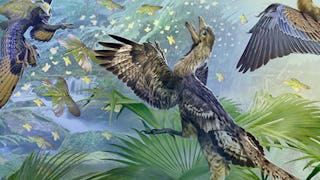
Paleontology: Theropod Dinosaurs and the Origin of Birds is a five-lesson course teaching a comprehensive overview of the origins of birds. This course examines the anatomy, diversity, and evolution of theropod dinosaurs in relation to the origin of birds. Students explore various hypotheses for the origin of flight. Watch a preview of the course here: https://uofa.ualberta.ca/courses/paleontology-theropod-dinosaurs
Highly educational, even for a veteran paleontologist like myself. I would indeed reccomend this course to anyone who has an interest in paleontology, evolutionary biology, or ornithology!
This course was great! It explains everything clearly, and it keeps you involved by asking questions about the material, and keeps you amused with some interesting anecdotes. Highly suggested by me!
The course is exceptional, but loses track near the end. In the beginning it has detailed taxonomical images of relevant bone-structure which is entirely missing by the final chapter.
Excellent course! Very thorough. Very knowledgable presenters. Loved how well the course was laid out. I with there could be more interactive activities like the dinosaur foot!
University of Alberta is specialized in courses! Another AMAZING course about pre history life! I'am really glad for you all taking your precious time to do it! Tks!
An engaging and interesting walk through the theropod family tree. It takes in the major non-avian species whilst looking at the traits that took them down the path to modern birds. Very much enjoyed.
I loved taking this course. I learned a lot (The first course I did was DINO 101 and I wanted to dig deeper). The teachers are really passionate and engaging. Cannot wait to do the others courses!
Very good job to summarise a large academic information to an interesting lecture. I cannot help see all the content continuously. The lecture notes are also very good for beginners.
assume class... You explore a lot of dinosaurs. Including many weird newly discovered ones. Plus you explore the variety what characterizes different types of birds.
I loved this course. It was informative, easy to understand, and exciting. The lecturer's knowledge and passion shone through in the lectures, and the course notes were a great supplement too.
This was a fantastic course, full of information and evidence.I loved the tutors. Very well presented and not complicated despite the subject matter.Do take this course.
We've got some extreme quality content here, as always when Philip J Curry is involved. The new student that presents most of the videos has great educational skills.
Showing: 19 of 478
Fascinating class! Covers a lot of material very clearly in five weeks. The use of the media is good with in-video quizzes, some games and an interactive phylogenetic tree of life. Course notes are provided for each lessons (they are very well done). The presenter, Scott Persons, a PhD student at the time if I am not mistaken, is great, though he is very surprisingly not credited on the homepage of the course, which is a shame (especially given that he has also written his scripts among other things...) I have attended all four paleontology courses from the University of Alberta and this is the one I preferred. Having first hand accounts of the discovery of Therapod fossils by Professor Currie is great and as a result the course strikes a good balance between giving facts and explaining the scientific method. Moreover, the historical part of the course, on the debate on the origin of dinosaurs, is very interesting and, as an added bonus, gives an idea of what the state of the field is today.
Amazing course!! I always wanted to learn about dinosaurs but most material that was available on the internet was either too easy or hard and filled with scientific jargon.This course had the right mix of scientific terms and analogies and Scott Persons and Dr.Currie made the complex terminology of dinosaurs quite easy to understand.
This course was great! It explains everything clearly, and it keeps you involved by asking questions about the material, and keeps you amused with some interesting anecdotes. Highly suggested by me!
I loved taking this course. I learned a lot (The first course I did was DINO 101 and I wanted to dig deeper). The teachers are really passionate and engaging. Cannot wait to do the others courses!
I loved this course. It was informative, easy to understand, and exciting. The lecturer's knowledge and passion shone through in the lectures, and the course notes were a great supplement too.
A really enjoyable class to go through if you're interested in evolution! However, I would certainly recommend studying up on paleontology and maybe ornithology as well before taking this class, as theres a lot of assumed knowledge that can bog you down if you don't already have it. I reccomend checking out the University of Alberta's Dino 101: Dinosaur Paleobiology first, which is a longer course but contains a lot of information that'll help you through some of the stickier portions of this class.
An excellent course......so well presented, so very exciting! I just loved it! I'm a retired neuroscience researcher (dementia) and held held positions as a Research Fellow and Adjunct Professor, Australian Catholic University. Since retiring I have been pursuing a long dormant passion for palaeontology and have worked on dinosaur projects in Outback Australia and have studied formal units in Palaeontology through the University of New England, Australia, and now this course through the University of Alberta! I have also obtained credentials as a laboratory technician with the Australian Age of Dinosaurs Museum. I look forward to doing another course via Coursera through the University of Alberta! Bloody beauty, mate!
I found this course to be fascinating, and it was a real achievement to get to grips with the biology and evolutionary changes that led to the Modern Dinosaurs - birds - surviving and thriving. I had, like many others, thought that this was a planet that was now dominated by mammals, after the dinosaurs became extinct. However, the enormous variety of birds that exist means that we co-evolved, and the mammalian branch of modern life is not quite so dominant as we had been taught! This is a really enjoyable course, if you like an intellectual challenge and a genuine sense of educational achievement when completed!
Hello, I am Manuel Aguirre, from Chile, for 25 years that I have not studied about Paleontology and dinosaurs. Since I presented my photography thesis project with a slide show of "Dinoaurs in Chile" 1995. Today, thanks to the University of Alberta, Canada and thanks to Professors Scott People and Phill Currie, at 56 years old I have become re-enchanted with these "prehistoric critters". And of course with the knowledge of the Evolution of the Birds. Despite the language barrier, I managed to do a good course. Just say thank you very much and I would like to continue studying Dinosaurs with you.
Loved it. I wish there were a 10 minute review at the end where everything is pulled together in a meaningful and cohesive way with a summary of the key evolutionary paths from dinosaurs to modern birds. I will go back through all the course material to sketch this out for myself. It would be nice to have an overview/summary/chart to study from though. I'd like to memorize key points and some more signposts to help with that would be great.
I finished the course in less than a week and loved every minute. I am left wanting more. P.S. I have a master's degree in biological sciences.
Originally took the class to keep up with my daughter who is in the childhood Paleontology phase. However, I found the class to be very informative and learned way more than I was expecting.
Highly educational, even for a veteran paleontologist like myself. I would indeed reccomend this course to anyone who has an interest in paleontology, evolutionary biology, or ornithology!
That was one of the Best Experience of Learning u people Nailed it Perfectly, waiting for some new courses from your side, Dhaval Shukal
A lot to inhale in a week or so, but very worth it. Hadn't taken any dinosaur course previously, so initially some of the terminology took some energy to assimilate. The course notes were worthy of far more attention than just the 10 or so minutes budgeted; I think they are given short shrift if read only cursorily. I would, however, recommend another editing pass to clear up the odd typo and grammar glitch to kick them up a notch and bring them to the same high quality as the videos.
There's good parallelism between the notes and the videos. The videos are thus very reinforcing of the notes, and vice versa. At times, it felt like trying to swallow a torrent of information - but my mindset was to remember everything said. That's not necessary; perhaps the greatest value of the course is the general sense of the flow of Theropod evolution, and of the diverse mechanics of evolution overall, revealed in that general sense.
As for content, at the course start I felt like my mind was an empty closet, and the facts were just being thrown in, onto a pile on the floor in the hope that later a coherent vision would emerge; at this point, I feel like the closet now has hooks and hangers and drawers by which those facts can be organized into that coherent collection. That's a very satisfying feeling, and encourages further exploration - which is one of the measures of a great course: engendering the desire to learn more.
On a practical level, the development of the understanding of dinosaur evolution as it evolved in the scientific community over time is a great reminder that science is rarely "settled," but rather is an exercise of trying to draw a detailed picture of a complex ship when you can only see parts of it through occasional openings in the fog, in little glimpses. Missteps and misinterpretations that need later correcting are intermingled with ongoing debates about what we are seeing and what it means. Scientists need always to be ready to throw out their most dearly-held beliefs in the face of new data - one of the hardest mental and emotional challenges we have to face in the search for truth. That's a pretty practical value to have reinforced by a course on dinosaurs - equally applicable to many aspects of life.
Finally, and with gratitude, I appreciate not only Coursera for making this available, but the people at University of Alberta for the major effort it took to put this course together, synthesizing and editing down the information into a nicely, well-rounded compendium that told an interesting and imagination-capturing story. Dinosaurs are one of the superstar interest areas in paleontology - captivating because of their amazing diversity and extreme size, as is obvious from their penetration so widely into the entertainment world. More than just their ability to hold our fascination, however, they are a gateway to interest in a broader study of life's diversity and origins, as well as a deeper respect for nature.
That's a good thing.
The truth is, ever since a little, I love dinosaurs. I even has several books about dinosaur. It is amazing that dinosaur still exist, the modern birds. The topic about theropod and origins of birds interests me. I figured out that birds are the only theropods with better physiology and adaptations. I don't need to revive those extinct dinosaurs, because in farms, forest, savanna, bird shop, park, city, Antartica, and all around the world, dinosaurs living among the mammals and other animals. There is another fact based on Molecular evidence, seven collagen types obtained from T rex's leg bone fragments, compared to collagen data from living birds (specifically, a chicken), suggest that older theropods and birds are closely related. And when you look at all the birds' legs, cooked or uncooked, they're still scaly like the dinosaur and their other relatives, the crocodilians.
In 2017, a study found that a peptide was present in the bone of the modern ostrich that was identical to that found in the Tyrannosaurus and Brachylophosaurus specimens. AND LIKE I SAID, you don't need to revive the dinosaurs, because they are still surround us.
I am a dinosaur lover. I even dreamed to have a Canary, pet finch bird, and budgerigar as a cheap dinosaur companion in my house, although dad doesn't agree with that.
One thing that I am still curious about is, if the birds are dinosaurs just like the non avian theropods, why the hip bone shape or structure of the birds are different than the non avian theropods' hip bones (saurischian hip bone). Which is why I hope Alberta University do more research abouth this
Excellent and informative course! I thoroughly enjoyed every minute of it and the class notes will be cherished and re-read every now and again. I'm really happy that the course wasn't too easy and was more aimed at those of us with already a decent understanding of palaeontology and zoology as it really taught me a lot.
The only thing I would mark it down on is that the course notes did not always correspond correctly and were out of order to the videos. I like to make notes and highlight as I watch and it took a lot of page jumping to do that. At the same time I am uncertain if the notes were supposed to be done this way, or worked through after the course.
I look forward to other courses by this University as this one was absolutely fantastic! I would love to see a course that goes more into detail on modern bird evolution and adaptions, the last lesson felt very rushed. I would also love to see courses covering other prehistoric species, perhaps the evolution of cats, whales etc or other dinosaur clades.
The instructors were a joy to listen to and easily understood too. I felt very involved and now have a much better understanding of theropods and their descendants. As an amateur paleoartist this helps me a lot!
Thank you so much for this wonderful course!
Entertaining, well designed and organized, thought-provoking course with enusiastic presentors and spectacular graphics.
Because I have never paid any attention to dinosaurs from the Mesozoic, and din't have a clue about the variety and naming conventions, I was initially overwhelmed by all the 15+ (seemed like 100+) character long names that were tossed about like popcorn tossed at the villan in a melodrama. It took a while, but I adjusted. Beware if you are not a dino connisseur.
While the course offers a primer in bird anatomy at the very beginning, the more you know about modern bird anatomy the better you will see the convulted map of evolution (and where you are heading) from the outset. My knowledge of bird anatomy was a helpful counter balance to my ignorance of Mesozoic dinos!
I thought that this course would simply be a nice side bar to my understanding and appreciation of birds. Instead it added a remarkable depth to my understanding, respect, and appreciation for the birds I observe and photograph every day.
Many thanks to the University of Alberta faculty and staff that make this course available!
Exceptional course! This course is great for anyone trying to get into Paleontology or even get a basic understanding of the evolution of adaptions for changing to evolutionary needs and ecology. All lessons are incredibly informative and easy to understand. i took this course because I have always had an interest in Paleontology, but never knew whether I wanted to pursue a career in it. I am in the US Navy and thanks to these paleontology courses presented by University of Alberta, I am now looking to continue forward with a career into Paleontology and pursue this interest that has been there since childhood. Paleontology: Theropod Dinosaurs and the origins of Birds is only one of the courses from the University of Alberta I would recommend. To the University of Alberta, Thank you for giving me the opportunity to dip my toe into this field and truly differentiate whether or not, I just loved the concept of dinosaurs or if I actually wanted to pursue a career in Paleontology and research. Fantastic course overall and truly changed my idea of what i want to pursue in my future career. Thank you.
A very good and in-depth course that can be taken with very little previous knowledge on the subject. Lecturers go in great detail, not simply giving you information, but really making sure you understand how we infer dinosaur's behaviour and function of different body parts. Biomechanics are taught at a level that is very easy to understand and allow you to apply your learning to different areas. The course is interactive, with many quizzes along the way that ensure you are not just memorising, but actually engaging and learning how to develop your thinking so that you can also interpret fossils to determine function and behaviour. Both illustrations and fossils are shown throughout the course, which are helpful in guiding one's learning. Recommended even for those not interested in Paleontology but are passionate for biology in general.