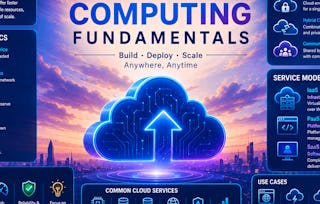
This comprehensive course provides a structured and practice-oriented introduction to cloud computing fundamentals, guiding learners from core theoretical concepts to real-world cloud system implementation. Beginning with distributed computing principles, virtualisation, and containerisation, the course establishes the technological foundations that enable modern cloud infrastructures. Learners gain clarity on cloud characteristics, deployment models, and service models (IaaS, PaaS, SaaS), supported by the 3-4-5 rule for conceptual coherence.

Cloud Computing Fundamentals
kurs ist nicht verfügbar in Deutsch (Deutschland)
Wir übersetzen es in weitere Sprachen.

Verschaffen Sie sich einen Einblick in ein Thema und lernen Sie die Grundlagen.
Stufe Mittel
Empfohlene Erfahrung
3.5 months to complete
unter 10 Stunden pro Woche
Flexibler Zeitplan
In Ihrem eigenen Lerntempo lernen
Verschaffen Sie sich einen Einblick in ein Thema und lernen Sie die Grundlagen.
Stufe Mittel
Empfohlene Erfahrung
3.5 months to complete
unter 10 Stunden pro Woche
Flexibler Zeitplan
In Ihrem eigenen Lerntempo lernen
Was Sie lernen werden
Explain cloud computing fundamentals, including service models, deployment models, and key characteristics of the cloud.
Apply virtualization and containerization concepts to build scalable, portable, and efficient cloud environments.
Use AWS services (EC2, S3, IAM, CloudWatch) to deploy, manage, monitor, and secure cloud-based applications.
Evaluate scalability, scheduling, reliability, and fault tolerance challenges in cloud systems using real-world scenarios.
Kompetenzen, die Sie erwerben
- Kategorie: Software As A ServiceSoftware As A Service
- Kategorie: Cloud ServicesCloud Services
- Kategorie: Cloud ManagementCloud Management
- Kategorie: Cloud ComputingCloud Computing
- Kategorie: Capacity ManagementCapacity Management
- Kategorie: Cloud InfrastructureCloud Infrastructure
- Kategorie: VirtualizationVirtualization
- Kategorie: Multi-Tenant Cloud EnvironmentsMulti-Tenant Cloud Environments
- Kategorie: Cloud DeploymentCloud Deployment
- Kategorie: Cloud Computing ArchitectureCloud Computing Architecture
- Kategorie: Cloud SecurityCloud Security
- Kategorie: Cloud HostingCloud Hosting
- Kategorie: Cloud SolutionsCloud Solutions
- Kategorie: Distributed ComputingDistributed Computing
Werkzeuge, die Sie lernen werden
- Kategorie: AWS Identity and Access Management (IAM)AWS Identity and Access Management (IAM)
- Kategorie: Infrastructure As A Service (IaaS)Infrastructure As A Service (IaaS)
- Kategorie: Amazon Web ServicesAmazon Web Services
- Kategorie: Cloud StorageCloud Storage
- Kategorie: KubernetesKubernetes
- Kategorie: Amazon Elastic Compute CloudAmazon Elastic Compute Cloud
Wichtige Details

Zertifikat zur Vorlage
Zu Ihrem LinkedIn-Profil hinzufügen
Bewertungen
95 Aufgaben
Unterrichtet in Englisch
Erfahren Sie, wie Mitarbeiter führender Unternehmen gefragte Kompetenzen erwerben.

In diesem Kurs gibt es 12 Module
This module introduces you to the course and its syllabus. The course introductory video orients you to the skills and knowledge you will acquire through this course. The syllabus reading highlights the course values, assessments, grading scheme, schedule and details of live sessions, and readings list that you must procure to acquire the concepts better. You will also meet and greet your peers around the globe through a discussion prompt.
Das ist alles enthalten
3 Videos1 Lektüre1 Diskussionsthema
3 Videos•Insgesamt 11 Minuten
- Course Introduction•8 Minuten
- Meet Your Instructor: Prof. R. K. Chandrasekar•2 Minuten
- Meet Your Instructor: Prof. Sai Kishor Jangiti•2 Minuten
1 Lektüre•Insgesamt 10 Minuten
- Course Overview•10 Minuten
1 Diskussionsthema•Insgesamt 10 Minuten
- Meet Your Peers•10 Minuten
This module provides a foundational understanding of cloud computing, starting with the core principles of distributed computing and progressing toward the essential characteristics, deployment models, and service models that define the cloud. Learners will explore the evolution of computing technologies that paved the way for the cloud and gain clarity on how modern infrastructure leverages distributed resources to deliver scalable and reliable computing services. The module introduces the 3-4-5 Rule of Cloud Computing, a simplified framework to grasp the three service models, four deployment models, and five key characteristics of cloud computing.
Das ist alles enthalten
9 Videos2 Lektüren8 Aufgaben1 Diskussionsthema
9 Videos•Insgesamt 92 Minuten
- Distributed Computing and Models•5 Minuten
- Distributed Computing Models•6 Minuten
- Cloud Computing•6 Minuten
- Evolution of Computing•8 Minuten
- 5 – Characteristics of Cloud•4 Minuten
- Deployment Models•9 Minuten
- Service Models•5 Minuten
- Cloud Infrastructure•6 Minuten
- Recording of Cloud Computing Fundamentals: Week 1 - Live Session on 26-03-22•42 Minuten
2 Lektüren•Insgesamt 40 Minuten
- Recommended Reading: Introduction to Cloud Concepts•20 Minuten
- Recommended Reading: 3-4-5 Rule of Cloud Concepts•20 Minuten
8 Aufgaben•Insgesamt 48 Minuten
- Distributed Computing and Models•6 Minuten
- Distributed computing models•6 Minuten
- Cloud Computing•6 Minuten
- Evolution of Computing•6 Minuten
- 5 – Characteristics of Cloud•6 Minuten
- Deployment Models•6 Minuten
- Service Models•6 Minuten
- Cloud Infrastructure•6 Minuten
1 Diskussionsthema•Insgesamt 30 Minuten
- Cloud Computing: Evolution, Models, and Impact on IT Infrastructure•30 Minuten
This module introduces the concept of virtualisation—one of the foundational technologies behind cloud computing. Learners will explore how virtualisation abstracts physical resources to create scalable and efficient computing environments. The module covers the basics of virtualisation, the purpose and function of hypervisors, and dives deeper into the virtualisation of key system components such as CPU, memory, and I/O. It also explains the different approaches to CPU virtualisation and categorises hypervisor types based on architecture and use case. Through interactive videos, quizzes, and readings, students will build a solid foundation in virtualisation technologies.
Das ist alles enthalten
7 Videos2 Lektüren7 Aufgaben1 Diskussionsthema
7 Videos•Insgesamt 91 Minuten
- Basics of Virtualisation•6 Minuten
- Hypervisor•7 Minuten
- Virtualisation - CPU•6 Minuten
- Approaches to CPU Virtualisation•5 Minuten
- Virtualisation – Memory and I/O•7 Minuten
- Hypervisor Types •5 Minuten
- Recording of Cloud Computing Fundamentals: Week 2 - Live Session on 26-03-27•56 Minuten
2 Lektüren•Insgesamt 35 Minuten
- Recommended Reading: Virtualisation•15 Minuten
- Recommended Reading: Virtualisation of Components•20 Minuten
7 Aufgaben•Insgesamt 96 Minuten
- Basics of Virtualisation•6 Minuten
- Hypervisor•6 Minuten
- Virtualisation - CPU•6 Minuten
- Approaches to CPU Virtualisation•6 Minuten
- Virtualisation – Memory and I/O•6 Minuten
- Hypervisor Types •6 Minuten
- Graded Quiz for Week 1 and 2•60 Minuten
1 Diskussionsthema•Insgesamt 30 Minuten
- Virtualisation: The Enabling Technology of Cloud Computing•30 Minuten
This module introduces the core concepts of containerisation and its critical role in modern software development and deployment. It begins by explaining what containers are, their evolution, and the different types used in the industry today. The module then explores Docker, a popular containerisation platform, including how to install, run, and manage containers using essential Docker commands. Finally, learners will gain hands-on insights into container networking (bridge, host, and overlay modes) and persistent storage techniques. Through structured video lessons, practice quizzes, and readings, learners will build the foundational skills needed to work with containerised applications.
Das ist alles enthalten
11 Videos3 Lektüren10 Aufgaben1 Diskussionsthema
11 Videos•Insgesamt 96 Minuten
- What are Containers?•5 Minuten
- Containers - History•6 Minuten
- Types of Containers•6 Minuten
- Docker•8 Minuten
- Running a Docker Container•4 Minuten
- Docker Commands•8 Minuten
- Networking in Containers – Bridge Type•8 Minuten
- Network Drivers – Host Type•5 Minuten
- Network Drivers – Overlay Type•2 Minuten
- Container Storage•5 Minuten
- Recording of Cloud Computing Fundamentals: Week 3 - Live Session on 26-04-03•40 Minuten
3 Lektüren•Insgesamt 55 Minuten
- Recommended Reading: Containers•15 Minuten
- Recommended Reading: The Docker Platform•20 Minuten
- Recommended Reading: Container Networking•20 Minuten
10 Aufgaben•Insgesamt 72 Minuten
- What are Containers?•6 Minuten
- Containers - History•6 Minuten
- Types of Containers•9 Minuten
- Docker•6 Minuten
- Running a Docker Container•6 Minuten
- Docker Commands•6 Minuten
- Networking in Containers – Bridge Type•6 Minuten
- Network Drivers – Host Type•9 Minuten
- Network Drivers – Overlay Type•9 Minuten
- Container Storage•9 Minuten
1 Diskussionsthema•Insgesamt 30 Minuten
- The Container Revolution: Docker and Container Orchestration•30 Minuten
This module introduces Infrastructure as a Service (IaaS), one of the core service models in cloud computing. Learners begin by exploring the foundational concepts of IaaS and its role in modern IT environments. The focus then shifts to Amazon Web Services (AWS), the leading IaaS provider, where learners will understand key services such as compute, networking, identity, and access management. Practical insights into launching and managing EC2 instances, AWS's shared responsibility model, IAM roles and policies, and compute pricing models will prepare learners for hands-on work with cloud infrastructure.
Das ist alles enthalten
14 Videos4 Lektüren14 Aufgaben1 Diskussionsthema
14 Videos•Insgesamt 128 Minuten
- Infrastructure as Software•5 Minuten
- Key Concepts of IaaS•5 Minuten
- What is a Web Service?•6 Minuten
- AWS Global Infrastructure•5 Minuten
- AWS Global Infrastructure•10 Minuten
- AWS Shared Responsibility Model•6 Minuten
- IAM•6 Minuten
- IAM: Policies and Roles•6 Minuten
- Choosing the Optimal Compute Service: EC2•4 Minuten
- Launching an EC2 Instance: Part 1•6 Minuten
- Launching an EC2 Instance: Part 2•4 Minuten
- Amazon EC2 Instance Lifecycle•5 Minuten
- Amazon EC2 Pricing Models•5 Minuten
- Recording of Cloud Computing Fundamentals: Week 4 - Live Session on 26-04-10•57 Minuten
4 Lektüren•Insgesamt 70 Minuten
- Recommended Reading: Infrastructure As A Service – A Beginning •20 Minuten
- Recommended Reading: AWS Web Services•20 Minuten
- Recommended Reading: AWS – Identity and Access Management•15 Minuten
- Recommended Reading: AWS Compute Service•15 Minuten
14 Aufgaben•Insgesamt 144 Minuten
- Infrastructure as Software•6 Minuten
- Key Concepts of IaaS•6 Minuten
- What is a Web Service?•6 Minuten
- AWS Global Infrastructure•6 Minuten
- AWS Global Infrastructure•12 Minuten
- Model AWS Shared Responsibility•6 Minuten
- IAM (Identity and Access Management)•6 Minuten
- IAM: Policies and Roles•6 Minuten
- Choosing the Optimal Compute Service: EC2•6 Minuten
- Launching an EC2 Instance: Part 1•6 Minuten
- Launching an EC2 Instance: Part 2•6 Minuten
- Amazon EC2 Instance Lifecycle•6 Minuten
- Amazon EC2 Pricing Models•6 Minuten
- Graded Quiz for Week 3 and 4•60 Minuten
1 Diskussionsthema•Insgesamt 30 Minuten
- Infrastructure as Software: Transforming IT through Cloud-Based IaaS•30 Minuten
This module focuses on the storage and database services offered by AWS, along with an introduction to the Platform as a Service (PaaS) and Software as a Service (SaaS) models. Learners will explore various AWS storage options, including Amazon EBS, S3, and EFS, and understand when and how to use each. The module also covers AWS's managed database services such as Amazon RDS, DynamoDB, Aurora, and Redshift. In addition, learners will examine the principles of PaaS and SaaS, their architectures, business models, and user benefits, highlighting their applicability across different cloud solutions.
Das ist alles enthalten
13 Videos4 Lektüren13 Aufgaben1 Diskussionsthema
13 Videos•Insgesamt 115 Minuten
- Storage Types in AWS•4 Minuten
- Amazon EBS – Elastic Block Storage•6 Minuten
- Amazon S3 – Simple Storage Service•5 Minuten
- Amazon EFS – Elastic File System•3 Minuten
- Amazon RDS – Relational Database Service•5 Minuten
- Amazon RDS – DB Instance•4 Minuten
- When to Use Amazon RDS?•4 Minuten
- Amazon Dynamo DB•4 Minuten
- Amazon Redshift•4 Minuten
- Amazon Aurora•5 Minuten
- Introduction to PaaS•4 Minuten
- How does PaaS Work?•4 Minuten
- Recording of Cloud Computing Fundamentals: Week 5 - Live Session on 26-04-17•62 Minuten
4 Lektüren•Insgesamt 55 Minuten
- Recommended Reading: AWS Storage•10 Minuten
- Recommended Reading: Amazon Databases•20 Minuten
- Recommended Reading: PaaS – Platform As A Service•15 Minuten
- Live Session•10 Minuten
13 Aufgaben•Insgesamt 4.392 Minuten
- Storage Types in AWS•6 Minuten
- Amazon EBS – Elastic Block Storage•6 Minuten
- Amazon S3 – Simple Storage Service•6 Minuten
- Amazon EFS – Elastic File System•6 Minuten
- Amazon RDS – Relational Database Service•6 Minuten
- Amazon RDS – DB Instance•6 Minuten
- When to Use Amazon RDS?•6 Minuten
- Amazon Dynamo DB•6 Minuten
- Amazon Redshift•6 Minuten
- Amazon Aurora•6 Minuten
- Introduction to PaaS•6 Minuten
- How does PaaS Work?•6 Minuten
- SGA-1: Build and Deploy a Scalable Secure Web App on AWS•4.320 Minuten
1 Diskussionsthema•Insgesamt 30 Minuten
- AWS Storage Services and Cloud Platform Models•30 Minuten
This module introduces learners to the foundational cloud service models—Infrastructure as a Service (IaaS), Platform as a Service (PaaS), and Software as a Service (SaaS)—with a focus on SaaS. It explores how SaaS applications are architected, delivered, and consumed over the internet without requiring users to manage infrastructure. Through real-world examples like Google Docs, Netflix, and Lideo, learners will understand the benefits of SaaS, including scalability, accessibility, and cost-efficiency. The module also demystifies multi-tenancy, a core concept in SaaS, using visual aids and hands-on deployment of a Java-based LMS on AWS EC2. By the end, learners will be able to explain SaaS architecture and deploy a basic SaaS application.
Das ist alles enthalten
11 Videos4 Lektüren11 Aufgaben1 Diskussionsthema
11 Videos•Insgesamt 160 Minuten
- Software as a Service•18 Minuten
- SaaS, PaaS & IaaS•15 Minuten
- Deep Dive into SaaS Architecture•11 Minuten
- Industry Use Cases•10 Minuten
- How laaS Provides Compute and Storage •7 Minuten
- PaaS as Middleware for API-Driven Services •7 Minuten
- Virtualisation and Containerisation Enabling Scalability•12 Minuten
- How Lideo Uses SaaS Frameworks •12 Minuten
- Evaluate the Pros and Cons of Cloud-Based LMS •12 Minuten
- SaaS App Deployment in AWS•12 Minuten
- Recording of Cloud Computing Fundamentals: Week 6 - Live Session on 26-04-24•46 Minuten
4 Lektüren•Insgesamt 125 Minuten
- Recommended Reading: Introduction to SaaS Fundamentals•40 Minuten
- Recommended Reading: SaaS Models in Cloud Computing – How Lideo Leverages IaaS & PaaS•50 Minuten
- Recommended Reading: Deploying LMS as a SaaS Application•20 Minuten
- Instructional Document: Staff-Graded Assignment-2•15 Minuten
11 Aufgaben•Insgesamt 147 Minuten
- Software as a Service•9 Minuten
- SaaS, PaaS & IaaS•9 Minuten
- Deep Dive into SaaS Architecture•9 Minuten
- Industry Use Cases•9 Minuten
- How laaS Provides Compute and Storage •9 Minuten
- PaaS as Middleware for API-Driven Services •9 Minuten
- Virtualisation and Containerisation Enabling Scalability•9 Minuten
- How Lideo Uses SaaS Frameworks •9 Minuten
- Evaluate the Pros and Cons of Cloud-Based LMS •9 Minuten
- SaaS App Deployment in AWS•6 Minuten
- Graded Quiz for Week 5 and 6•60 Minuten
1 Diskussionsthema•Insgesamt 30 Minuten
- Analysing Cloud Service Models through Real-World SaaS Applications•30 Minuten
This module focuses on cloud storage types—object, block, and file—and how they are used in SaaS applications. Learners will explore AWS S3 storage classes such as Standard, Intelligent-Tiering, and Glacier, and understand how lifecycle policies help optimize storage costs. Using LMS content as a case study, the module demonstrates how different types of data map to different storage tiers. Learners will configure S3 buckets, set lifecycle rules, and estimate monthly costs using the AWS Pricing Calculator.
Das ist alles enthalten
6 Videos3 Lektüren6 Aufgaben1 Diskussionsthema
6 Videos•Insgesamt 35 Minuten
- Storage Models•12 Minuten
- Lifecycle and Tiering•6 Minuten
- Cost Estimation•5 Minuten
- Data Access Patterns•4 Minuten
- LMS Storage Integration •4 Minuten
- Storage Monitoring and Security •4 Minuten
3 Lektüren•Insgesamt 110 Minuten
- Recommended Reading: Storage Models and Tiering•25 Minuten
- Recommended Reading: Cost and Access Optimisation•60 Minuten
- Recommended Reading: LMS Integration and Security•25 Minuten
6 Aufgaben•Insgesamt 54 Minuten
- Storage Models•9 Minuten
- Lifecycle and Tiering•9 Minuten
- Cost Estimation•9 Minuten
- Data Access Patterns•9 Minuten
- LMS Storage Integration •9 Minuten
- Storage Monitoring and Security•9 Minuten
1 Diskussionsthema•Insgesamt 30 Minuten
- Cost and Access Optimisation for Cloud Storage•30 Minuten
This module explores how cloud platforms manage fluctuating demand through elasticity, scalability, auto-scaling, and load balancing. Learners will understand the principles of capacity planning and how cloud services dynamically allocate resources to maintain performance and cost-efficiency. Using the LMS backend as a case study, learners will create AMIs, configure Auto Scaling Groups, and deploy Load Balancers to handle simulated traffic. CloudWatch metrics will be used to monitor performance and scaling behaviour.
Das ist alles enthalten
7 Videos3 Lektüren7 Aufgaben1 Diskussionsthema
7 Videos•Insgesamt 59 Minuten
- Capacity Concepts•4 Minuten
- Provisioning Strategies•3 Minuten
- Auto Scaling Setup•5 Minuten
- Load Balancing•7 Minuten
- Traffic Simulation•5 Minuten
- Performance Monitoring•4 Minuten
- Recording of Cloud Computing Fundamentals: Week 9 - Live Session on 26-05-15 •30 Minuten
3 Lektüren•Insgesamt 120 Minuten
- Recommended Reading: Elasticity and Provisioning•45 Minuten
- Recommended Reading: Scaling Infrastructure•30 Minuten
- Recommended Reading: Monitoring and Simulation•45 Minuten
7 Aufgaben•Insgesamt 114 Minuten
- Capacity Concepts•9 Minuten
- Provisioning Strategies•9 Minuten
- Auto Scaling Setup•9 Minuten
- Load Balancing•9 Minuten
- Traffic Simulation•9 Minuten
- Performance Monitoring•9 Minuten
- Graded Quiz for Week 7 and 8•60 Minuten
1 Diskussionsthema•Insgesamt 30 Minuten
- Auto Scaling and Load Balancing in Real-World Deployments•30 Minuten
This module introduces scheduling in cloud environments, emphasising its role in optimising resource usage and application performance. Learners will explore static and dynamic scheduling approaches, including Round Robin and priority-based algorithms. The module also covers Kubernetes pod scheduling using Amazon EKS, demonstrating how cloud-native applications manage workloads efficiently. Through a hands-on lab, learners will implement a Java-based scheduler in the LMS backend that adjusts task execution based on system load, using CloudWatch metrics.
Das ist alles enthalten
6 Videos3 Lektüren7 Aufgaben1 Diskussionsthema
6 Videos•Insgesamt 50 Minuten
- Scheduling Concepts•9 Minuten
- Java Schedulers in Cloud Applications•12 Minuten
- CloudWatch Integration•9 Minuten
- Logging and Visualisation•6 Minuten
- Pod Deployment•8 Minuten
- Performance Analysis•7 Minuten
3 Lektüren•Insgesamt 140 Minuten
- Recommended Reading: Scheduling Fundamentals•40 Minuten
- Recommended Reading: Implementing Scheduling Logic•60 Minuten
- Recommended Reading: Kubernetes Scheduling•40 Minuten
7 Aufgaben•Insgesamt 654 Minuten
- Scheduling Concepts•9 Minuten
- Java Schedulers in Cloud Applications•9 Minuten
- CloudWatch Integration•9 Minuten
- Logging and Visualisation•9 Minuten
- Pod Deployment•9 Minuten
- Performance Analysis•9 Minuten
- SGA-2: Cloud Deployment, Optimisation, and Monitoring of a Cloud-Based Fitness & Wellness Platform•600 Minuten
1 Diskussionsthema•Insgesamt 30 Minuten
- Cloud Scheduler Design Decisions•30 Minuten
This module addresses the critical challenges in cloud computing, including availability, fault tolerance, multi-tenancy risks, security, and compliance. Learners will explore how AWS services like IAM, CloudWatch, and encryption tools help mitigate these risks. The module includes a case study on cloud outages and SLA enforcement, guiding learners through the process of defining and monitoring service-level objectives. In the lab, learners will configure IAM roles, simulate failures, and analyse recovery metrics using CloudWatch.
Das ist alles enthalten
10 Videos3 Lektüren11 Aufgaben1 Diskussionsthema
10 Videos•Insgesamt 87 Minuten
- Availability Concepts•10 Minuten
- Fault Tolerance Mechanisms•9 Minuten
- Outage Analysis•9 Minuten
- Multi-Tenancy Risks and Mitigation•9 Minuten
- IAM Configuration for EC2 and S3•11 Minuten
- Monitoring with CloudWatch•7 Minuten
- Log Analysis for Security•7 Minuten
- SLA Metrics and Monitoring•8 Minuten
- Encryption and Access Control•8 Minuten
- Compliance Evaluation •8 Minuten
3 Lektüren•Insgesamt 165 Minuten
- Recommended Reading – Reliability and Fault Tolerance•50 Minuten
- Recommended Reading – Security and Monitoring•65 Minuten
- Recommended Reading: Compliance and SLA•50 Minuten
11 Aufgaben•Insgesamt 150 Minuten
- Availability Concepts•9 Minuten
- Fault Tolerance Mechanisms•9 Minuten
- Outage Analysis•9 Minuten
- Multi-Tenancy Risks and Mitigation•9 Minuten
- IAM Configuration for EC2 and S3•9 Minuten
- Monitoring with CloudWatch•9 Minuten
- Log Analysis for Security•9 Minuten
- SLA Metrics and Monitoring•9 Minuten
- Encryption and Access Control•9 Minuten
- Compliance Evaluation •9 Minuten
- Graded Quiz for Week 9 and 10•60 Minuten
1 Diskussionsthema•Insgesamt 30 Minuten
- Security in Multi-Tenant Cloud Environments•30 Minuten
End-Term Examination
Das ist alles enthalten
3 Videos1 Aufgabe
3 Videos•Insgesamt 158 Minuten
- Recording of Cloud Computing Fundamentals: Week 10 - Live Session on 26-05-17 18:30:41 [04:28]•64 Minuten
- Recording of Cloud Computing Fundamentals: Week 7 - Live Session on 26-05-18 18:35:13 [47:55]•48 Minuten
- Recording of Cloud Computing Fundamentals: Week 8 - Live Session on 26-05-19 18:35:49 [45:26]•45 Minuten
1 Aufgabe•Insgesamt 30 Minuten
- End-Term Examination•30 Minuten
Dozenten


Mehr von Computer Security and Networks entdecken
 B
BBirla Institute of Technology & Science, Pilani
Kurs
Kategorie: VorschauVorschau U
UUniversity of Pittsburgh
Kurs
Status: Kostenloser TestzeitraumKostenloser Testzeitraum W
WWhizlabs
Kurs
Status: Kostenloser TestzeitraumKostenloser Testzeitraum W
WWhizlabs
Kurs
Status: Kostenloser TestzeitraumKostenloser Testzeitraum
Warum entscheiden sich Menschen für Coursera für ihre Karriere?

Felipe M.
Lernender seit 2018
„Es ist eine großartige Erfahrung, in meinem eigenen Tempo zu lernen. Ich kann lernen, wenn ich Zeit und Nerven dazu habe.“

Jennifer J.
Lernender seit 2020
„Bei einem spannenden neuen Projekt konnte ich die neuen Kenntnisse und Kompetenzen aus den Kursen direkt bei der Arbeit anwenden.“

Larry W.
Lernender seit 2021
„Wenn mir Kurse zu Themen fehlen, die meine Universität nicht anbietet, ist Coursera mit die beste Alternative.“

Chaitanya A.
„Man lernt nicht nur, um bei der Arbeit besser zu werden. Es geht noch um viel mehr. Bei Coursera kann ich ohne Grenzen lernen.“
Bringen Sie Ihre Karriere mit einem Online-Abschluss voran.
Erwerben Sie einen Abschluss von erstklassigen Universitäten – 100 % online




Häufig gestellte Fragen
To access course materials, assignments, and earn a Certificate, you'll need to purchase the Certificate experience when you enroll in a course. Eligible learners may also have the option to start with a Free Trial. Some courses may also offer a Full Course, No Certificate option. This lets you access course materials, submit required assessments, and receive a final grade, but you won't be able to earn or purchase a Certificate.
When you purchase a Certificate you get access to all course materials, including graded assignments. Upon completing the course, your electronic Certificate will be added to your Accomplishments page - from there, you can print your Certificate or add it to your LinkedIn profile.
Yes. In select learning programs, you can apply for financial aid or a scholarship if you can’t afford the enrollment fee. If fin aid or scholarship is available for your learning program selection, you’ll find a link to apply on the description page.
Weitere Fragen
Finanzielle Unterstützung verfügbar,