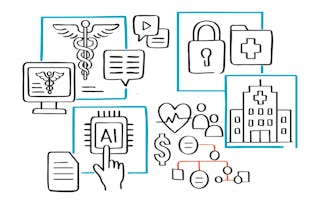
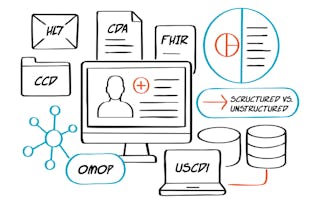
This course provides an introduction to health informatics, the discipline at the intersection of people, information, and technology in healthcare. Across four modules, it covers the transition from paper to electronic records and the distinctions among EMR, EHR, PHR, and CHR; how healthcare data is captured, organized, and stored, including database fundamentals, the components of the electronic health record, and the usability and workflow factors that determine whether systems succeed; the standards and terminologies that enable interoperability — HL7, FHIR, LOINC, SNOMED CT, ICD-10, and DICOM — along with health information exchange and information-blocking policy; and the application of informatics to clinical decision support and patient safety, telemedicine and telehealth, consumer and public health informatics, privacy and security, and artificial intelligence in healthcare.

Intro to Health Informatics and Health Information Systems
Zum Labor Day gibt es bei Coursera Plus Rabatte von über 70 $. Sparen Sie 3 Monate lang 40 %.

Intro to Health Informatics and Health Information Systems

Dozent: Armando Cortez
Bei Mehr erfahren enthalten
Verschaffen Sie sich einen Einblick in ein Thema und lernen Sie die Grundlagen.
Stufe Anfänger
Keine Vorkenntnisse erforderlich
1 Woche zu vervollständigen
unter 10 Stunden pro Woche
Flexibler Zeitplan
In Ihrem eigenen Lerntempo lernen
Kompetenzen, die Sie erwerben
- Kategorie: ICD Coding (ICD-9/ICD-10)
- Kategorie: Responsible AI
- Kategorie: Healthcare Industry Knowledge
- Kategorie: Computerized Physician Order Entry
- Kategorie: Human Computer Interaction
- Kategorie: Medical Records
- Kategorie: Health Technology
- Kategorie: Informatics
- Kategorie: Health Information Management
- Kategorie: Health Care Procedure and Regulation
- Kategorie: Interoperability
- Kategorie: Health Systems
- Kategorie: Usability
- Kategorie: Electronic Medical Record
- Kategorie: Health Informatics
- Kategorie: Telehealth
- Kategorie: Health Information Management and Medical Records
- Kategorie: Health Care
- Kategorie: Clinical Informatics
Werkzeuge, die Sie lernen werden
- Kategorie: Electronic Medical Record System
Wichtige Details

Zertifikat zur Vorlage
Zu Ihrem LinkedIn-Profil hinzufügen
Kürzlich aktualisiert!
Juni 2026
Bewertungen
19 Aufgaben
Unterrichtet in Englisch
Erfahren Sie, wie Mitarbeiter führender Unternehmen gefragte Kompetenzen erwerben.

In diesem Kurs gibt es 4 Module
Dozent

Mehr von Health Informatics entdecken

Northeastern University

Northeastern University
Illinois Tech
Illinois Tech
Warum entscheiden sich Menschen für Coursera für ihre Karriere?

Felipe M.
Lernender seit 2018
„Es ist eine großartige Erfahrung, in meinem eigenen Tempo zu lernen. Ich kann lernen, wenn ich Zeit und Nerven dazu habe.“

Jennifer J.
Lernender seit 2020
„Bei einem spannenden neuen Projekt konnte ich die neuen Kenntnisse und Kompetenzen aus den Kursen direkt bei der Arbeit anwenden.“

Larry W.
Lernender seit 2021
„Wenn mir Kurse zu Themen fehlen, die meine Universität nicht anbietet, ist Coursera mit die beste Alternative.“

Chaitanya A.
„Man lernt nicht nur, um bei der Arbeit besser zu werden. Es geht noch um viel mehr. Bei Coursera kann ich ohne Grenzen lernen.“




Häufig gestellte Fragen
Weitere Fragen
Finanzielle Unterstützung verfügbar,