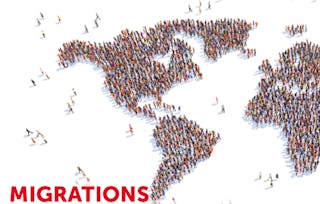
Migration to and within Europe poses particular issues related to ensuring equitable access to healthcare. Throughout this course, you will gain insight into the root causes and types of migration, the current evidence and state of data in the region, examples of good practice, and how migration health can be studied and new evidence generated and translated into policy and practice.
The course is specifically aimed at public health practitioners, researchers and policymakers, however, healthcare providers and educators may also find the course very useful.
This course - co-developed with policy, academic, clinical and humanitarian actors - is strongly and uniquely positioned to give you the needed skills and knowledge to build a bridge between research and practice. The course was created with the University of Milan in collaboration with the Lancet Migration European hub and support from the 4EU+ Alliance. This course was based on the Series on Addressing Migration and Health Inequity in Europe published in May 2024 in The Lancet Regional Health - Europe.
The learning objectives of this MOOC are fourfold:
1. To understand the typology of migration and forced displacement to and within Europe and the potential effects on health
2. To be aware of the systemic barriers to accessing health services and healthcare facing refugee and migrant populations in Europe
3. To identify good practices for promoting health and access to health services and healthcare for refugee and migrant populations
4. To explain and analyse the ethical challenges surrounding evidence generation for refugee and migrant health
We hope that this course will change your perspectives and improve your knowledge and, ultimately, make your work more evidence-based and equitable for migrants, refugees and other displaced populations.
Enjoy!
In this first module, we dive right into the root causes of migration to and within Europe, asking who, why, and where. We will explore patterns of transitions taken by people on the move and how they impact people's health. Together, we will round the module up by examining key terminologies around migration, going beyond their definitions to discuss their role in shaping how people perceive the challenges and potential solutions around migration, health, and equity.
Inclus
7 vidéos5 lectures3 devoirs1 élément d'application1 sujet de discussion
Afficher les informations sur le contenu du module
7 vidéos•Total 29 minutes
MOOC trailer•2 minutes
Welcome to this MOOC•2 minutes
Welcome to Module 1•2 minutes
Introduction to migration: root causes of migration and the various situations•6 minutes
Political climate surrounding migration in Europe•9 minutes
Why terminology matters•6 minutes
Summary of Module 1•2 minutes
5 lectures•Total 37 minutes
Course Information•10 minutes
📢 Important preliminary information: Evaluations and subtitles•5 minutes
List of acronyms•2 minutes
Migration to and within Europe: who, why and where?•10 minutes
Terminology•10 minutes
3 devoirs•Total 34 minutes
Root causes of migration•10 minutes
Definitions•6 minutes
End of module quiz•18 minutes
1 élément d'application•Total 4 minutes
Push and pull factors relating to migration•4 minutes
1 sujet de discussion•Total 10 minutes
Share your expectations•10 minutes
State of health and healthcare provision in Europe
Module 2•4 heures à terminer
Détails du module
In this module, our focus is on the status quo of the health risks and the health service delivery that refugees and migrants face in Europe. We are guided by the question: "What do we know about the health of refugees and migrants in Europe?" Building on up-to-date evidence, we explore the key health risks that migrants face and how their impacts shape differences in their health outcomes compared to host populations. This journey will lead us to understand the variability in healthcare provision across Europe and the importance of universal health coverage (UHC) and evidence-based guidelines. Finally, we will walk through where and how to find migrant health data and zoom in on its limitations and existing gaps.
Inclus
8 vidéos10 lectures5 devoirs2 plugins
Afficher les informations sur le contenu du module
8 vidéos•Total 66 minutes
Welcome to Module 2•3 minutes
Misconceptions about health risks in migrant populations•11 minutes
What healthcare is provided to undocumented migrants in Europe?•9 minutes
UHC for undocumented migrants: where are we today?•19 minutes
Access to immunization and vaccine equity•11 minutes
Data and data sources in migration and health•6 minutes
Integration of migrant and refugee data in health information systems in Europe•6 minutes
Summary of Module 2•3 minutes
10 lectures•Total 106 minutes
Health status of migrants in the WHO European Region•10 minutes
Health consequences of detention and border violence•15 minutes
UHC for undocumented migrants in the WHO European region•15 minutes
Mental health services•10 minutes
Oral health among refugees and asylum seekers•15 minutes
Ensuring financial protection for migrants•10 minutes
Immunization of migrants in Europe: a brief summary of policies and practices•10 minutes
The importance of data and data protection•6 minutes
Overview of health and data guidelines at European level•10 minutes
Main actors involved in publishing migrant health guidance at European level•5 minutes
5 devoirs•Total 60 minutes
Health risk misconceptions•10 minutes
Access to health services and care•8 minutes
Access to vaccines•10 minutes
Understanding migrant health data and health information systems•12 minutes
End of module quiz•20 minutes
2 plugins•Total 9 minutes
Invisible Suffering of Migrants & Asylum Seekers •6 minutes
Migrant health data collection - leaving no one behind•3 minutes
Barriers to health services and healthcare
Module 3•3 heures à terminer
Détails du module
In this module, we will explore common barriers that migrants, refugees and other displaced populations experience in Europe when it comes to their health. Together we will break these down into distinct categories to better understand the various types of barriers that impact health outcomes and health service utilization. We will deep-dive into some of the most impactful examples of barriers, including the role of European and international legislation and policies, of discrimination, racism, and xenophobia, and of people's health (system) literacy. This module will sharpen our understanding of the existing gaps in Europe which is essential before progressing to our next module on how to best address them.
Inclus
10 vidéos6 lectures6 devoirs1 plugin
Afficher les informations sur le contenu du module
10 vidéos•Total 75 minutes
Welcome to Module 3•2 minutes
Types of barriers•8 minutes
Barriers to health faced by refugees in Greece•7 minutes
The right to healthcare: refugees and asylum seekers•10 minutes
The right to healthcare: undocumented migrants•11 minutes
Refugee health in Europe•7 minutes
How do racism and xenophobia affect migrant health in Europe?•10 minutes
Health system barriers•8 minutes
Health literacy and illness perception•9 minutes
Summary of Module 3•3 minutes
6 lectures•Total 58 minutes
Impacts of migration on health service access•8 minutes
European policies•10 minutes
Discrimination, racism and xenophobia experienced by migrant groups in Europe•10 minutes
Overview of health system barriers at different entry points•10 minutes
Health literacy and language barriers•10 minutes
Illness perception•10 minutes
6 devoirs•Total 53 minutes
Identifying types of barriers to health•5 minutes
Legal bariers to health•10 minutes
Countering discrimination, xenophobia and racism•6 minutes
Health system barriers•6 minutes
Health literacy and language barriers•6 minutes
End of module quiz•20 minutes
1 plugin•Total 8 minutes
Promoting health literacy through community health workers among the refugee population in Malaysia•8 minutes
Good practices for improving and studying migrant health in Europe
Module 4•4 heures à terminer
Détails du module
In this fourth module, we shift gears by moving from analysing existing challenges to exploring potential solutions towards migration and health equity for all. We will start from exploring the fundamentals of migrant-sensitive and culturally-appropriate care. These themes are then put into practice by following several good practice examples which were selected from a range of actors and contexts in Europe. Through this module, you will not only take away practical tools to addressing these challenges but also - hopefully - an inspiring sense of what is possible when different actors come together to work towards a common goal.
Inclus
10 vidéos8 lectures5 devoirs1 sujet de discussion1 plugin
Afficher les informations sur le contenu du module
10 vidéos•Total 72 minutes
Welcome to Module 4•2 minutes
Culturally appropriate care and language•15 minutes
Integrated care•5 minutes
Good practices for immunization•10 minutes
The importance of CSOs for promoting and protecting refugee and migrant health in Europe•7 minutes
Health education in refugee camps: the work of InZone•3 minutes
The role of health professionals•9 minutes
Primary care provision: a specialised department in Geneva•10 minutes
Norway: integration for health projects as a way to reduce health inequalities among migrants•8 minutes
Summary of Module 4•3 minutes
8 lectures•Total 80 minutes
Migrant-sensitive healthcare•10 minutes
Priority setting and migration health policies in Europe•5 minutes
Catch-up vaccination•10 minutes
Overview of the various roles of CSOs•10 minutes
Good practices for health professionals•10 minutes
Sexual violence in migration•15 minutes
Role of peer support for Hepatitis C elimination•10 minutes
Cultural competency training in higher education•10 minutes
5 devoirs•Total 40 minutes
Migrant-sensitive and culturally appropriate healthcare•4 minutes
Priority interventions and strategies•4 minutes
The role of CSOs•4 minutes
Overcoming obstacles to primary care•6 minutes
End of module quiz•22 minutes
1 sujet de discussion•Total 10 minutes
Reflection: share a good practice example from your country or work•10 minutes
1 plugin•Total 15 minutes
Volunteers in Poland: a good practice shared by UNHCR•15 minutes
Research, evidence, and better science
Module 5•3 heures à terminer
Détails du module
In this final module, our focus shifts forward to actionable evidence-based practice and policies. Together, we will consider the role of data and research in informing all our actions as practitioners, policymakers, or researchers. We will explore some of the notable initiatives and data platforms. Finally, we will explore ways to translate evidence into practice, including through the use of participatory research methods. Throughout this module, we tie together the content and skills covered in this MOOC and provide a positive outlook to the future.
Inclus
9 vidéos6 lectures4 devoirs1 élément d'application1 sujet de discussion
Afficher les informations sur le contenu du module
9 vidéos•Total 56 minutes
Welcome to Module 5•2 minutes
The WHO Global Research Agenda on health, migration and displacement•12 minutes
Introduction to various research methods•10 minutes
What is participatory research?•11 minutes
Introduction to European data sources•7 minutes
Translating evidence into policy and practice•7 minutes
European research network: What is Lancet Migration?•4 minutes
Summary of Module 5•1 minute
Farewell•2 minutes
6 lectures•Total 55 minutes
More details about the WHO Global Research Agenda•10 minutes
Types of research•10 minutes
Participatory health research methods•10 minutes
Overview of data portals•10 minutes
Resources from the European Centre of Disease Control and Prevention•10 minutes
List of European networks•5 minutes
4 devoirs•Total 39 minutes
Research priorities•4 minutes
Data finding exercise•5 minutes
Knowledge translation•6 minutes
End of module quiz•24 minutes
1 élément d'application
Activity: Limitations of research methods•0 minutes
Founded in 1559, the University of Geneva (UNIGE) is one of Europe's leading universities. Devoted to research, education and dialogue, the UNIGE shares the international calling of its host city, Geneva, a centre of international and multicultural activities with a venerable cosmopolitan tradition.
Pour quelles raisons les étudiants sur Coursera nous choisissent-ils pour leur carrière ?
Felipe M.
Étudiant(e) depuis 2018
’Pouvoir suivre des cours à mon rythme à été une expérience extraordinaire. Je peux apprendre chaque fois que mon emploi du temps me le permet et en fonction de mon humeur.’
Jennifer J.
Étudiant(e) depuis 2020
’J'ai directement appliqué les concepts et les compétences que j'ai appris de mes cours à un nouveau projet passionnant au travail.’
Larry W.
Étudiant(e) depuis 2021
’Lorsque j'ai besoin de cours sur des sujets que mon université ne propose pas, Coursera est l'un des meilleurs endroits où se rendre.’
Chaitanya A.
’Apprendre, ce n'est pas seulement s'améliorer dans son travail : c'est bien plus que cela. Coursera me permet d'apprendre sans limites.’
When will I have access to the lectures and assignments?
To access the course materials, assignments and to earn a Certificate, you will need to purchase the Certificate experience when you enroll in a course. You can try a Free Trial instead, or apply for Financial Aid. The course may offer 'Full Course, No Certificate' instead. This option lets you see all course materials, submit required assessments, and get a final grade. This also means that you will not be able to purchase a Certificate experience.
What will I get if I purchase the Certificate?
When you purchase a Certificate you get access to all course materials, including graded assignments. Upon completing the course, your electronic Certificate will be added to your Accomplishments page - from there, you can print your Certificate or add it to your LinkedIn profile.
Is financial aid available?
Yes. In select learning programs, you can apply for financial aid or a scholarship if you can’t afford the enrollment fee. If fin aid or scholarship is available for your learning program selection, you’ll find a link to apply on the description page.